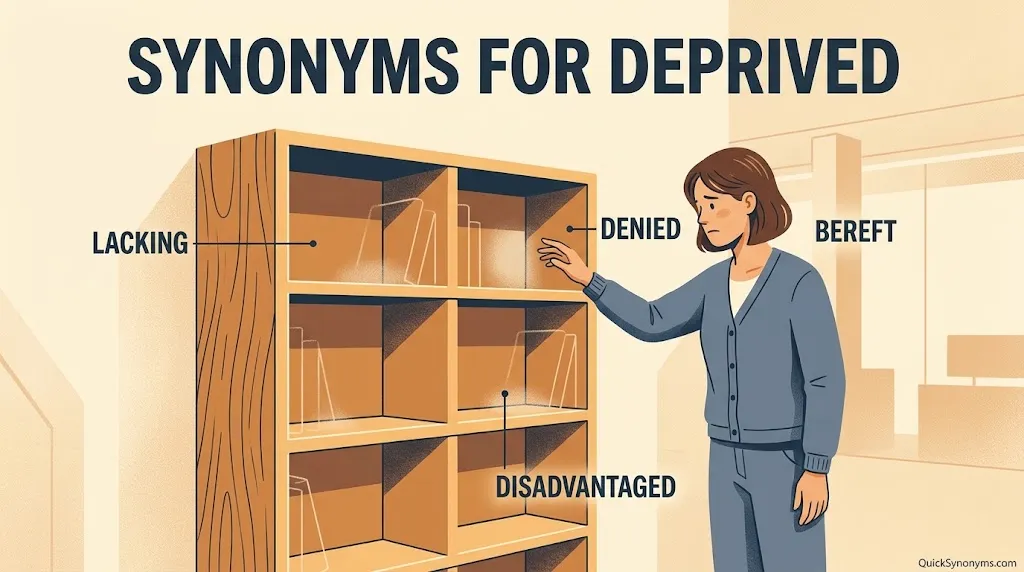
The best synonyms for deprived include lacking, denied, disadvantaged, underprivileged, and bereft. These words are used when someone lacks basic needs, opportunities, rights, possessions, or something important, with the exact choice depending on the context and degree of loss.
Deprived describes a person or group that does not have something important they need, deserve, or once had. Imagine a child growing up without reliable food, a student without access to good education, or someone kept from a basic right. In each case, the word can describe what is missing.
Learning synonyms for deprived helps you express the exact kind of shortage or loss you mean. Some alternatives focus on poverty, while others highlight unfair treatment, exclusion, loss, or a simple lack of something. This guide explains their meanings, tones, examples, and best uses so you can choose the right word with confidence.
Meaning of Deprived
Definition
Deprived (adjective): lacking something important, necessary, or normally available, often because it has been taken away, denied, or made unavailable.
Example
- Many children in the area are deprived of access to quality education.
Connotative Meaning
- Positive tone: Usually uncommon because deprived normally describes a difficult condition or loss.
- Negative tone: Suggests hardship, unfairness, poverty, or loss.
- Neutral tone: Can simply describe the absence of something, especially in phrases such as “deprived of sleep.”
(Connotation means the feeling or idea a word suggests beyond its basic meaning.)
Formal vs Informal Usage
Deprived is generally neutral to formal. It is common in education, social issues, health, law, journalism, and everyday expressions such as “sleep deprived.”
Etymology
The word deprived comes from the idea of taking something away or stripping someone of something they had or should have.
- Old English (450-1100): The modern word was not part of Old English vocabulary. Its source developed through later French and Latin.
- Middle English (1100-1500): Deprive entered English through Anglo-French, from Latin deprivare, meaning to remove or strip away.
- Modern English (1500-Present): Deprived developed as the past participle and adjective of deprive, commonly describing someone who lacks something important or has been denied it.
Pronunciation (IPA)
- IPA: /dɪˈpraɪvd/
- Syllables: deprived, 2 syllables
- US/UK difference: The standard pronunciation is essentially the same in both varieties.
Affixation Pattern of Deprived
- Root: priv, related to the idea of being separate, private, or deprived of something
- Prefix: de-
- Suffix: -ed
- Word formations:
- deprive (verb): to take something away or deny access to it
- deprivation (noun): the condition of lacking something necessary or important
- depriving (verb): taking something away or denying it
- deprivations (noun): instances or conditions of deprivation
27 Synonyms of Deprived With Meaning & Examples
1. Lacking (Adjective)
Meaning: Not having something that is needed, wanted, or expected.
Examples:
- The village is lacking reliable medical services.
- The program is lacking enough funding to continue.
Best for: General absence
2. Denied (Adjective)
Meaning: Prevented from receiving, using, or having something.
Examples:
- The workers were denied access to clean water.
- The child was denied an opportunity to attend school.
Best for: Refused access
3. Disadvantaged (Adjective)
Meaning: Facing poorer conditions or fewer opportunities than others.
Examples:
- The program supports disadvantaged students.
- The city has several disadvantaged communities.
Best for: Social inequality
4. Underprivileged (Adjective)
Meaning: Having fewer social, economic, or educational advantages than most people.
Examples:
- The charity provides meals for underprivileged children.
- The school offers scholarships to underprivileged students.
Best for: Social and economic hardship
5. Bereft (Adjective)
Meaning: Completely without something important, especially after a loss.
Examples:
- The family was bereft of hope after the disaster.
- He felt bereft of support when his friends left.
Best for: Deep personal loss
6. Destitute (Adjective)
Meaning: Extremely poor and lacking the basic necessities of life.
Examples:
- The disaster left many families destitute.
- The shelter provides meals for destitute people.
Best for: Extreme poverty
7. Impoverished (Adjective)
Meaning: Made poor or left with very few financial resources.
Examples:
- The war left the region impoverished.
- The charity helps impoverished families.
Best for: Financial hardship
8. Needy (Adjective)
Meaning: Lacking money or basic resources and requiring help.
Examples:
- The organization provides food to needy families.
- Donations are distributed among needy residents.
Best for: People needing financial help
9. Poor (Adjective)
Meaning: Having little money, wealth, or material resources.
Examples:
- The project aims to help poor families.
- Many poor communities lack basic services.
Best for: Simple everyday language
10. Poverty-Stricken (Adjective)
Meaning: Seriously affected by extreme poverty.
Examples:
- Aid reached several poverty-stricken communities.
- The organization works in poverty-stricken areas.
Best for: Severe economic hardship
11. Dispossessed (Adjective)
Meaning: Having property, land, or possessions taken away.
Examples:
- The dispossessed families searched for new homes.
- Many dispossessed farmers moved to nearby cities.
Best for: Loss of property or land
12. Excluded (Adjective)
Meaning: Prevented from taking part in something or gaining access to it.
Examples:
- Some residents felt excluded from local services.
- The group was excluded from important discussions.
Best for: Social or institutional access
13. Disenfranchised (Adjective)
Meaning: Denied rights, power, or a meaningful voice in society.
Examples:
- The reforms aimed to support disenfranchised communities.
- Many disenfranchised citizens demanded political reform.
Best for: Rights and political participation
14. Underserved (Adjective)
Meaning: Receiving fewer services or resources than a population needs.
Examples:
- The clinic focuses on underserved communities.
- Rural areas are often underserved by public transportation.
Best for: Public services
15. Neglected (Adjective)
Meaning: Not given the care, attention, or support that is needed.
Examples:
- The neglected neighborhood needs major investment.
- The child came from a neglected home.
Best for: Lack of care
16. Deficient (Adjective)
Meaning: Lacking an amount or quality that is necessary.
Examples:
- The diet was deficient in essential nutrients.
- The system is deficient in basic security measures.
Best for: Formal or technical writing
17. Wanting (Adjective)
Meaning: Lacking something that is needed or desirable.
Examples:
- The plan was wanting in practical detail.
- The report was wanting in clear evidence.
Best for: Formal descriptions of shortcomings
18. Short (Adjective)
Meaning: Having less of something than is needed or required.
Examples:
- The project is short of the money it needs.
- The team was short of essential supplies.
Best for: Everyday shortages
19. Devoid (Adjective)
Meaning: Completely lacking something.
Examples:
- The abandoned building was devoid of basic facilities.
- The report was devoid of useful evidence.
Best for: Complete absence
20. Starved (Adjective)
Meaning: Lacking something necessary or valuable, often used figuratively.
Examples:
- The rural school was starved of funding.
- The community was starved of reliable information.
Best for: Severe shortages
21. Deprived-of (Adjectival Phrase)
Meaning: Left without a particular thing that is normally needed or expected.
Examples:
- The children were deprived-of adequate nutrition.
- The residents were deprived-of essential services.
Best for: Specific forms of loss
22. Unprovided (Adjective)
Meaning: Not supplied with something that is needed.
Examples:
- Several families remained unprovided with adequate shelter.
- The workers were unprovided with suitable equipment.
Best for: Formal descriptions of unmet provision
23. Resource-Poor (Adjective)
Meaning: Having very limited access to money, materials, or other useful resources.
Examples:
- The program targets resource-poor communities.
- Researchers studied healthcare in resource-poor regions.
Best for: Development and policy writing
24. Unfortunate (Adjective)
Meaning: Experiencing difficult circumstances or poor conditions.
Examples:
- The program assists unfortunate families during emergencies.
- Aid was provided to unfortunate people affected by the crisis.
Best for: General hardship
25. Ill-Provided (Adjective)
Meaning: Not supplied with enough resources, equipment, or support.
Examples:
- The school was ill-provided with learning materials.
- The clinic was ill-provided with modern equipment.
Best for: Inadequate resources
26. Unfavored (Adjective)
Meaning: Receiving less support, approval, or advantage than others.
Examples:
- The policy affected unfavored groups most severely.
- The system often disadvantages unfavored communities.
Best for: Unequal treatment
27. Stricken (Adjective)
Meaning: Seriously affected by a damaging condition or hardship.
Examples:
- Aid workers entered the stricken community.
- The organization helped stricken families after the flood.
Best for: Crisis-related hardship
Deprived vs Its Closest Synonym
Unlike lacking, deprived often suggests that the missing thing is important or that someone has been prevented from having it. For example, “a school lacking computers” simply describes an absence, while “children deprived of education” can suggest a serious denial of an opportunity.
Unlike disadvantaged, deprived focuses more directly on what is missing. Disadvantaged describes a broader condition in which someone has fewer benefits or opportunities, while deprived can identify the specific resource, right, care, or experience that is absent.
Prototype Meaning
The most typical meaning of deprived is being without something important that a person should normally have. When people hear the word, they may imagine someone lacking food, education, money, care, opportunity, sleep, or basic rights.
The word often carries a sense of hardship rather than simple absence. It can describe both real material shortages and less visible losses, such as being deprived of freedom or emotional support.
Prototype Categorization
- General lack: lacking, wanting, deficient, short
- Social hardship: disadvantaged, underprivileged, needy, impoverished
- Extreme poverty: destitute, poverty-stricken, resource-poor
- Denied access or rights: denied, excluded, disenfranchised
- Loss of possessions: dispossessed, bereft
- Poor care or services: neglected, underserved, ill-provided
- Complete absence: devoid
- Severe shortage: starved, stricken
These categories help writers choose a synonym based on why something is missing, rather than replacing deprived with a word that only partly matches its meaning.
Antonyms of Deprived
- Provided (adjective): supplied with what is needed.
- Privileged (adjective): enjoying advantages or opportunities that others may not have.
- Advantaged (adjective): having better opportunities, resources, or circumstances.
- Affluent (adjective): having substantial financial resources.
- Supported (adjective): receiving help, care, or resources.
- Included (adjective): allowed to participate or have access.
- Well-equipped (adjective): supplied with the tools or resources needed.
Short Questions and Answers
What does deprived mean?
Deprived means lacking something important or being prevented from having it. It often describes missing necessities, opportunities, rights, care, or resources.
Is deprived a negative word?
Yes, deprived usually has a negative connotation because it often suggests hardship, unfair treatment, poverty, or serious loss.
What is the best synonym for deprived?
Lacking is one of the closest general alternatives, while denied, disadvantaged, and underprivileged are better for specific contexts.
Is deprived the same as disadvantaged?
Not exactly. Deprived emphasizes the absence or denial of something, while disadvantaged describes a wider condition of having fewer opportunities or benefits.
What is a formal synonym for deprived?
Deficient, disenfranchised, dispossessed, and underserved can work as formal alternatives, depending on what is missing.
Can deprived describe a lack of sleep?
Yes. In “sleep deprived,” it means not getting enough sleep. The word can describe both physical necessities and broader forms of deprivation.
Conclusion
Learning synonyms for deprived gives you more control over how you describe absence, hardship, inequality, and loss. Words such as lacking work for simple shortages, while destitute points to extreme poverty and disenfranchised focuses on denied rights. Choosing the right alternative makes your meaning clearer.
These words can also make everyday speech and formal writing more precise. Instead of repeating deprived, you can select a synonym that shows exactly what is missing and why it matters. Practice by writing a few sentences with different alternatives each day. Over time, this will strengthen your vocabulary, improve your descriptions, reduce repetition, and make you more confident when speaking or writing.
Want to expand your vocabulary further? Check out Synonyms for Crude: 30 Clear Alternatives

Senior English Language Expert
Eleanor Brooks specializes in English grammar, vocabulary, and word usage. She enjoys simplifying complex language concepts and creating practical resources that help learners write and speak with confidence.








1 thought on “Synonyms for Deprived: 27 Words for Lacking and Loss”