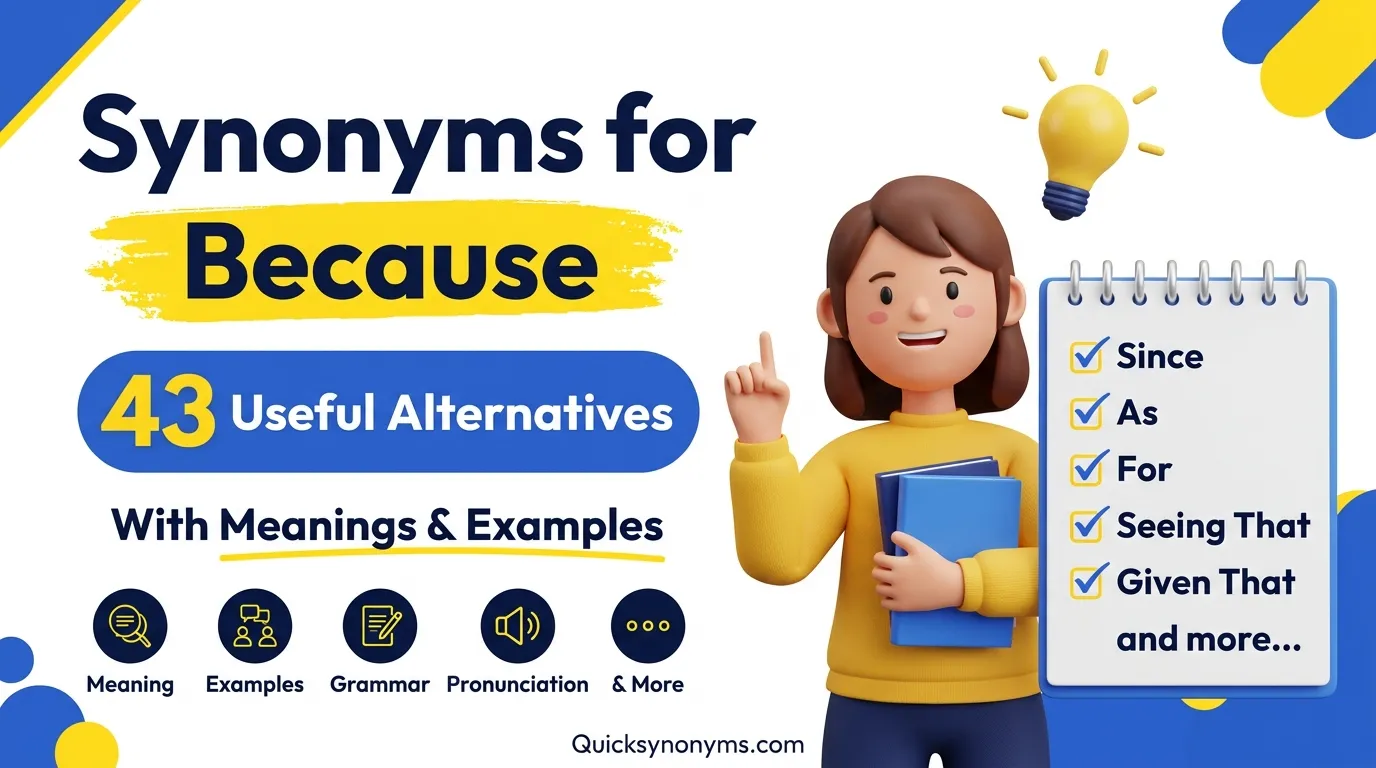
Because is a common English word that tells us why something happens. We use it every day to explain our choices, share our feelings, and give reasons. For example, you might say, “I stayed home because it was raining.” The word helps connect an action to its cause, so readers and listeners can understand our thoughts.
Learning synonyms for because helps English learners build stronger sentences and speak with more confidence. It also helps students, teachers, bloggers, and content writers avoid repeated words. However, not every alternative fits every sentence. Some words work well in formal writing, while others are better for daily speech.
This guide covers the meaning of because, 43 related words and expressions, clear definitions, and useful examples. You will also learn about grammar, word history, pronunciation, word forms, and semantic groups. These tips will help you choose the right expression for essays, emails, stories, and everyday talks.
Meaning of Because
Definition
Because (conjunction): A word used to show the reason why something happens or why someone does something.
Examples
- I wore a coat because it was cold outside.
- She smiled because she heard good news.
Connotative Meaning
- Positive tone: Shows a good reason, such as “She was happy because she passed.”
- Negative tone: Explains an unwanted event, such as “He left because he felt sick.”
- Neutral tone: Gives a simple fact or reason without strong feelings.
(Connotation: the emotional or cultural feeling a word carries beyond its literal meaning.)
Etymology
The word because developed in Middle English from the phrase by cause, which meant “for the reason of.” The word cause came through Old French from Latin causa, meaning “reason” or “cause.”
- Old English (450 to 1100): Because was not yet used in its modern form. English used other ways to express reasons.
- Middle English (1100 to 1500): The phrase by cause developed into because and began to express reasons.
- Modern English (1500 to present): Because became a common conjunction used to link reasons with actions or events.
Pronunciation (IPA)
- IPA: /bɪˈkɔːz/ in many British pronunciations; /bɪˈkʌz/ or /bɪˈkɔːz/ in American English, depending on the speaker.
- Syllables: be-cause
Affixation Pattern of Because
- Root: Cause, from Latin causa through Old French.
- Prefix: None in the modern word.
- Suffix: None in the modern word.
- Word formations:
- Because: Conjunction, gives a reason.
- Cause: Noun or verb, refers to a reason or to making something happen.
- Causal: Adjective, describes a link between a cause and an effect.
- Causation: Noun, the process of causing something.
- Causative: Adjective or noun, describes or expresses a cause.
43 Synonyms of Because: With Meaning and Examples
Because usually introduces a reason, so its closest alternatives are words and phrases that also explain why something happens. Some are conjunctions, while others need a different sentence structure.
1. Since (conjunction)
Meaning: Introduces the reason for an action or event.
Examples:
- Since it was late, we went home.
- Since you are here, we can begin.
2. As (conjunction)
Meaning: Gives the reason why something happens.
Examples:
- As the road was wet, we drove slowly.
- As nobody answered, I left a note.
3. For (conjunction)
Meaning: Gives an explanation or reason, often in a formal or literary style.
Examples:
- We stayed indoors, for the storm was strong.
- She spoke softly, for the baby was asleep.
4. Seeing That (conjunction)
Meaning: Introduces a reason that is clear from the situation.
Examples:
- Seeing that it was dark, we turned back.
- Seeing that you are ready, we can start.
5. Given That (conjunction)
Meaning: Introduces a fact that helps explain a result.
Examples:
- Given that time is short, we should act now.
- Given that he was tired, he did well.
6. Considering That (conjunction)
Meaning: Shows that a fact helps explain an action or result.
Examples:
- Considering that it was his first try, he did well.
- Considering that prices rose, the sale was fair.
7. Inasmuch As (conjunction)
Meaning: Gives a reason in a formal way.
Examples:
- Inasmuch as funds are limited, we must plan well.
- Inasmuch as the rules changed, we need a new plan.
8. Due To (prepositional phrase)
Meaning: Shows the cause of an event or situation.
Examples:
- The game stopped due to heavy rain.
- The shop closed early due to a power cut.
9. Owing To (prepositional phrase)
Meaning: Explains the cause of something, often in formal writing.
Examples:
- The flight was delayed owing to fog.
- The match was canceled owing to bad weather.
10. Because Of (prepositional phrase)
Meaning: Shows the reason for an event or action before a noun or noun phrase.
Examples:
- We stayed home because of the storm.
- The train stopped because of a fault.
11. On Account Of (prepositional phrase)
Meaning: Gives the reason for something, often in formal speech or writing.
Examples:
- The park closed on account of the heat.
- He missed class on account of illness.
12. Thanks To (prepositional phrase)
Meaning: Shows a cause, often one that leads to a good result.
Examples:
- Thanks to your help, we finished on time.
- Thanks to the map, we found the hotel.
13. Due To The Fact That (conjunction phrase)
Meaning: Gives a reason in a long, formal way.
Examples:
- We left early due to the fact that rain was coming.
- The event moved indoors due to the fact that the field was wet.
14. For The Reason That (conjunction phrase)
Meaning: States the reason for an action or event.
Examples:
- She stayed home for the reason that she felt ill.
- The road closed for the reason that repairs were needed.
15. In View Of (prepositional phrase)
Meaning: Shows that a fact or situation affects a choice.
Examples:
- In view of the storm, we canceled the trip.
- In view of the risks, they changed the plan.
16. In Light Of (prepositional phrase)
Meaning: Gives a reason based on facts or new information.
Examples:
- In light of the news, we delayed the launch.
- In light of these facts, the choice makes sense.
17. As A Result Of (prepositional phrase)
Meaning: Shows the cause of an event or outcome.
Examples:
- The match ended early as a result of rain.
- Several roads closed as a result of flooding.
18. By Reason Of (prepositional phrase)
Meaning: Gives the cause or grounds for something, often in legal or formal use.
Examples:
- The claim was accepted by reason of new proof.
- He qualified by reason of his long service.
19. In That (conjunction)
Meaning: Explains the sense in which a statement is true.
Examples:
- The plan is useful in that it saves time.
- The book is rare in that few copies remain.
20. Now That (conjunction)
Meaning: Gives a reason based on a new situation or fact.
Examples:
- Now that the rain has stopped, we can go out.
- Now that school is over, she can rest.
21. Especially Since (conjunction phrase)
Meaning: Highlights a reason that makes a point stronger.
Examples:
- We should leave now, especially since traffic is growing.
- I trust her, especially since she kept her promise.
22. Particularly Because (conjunction phrase)
Meaning: Points to one main reason among others.
Examples:
- I chose this bag, particularly because it is light.
- The garden thrives, particularly because the soil is rich.
23. Mainly Because (conjunction phrase)
Meaning: Shows the chief reason for something.
Examples:
- We chose the train mainly because it was cheap.
- He was upset mainly because nobody called.
24. Simply Because (conjunction phrase)
Meaning: Gives a reason while stressing that it is enough on its own.
Examples:
- Do not judge her simply because she is quiet.
- I bought the book simply because I liked the cover.
25. Just Because (conjunction phrase)
Meaning: Introduces a reason, often when rejecting an assumption or excuse.
Examples:
- Just because he is young does not mean he is careless.
- She did not agree just because her friends did.
26. Largely Because (conjunction phrase)
Meaning: Shows that something is mostly due to one reason.
Examples:
- The team won largely because it trained well.
- Sales grew largely because prices fell.
27. Partly Because (conjunction phrase)
Meaning: Shows that one reason explains only some of a result.
Examples:
- I was late partly because the bus broke down.
- The town grew partly because a new road opened.
28. Chiefly Because (conjunction phrase)
Meaning: States the main reason for something.
Examples:
- The shop is popular chiefly because prices are low.
- She succeeded chiefly because she worked hard.
29. Primarily Because (conjunction phrase)
Meaning: Gives the main or most important reason.
Examples:
- We chose this route primarily because it is safe.
- The project failed primarily because costs rose.
30. Mostly Because (conjunction phrase)
Meaning: Shows that a reason explains most of a result.
Examples:
- He stayed home mostly because he felt tired.
- The event was popular mostly because entry was free.
31. In Part Because (conjunction phrase)
Meaning: Shows that something is one of several reasons.
Examples:
- The plan worked in part because everyone helped.
- She improved in part because she practiced daily.
32. In Part Due To (prepositional phrase)
Meaning: Shows that a cause explains some, but not all, of a result.
Examples:
- The delay was in part due to heavy traffic.
- Their success was in part due to good planning.
33. As A Consequence Of (prepositional phrase)
Meaning: Shows that an event or result followed from a cause.
Examples:
- The road flooded as a consequence of the storm.
- He lost time as a consequence of the error.
34. Stemming From (verb phrase)
Meaning: Describes something that comes from a cause or source.
Examples:
- Her worry stemmed from a past mistake.
- The dispute stemmed from a small payment issue.
35. Resulting From (verb phrase)
Meaning: Describes something caused by an event or action.
Examples:
- Problems resulting from poor planning can be costly.
- The damage resulting from the storm was severe.
36. Arising From (verb phrase)
Meaning: Describes something that develops from a cause or situation.
Examples:
- Questions arising from the report need answers.
- The costs arising from the delay were high.
37. Attributable To (adjective phrase)
Meaning: Describes something that can be explained by a particular cause.
Examples:
- The rise is attributable to higher demand.
- Her progress is attributable to steady practice.
38. On The Grounds That (conjunction phrase)
Meaning: Gives a stated reason for a choice or decision.
Examples:
- The request was denied on the grounds that it was late.
- He left on the grounds that he felt unsafe.
39. Insofar As (conjunction)
Meaning: Gives a reason or limit within which a statement is true.
Examples:
- Insofar as the data is correct, the result is clear.
- The rule helps, insofar as it keeps people safe.
40. To The Extent That (conjunction phrase)
Meaning: Shows the degree to which a fact explains or limits a claim.
Examples:
- To the extent that costs fell, the plan helped.
- The idea works to the extent that people support it.
41. Seeing As (conjunction phrase)
Meaning: Introduces a reason in casual speech.
Examples:
- Seeing as it is late, let’s go home.
- Seeing as you know the way, please lead us.
42. With (preposition)
Meaning: Can give a reason or cause when followed by a noun phrase.
Examples:
- With the road closed, we took another route.
- With no tickets left, we watched at home.
43. Thanks To The Fact That (conjunction phrase)
Meaning: Gives a reason, often with a positive tone.
Examples:
- We arrived on time thanks to the fact that traffic was light.
- She passed thanks to the fact that she studied hard.
Prototype Meaning
The most common meaning of because is to give a reason for an action, feeling, or event. When people hear this word, they usually expect an explanation of why something happened. For example, “The child cried because she was hurt” links the crying to its cause. The word often answers the question “Why?” and helps make ideas clear.
Prototype Categorization
- Direct reason connectors: Since, As, For, Seeing That, Given That, Considering That, Inasmuch As, In That, Now That, Seeing As. Use these to connect a reason to a statement.
- Cause and source expressions: Due To, Owing To, Because Of, On Account Of, As A Result Of, By Reason Of, As A Consequence Of, Stemming From, Resulting From, Arising From, Attributable To, With. Use these to explain what caused an event or situation.
- Formal reason expressions: Due To The Fact That, For The Reason That, In View Of, In Light Of, On The Grounds That, Insofar As, To The Extent That. Use these in formal writing, reports, and careful explanations.
- Expressions that highlight a reason: Especially Since, Particularly Because, Mainly Because, Simply Because, Just Because, Largely Because, Partly Because, Chiefly Because, Primarily Because, Mostly Because, In Part Because, In Part Due To, Thanks To, Thanks To The Fact That. Use these to show how important a reason is or to add emphasis.
Grouping synonyms helps writers choose words that match their meaning and tone. It also helps prevent grammar mistakes because different expressions need different sentence patterns.
Antonyms of Because
Because has no exact antonym. It shows a reason, while the following words and phrases express contrast, opposition, or a different outcome.
- Although (conjunction): Introduces a fact that contrasts with another fact.
- Though (conjunction): Shows contrast between two ideas.
- Whereas (conjunction): Compares two different facts or situations.
- While (conjunction): Can show contrast between two statements.
- However (adverb): Introduces a contrasting idea.
- Nevertheless (adverb): Shows that something happens despite a problem.
- Yet (conjunction or adverb): Introduces a contrast or unexpected result.
- Instead (adverb): Shows that one choice replaces another.
Short Questions and Answers
What does Because mean?
Because means “for the reason that.” It connects an action, event, or fact to the reason behind it.
When should Because be used?
Use because when you want to explain why something happens. It usually comes before a clause with a subject and a verb, such as “I smiled because I was happy.”
Is Because positive or negative?
Because is neutral. The reason it introduces can be positive, negative, or neither, depending on the context.
How is it different from similar words?
Since and as can introduce reasons, but they may also express time or other relationships. Due to usually comes before a noun or noun phrase, as in “The delay was due to rain.” Thanks to often suggests a helpful or positive cause, though it can also be used sarcastically.
Conclusion
Learning because and its alternatives can make your English clearer and more natural. The word helps explain reasons, while related expressions let you change your tone, add detail, and suit different kinds of writing. For example, since may fit a simple explanation, while owing to may work better in a formal report.
These 43 alternatives can help you avoid repetition in essays, emails, stories, and daily conversations. However, always check the grammar and meaning before replacing one expression with another. Some alternatives need a full clause, while others need a noun or noun phrase. With regular practice, you can choose words that fit your message, improve your speaking and writing, and build confidence in English. Practice a few new words every day and use them in your own sentences.
See Synonyms: Synonyms for Plenty: 62 Powerful Words

Lexicographer & Vocabulary Specialist
Nathan Carter focuses on English vocabulary, synonyms, antonyms, and word meanings. He is passionate about producing clear, accurate, and easy-to-understand language guides for readers of all levels.



1 thought on “Synonyms for Because: 43 Useful Alternatives”