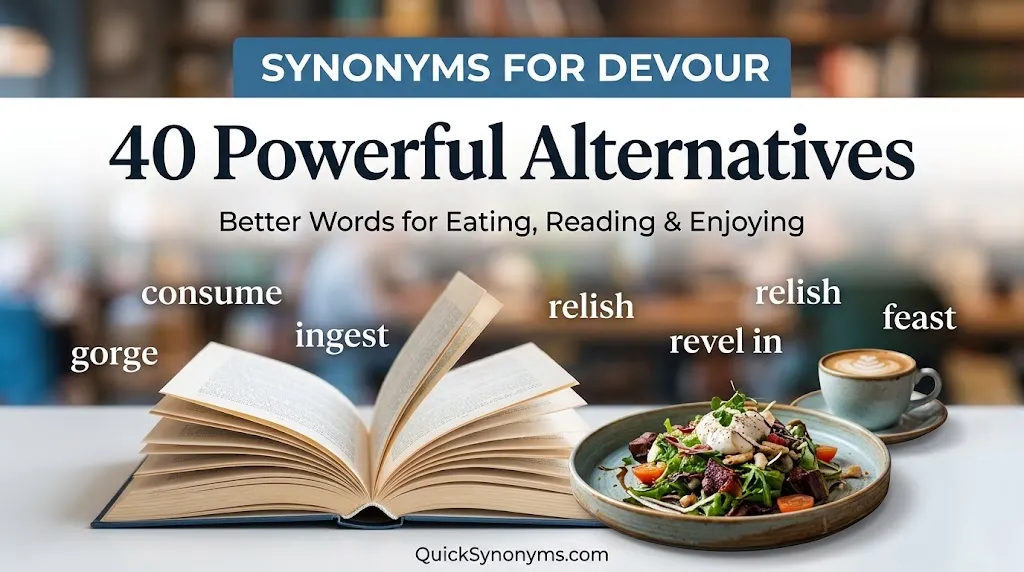
Synonyms for devour include consume, eat, gobble, gulp, wolf down, inhale, bolt, gorge, feast on, relish, savor, munch, scarf down, swallow, and absorb.
Devour means to eat something quickly, eagerly, or completely. Imagine coming home after a long day and seeing your favorite pizza waiting on the table. You may eat it so fast that someone jokes, “You devoured that pizza!”
The word devour is common because it gives a stronger picture than simply saying eat. It can show hunger, speed, excitement, or even deep interest. For example, you can devour a meal, but you can also devour a novel when you read it with great enthusiasm.
Learning synonyms for devour helps English learners and content writers avoid repeating the same word. It also makes writing more vivid and natural.
In this guide, you will learn the meaning, pronunciation, history, grammar, word formation, and 50 useful synonyms for devour. You will also see clear examples and semantic groups to help you choose the right word for each situation.
Meaning of Devour
Definition
Devour (Verb): To eat something quickly, eagerly, or completely.
It can also mean to read, watch, or take in something with great interest and enthusiasm.
Examples
- The hungry boy devoured his sandwich in minutes.
- She devoured the entire novel over the weekend.
Connotative Meaning
Positive tone: Devour can suggest strong enjoyment or excitement, especially when someone enjoys food, books, or experiences.
Negative tone: It can suggest greed, excessive hunger, destruction, or uncontrolled consumption.
Neutral tone: It can simply describe consuming something quickly or completely.
(Connotation: the feeling or idea that a word suggests beyond its basic dictionary meaning.)
Etymology of Devour
The word devour comes from Old French devorer, which came from Latin devorare, meaning “to swallow down” or “to eat up.” The Latin word combines de- with vorare, meaning “to swallow” or “to gulp down.”
Old English (450–1100): Devour was not a common Old English word. English mainly used native words related to eating and swallowing.
Middle English (1100–1500): The word entered English through Anglo-French and Old French forms related to devorer. It became associated with eating greedily or consuming completely.
Modern English (1500–Present): Devour developed both literal and figurative meanings. Today, it can describe eating food quickly as well as reading books, consuming information, or being strongly affected by something.
Pronunciation (IPA)
- IPA: /dɪˈvaʊər/
- Syllables: de-vour
- Stress: The second syllable is stressed.
Affixation Pattern of Devour
- Root: vour, related to Latin vorare, meaning “to swallow”
- Prefix: de-
- Suffix: None in the basic word devour
Word Formations
- Devour – verb
- Devours – verb, third-person singular
- Devoured – verb, past tense and past participle
- Devouring – verb, present participle
- Devourer – noun
- Devourment – noun, rare
50 Synonyms of Devour With Meaning & Examples
1. Consume (Verb)
Meaning: To eat, drink, use, or take in something completely.
Examples:
- The family consumed the entire meal.
- The machine consumes a lot of energy.
2. Eat (Verb)
Meaning: To take food into the body by chewing and swallowing it.
Examples:
- The children ate their lunch quickly.
- I usually eat breakfast at seven.
3. Gobble (Verb)
Meaning: To eat something very quickly and eagerly.
Examples:
- He gobbled his sandwich before class.
- The children gobbled the cookies.
4. Gulp (Verb)
Meaning: To swallow food or drink quickly.
Examples:
- She gulped down her water.
- He gulped his breakfast before leaving.
5. Wolf Down (Phrasal Verb)
Meaning: To eat something very quickly, usually because of hunger.
Examples:
- He wolfed down two slices of pizza.
- She wolfed down her lunch before work.
6. Inhale (Verb)
Meaning: To eat food extremely quickly.
Examples:
- The players inhaled their meals after the game.
- He practically inhaled the burger.
7. Bolt (Verb)
Meaning: To eat food very quickly.
Examples:
- Do not bolt your food.
- She bolted her breakfast and left.
8. Gorge (Verb)
Meaning: To eat a large amount of food greedily.
Examples:
- They gorged on sweets at the party.
- He gorged himself on pizza.
9. Feast On (Phrasal Verb)
Meaning: To eat a large or enjoyable meal with pleasure.
Examples:
- We feasted on grilled chicken.
- They feasted on fresh seafood.
10. Relish (Verb)
Meaning: To enjoy food or an experience greatly.
Examples:
- She relished every bite.
- He relished the delicious dessert.
11. Savor (Verb)
Meaning: To enjoy something slowly and fully.
Examples:
- She savored the rich chocolate cake.
- He savored every moment of the meal.
12. Munch (Verb)
Meaning: To eat something by chewing steadily.
Examples:
- She munched on popcorn during the movie.
- He munched a sandwich while working.
13. Scarf Down (Phrasal Verb)
Meaning: To eat something very quickly.
Examples:
- The boys scarfed down their burgers.
- She scarfed down breakfast before school.
14. Swallow (Verb)
Meaning: To move food or drink from the mouth into the stomach.
Examples:
- He swallowed the last bite.
- She swallowed the water quickly.
15. Eat Up (Phrasal Verb)
Meaning: To eat all of something.
Examples:
- The children ate up the cake.
- Please eat up your dinner.
16. Gobble Up (Phrasal Verb)
Meaning: To eat something quickly and eagerly.
Examples:
- The puppy gobbled up its food.
- They gobbled up the sandwiches.
17. Guzzle (Verb)
Meaning: To drink something quickly and in large amounts.
Examples:
- He guzzled the cold water.
- They guzzled drinks after the race.
18. Cram (Verb)
Meaning: To force a large amount of food into your mouth or body.
Examples:
- He crammed the last piece of cake into his mouth.
- She crammed food into her bag before leaving.
19. Scoff (Verb)
Meaning: To eat something quickly, especially in informal British English.
Examples:
- He scoffed the whole sandwich.
- The children scoffed their dinner.
20. Pig Out (Phrasal Verb)
Meaning: To eat a lot of food, especially unhealthy food.
Examples:
- We pigged out on pizza.
- They pigged out during the movie night.
21. Stuff Yourself (Phrase)
Meaning: To eat so much that you feel very full.
Examples:
- We stuffed ourselves with dessert.
- He stuffed himself with snacks.
22. Polish Off (Phrasal Verb)
Meaning: To finish all of a food or drink.
Examples:
- She polished off the entire cake.
- He polished off his dinner quickly.
23. Finish Off (Phrasal Verb)
Meaning: To eat or drink the remaining amount of something.
Examples:
- He finished off the last slice.
- She finished off the bowl of soup.
24. Clear (Verb)
Meaning: To finish all the food on a plate.
Examples:
- He cleared his plate in minutes.
- She cleared the entire table of snacks.
25. Devour Completely (Phrase)
Meaning: To consume something fully and leave little or nothing behind.
Examples:
- The children devoured the meal completely.
- The animals devoured their food.
26. Engorge (Verb)
Meaning: To fill yourself with a large amount of food.
Examples:
- The guests engorged themselves at the feast.
- The animals became engorged after feeding.
27. Raven (Verb)
Meaning: To eat something very eagerly or greedily.
Examples:
- The hungry travelers ravened the food.
- The animals ravened their meal.
28. Gormandize (Verb)
Meaning: To eat large amounts of food greedily.
Examples:
- He spent the evening gormandizing.
- The guests gormandized at the banquet.
29. Ingest (Verb)
Meaning: To take food, drink, medicine, or another substance into the body.
Examples:
- The body needs water to function properly.
- Do not ingest the chemical substance.
30. Down (Verb)
Meaning: To swallow or eat something quickly.
Examples:
- He downed his coffee in seconds.
- She downed the sandwich before leaving.
31. Absorb (Verb)
Meaning: To take in information, ideas, or experiences fully.
Examples:
- She absorbed every detail of the lesson.
- He absorbed the information quickly.
32. Digest (Verb)
Meaning: To understand and process information or ideas.
Examples:
- She needed time to digest the news.
- Students slowly digested the difficult lesson.
33. Immerse Yourself In (Phrase)
Meaning: To become deeply involved in something.
Examples:
- She immersed herself in the novel.
- He immersed himself in his research.
34. Soak Up (Phrasal Verb)
Meaning: To take in information, knowledge, or an experience eagerly.
Examples:
- The students soaked up every lesson.
- She soaked up the local culture.
35. Take In (Phrasal Verb)
Meaning: To receive or absorb information or experiences.
Examples:
- He took in every detail of the story.
- She took in the beautiful view.
36. Read Eagerly (Phrase)
Meaning: To read something with strong interest and excitement.
Examples:
- She read the new novel eagerly.
- He read the entire article eagerly.
37. Go Through (Phrasal Verb)
Meaning: To read, examine, or use something completely.
Examples:
- She went through the entire book.
- He went through all the reports.
38. Binge-Read (Verb)
Meaning: To read a large amount of written material in a short time.
Examples:
- She binge-read the entire series.
- He binge-read three chapters before bed.
39. Lap Up (Phrasal Verb)
Meaning: To accept, enjoy, or consume something eagerly.
Examples:
- The audience lapped up the exciting story.
- Fans lapped up the new information.
40. Consume Greedily (Phrase)
Meaning: To take in something with strong hunger or desire.
Examples:
- The animals consumed the food greedily.
- He consumed the meal greedily.
41. Devastate (Verb)
Meaning: To destroy or consume something completely in a powerful or destructive way.
Examples:
- The fire devastated the forest.
- The storm devastated the coastline.
42. Ravage (Verb)
Meaning: To damage or destroy something severely.
Examples:
- The fire ravaged the village.
- The disease ravaged the crops.
43. Destroy (Verb)
Meaning: To damage something so badly that it no longer exists or works.
Examples:
- The flames destroyed the building.
- The hungry crowd jokingly destroyed the buffet.
44. Demolish (Verb)
Meaning: To destroy something completely or, informally, eat something very quickly.
Examples:
- The workers demolished the old building.
- He demolished the entire pizza.
45. Wipe Out (Phrasal Verb)
Meaning: To remove or destroy something completely.
Examples:
- The disease wiped out the crop.
- The fire nearly wiped out the forest.
46. Exhaust (Verb)
Meaning: To use up a supply or resource completely.
Examples:
- The project exhausted its budget.
- The long trip exhausted all their supplies.
47. Deplete (Verb)
Meaning: To reduce something greatly by using or consuming it.
Examples:
- The drought depleted the water supply.
- The project depleted their resources.
48. Use Up (Phrasal Verb)
Meaning: To consume all of something until none remains.
Examples:
- We used up all the milk.
- The machine used up the available fuel.
49. Absorb Completely (Phrase)
Meaning: To take in something fully, especially information or an experience.
Examples:
- She absorbed the lesson completely.
- He absorbed every detail of the documentary.
50. Take In Eagerly (Phrase)
Meaning: To receive or enjoy something with strong interest.
Examples:
- The audience took in the performance eagerly.
- She took in every detail of the fascinating story.
Prototype Meaning
The most typical meaning of devour is to eat food quickly, eagerly, and often completely.
When people hear devour, they usually imagine a very hungry person eating a meal with little hesitation. The word is stronger than eat because it suggests speed, hunger, eagerness, or intensity.
However, devour is not limited to food. It can also describe someone reading a book quickly or consuming information with great interest.
Prototype Categorization
The 50 alternatives above can be grouped by their main meaning. This makes it easier to choose a word that matches your sentence instead of treating every synonym as interchangeable.
Fast and Eager Eating
- Gobble
- Gulp
- Wolf down
- Inhale
- Bolt
- Scarf down
- Down
- Eat up
These words work well when speed is the main idea.
Large or Greedy Eating
- Gorge
- Engorge
- Gormandize
- Cram
- Pig out
- Stuff yourself
- Raven
These words often suggest eating a lot or eating greedily.
Enjoying Food
- Feast on
- Relish
- Savor
- Munch
- Indulge
These alternatives focus more on pleasure than speed.
Finishing Food Completely
- Polish off
- Finish off
- Clear
- Eat up
- Consume
- Use up
These words emphasize completion.
Consuming Information
- Absorb
- Digest
- Immerse yourself in
- Soak up
- Take in
- Read eagerly
- Go through
- Binge-read
- Lap up
These work best when devour is used figuratively for books, news, lessons, or information.
Destructive Consumption
- Devastate
- Ravage
- Destroy
- Demolish
- Wipe out
- Exhaust
- Deplete
These words are useful when devour suggests destruction or complete removal rather than eating.
Antonyms of Devour
1. Nibble (Verb)
Meaning: To eat something in very small bites.
- She nibbled on a cookie.
- The child nibbled at the sandwich.
2. Peck At (Phrasal Verb)
Meaning: To eat only small amounts without much interest.
- He picked at his dinner.
- She pecked at her food.
3. Pick At (Phrasal Verb)
Meaning: To eat small amounts of food slowly or without appetite.
- She picked at her lunch.
- He picked at the salad.
4. Preserve (Verb)
Meaning: To protect something instead of using or consuming it.
- They preserved the food for later.
- The museum preserves old documents.
5. Save (Verb)
Meaning: To keep something for future use.
- She saved the last piece of cake.
- He saved some food for later.
Short Questions and Answers
What does devour mean?
Devour means to eat something quickly, eagerly, or completely. It can also mean to read or consume something with great interest.
When should devour be used?
Use devour when you want to show strong hunger, speed, eagerness, or complete consumption. It can also describe reading or enjoying something intensely.
Is devour positive or negative?
It depends on the context. It can sound positive when someone enjoys food or a book. It can sound negative when it suggests greed, destruction, or uncontrolled consumption.
How is devour different from similar words?
Devour is stronger than the simple word eat. Gobble and wolf down focus on speed, savor focuses on slow enjoyment, while consume is broader and can sound more formal.
Can devour be used for books?
Yes. Devour can be used figuratively for books, magazines, news, and information. For example, “She devoured the novel in one night” means she read it quickly and with great enthusiasm.
What is a formal synonym for devour?
Consume is one of the most useful formal alternatives. Depending on the context, ingest, absorb, and digest can also work.
What is a casual synonym for devour?
Gobble, wolf down, scarf down, and pig out are common informal alternatives.
Conclusion
Learning synonyms for devour gives you more ways to describe eating, reading, learning, and consuming something completely. Words such as gobble, gulp, wolf down, inhale, gorge, feast on, relish, savor, and consume each add a slightly different meaning.
Choosing the right synonym can make your writing more precise. For example, gobble shows fast eating, while savor suggests slow enjoyment. When talking about books or information, words such as absorb, digest, and immerse yourself in may sound more natural.
Using these alternatives also helps you avoid repetition in essays, articles, stories, and everyday conversations. Try learning a few new words each day and use them in your own sentences.
With regular practice, you can make devour and its synonyms a natural part of your English vocabulary.
Explore Related Words: 77 Best Synonyms for Train With Examples

English Teacher & Linguistics Writer
Grace Whitmore creates engaging educational content on vocabulary, word usage, and effective communication. Her goal is to help learners build confidence through clear and practical English guidance.








1 thought on “Synonyms for Devour: 50 Words for Every Context”