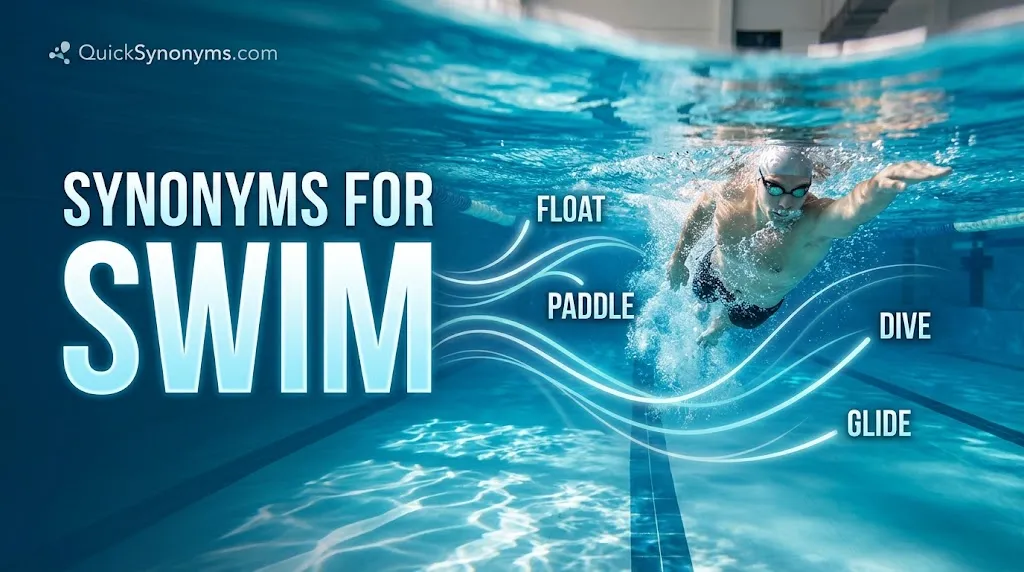
Common synonyms for swim include float, paddle, dive, glide, bathe, and splash. The best choice depends on whether you mean moving through water, staying on the surface, or moving smoothly through it.
Swim means moving through water by using your arms, legs, or body. Imagine a child jumping into a pool on a hot day and moving from one side to the other. That simple action is a common example of swimming.
The word is widely used in daily English, sports, travel, and fitness. Learning synonyms for swim helps English learners describe water movement with greater detail. It also helps writers avoid repeating the same word.
In this guide, we explore the meaning, grammar, history, pronunciation, word forms, and semantic groups connected to swim, with simple examples to make each word easy to understand.
Meaning of Swim
Definition
Swim (Verb/Noun):
To move through water by using your arms, legs, or body.
Examples
- I like to swim in the pool after work.
- The children swam across the lake.
Connotative Meaning
(Connotation: the feeling or idea a word suggests beyond its basic meaning.)
- Positive tone: Swim can suggest health, freedom, fun, or relaxation.
- Negative tone: It can suggest danger or struggle when someone has difficulty staying in water.
- Neutral tone: It can simply describe movement through water.
Etymology
The word swim has very old Germanic roots and has kept a similar meaning for centuries.
- Old English (450–1100): Swimman meant to move through water.
- Middle English (1100–1500): Forms such as swimmen continued to mean moving through water.
- Modern English (1500–Present): Swim developed into its modern form and remains the standard word for movement through water.
Pronunciation (IPA)
- IPA: /swɪm/
- Syllables: swim
Affixation Pattern of Swim
- Root: swim
- Prefix: None
- Suffix: None in the basic form
Word formations:
- Swim (verb): move through water
- Swimmer (noun): a person or animal that swims
- Swimming (noun/verb/adjective): the activity or act of moving through water
- Swam (verb): past tense of swim
- Swum (verb): past participle of swim
- Swimmable (adjective): suitable or safe for swimming
25 Synonyms of Swim: Words for Moving Through Water
1. Float (Verb)
Meaning: To stay on or near the surface of water without sinking.
Examples:
- The leaf floated across the pond.
- She learned to float on her back.
2. Paddle (Verb)
Meaning: To move through water using your hands, feet, or a paddle.
Examples:
- We paddled across the shallow river.
- The dog paddled toward the shore.
3. Dive (Verb)
Meaning: To jump or move headfirst into water.
Examples:
- He dived into the deep pool.
- She dived under the waves.
4. Glide (Verb)
Meaning: To move smoothly and easily through water.
Examples:
- The swimmer glided across the pool.
- The fish glided through the clear water.
5. Splash (Verb)
Meaning: To move through or hit water so that drops scatter.
Examples:
- The children splashed in the pool.
- He splashed through the shallow water.
6. Bathe (Verb)
Meaning: To wash or spend time in water.
Examples:
- The children bathed in the river.
- They went to the lake to bathe.
7. Wade (Verb)
Meaning: To walk through water that is not very deep.
Examples:
- We waded across the stream.
- She waded into the shallow sea.
8. Plunge (Verb)
Meaning: To enter water suddenly and forcefully.
Examples:
- He plunged into the cold lake.
- She plunged into the pool without hesitation.
9. Submerge (Verb)
Meaning: To put or move something completely under water.
Examples:
- He submerged himself under the water.
- The diver submerged slowly.
10. Dive Under (Verb)
Meaning: To move below the surface of water.
Examples:
- The swimmer dived under the wave.
- She dived under to find the toy.
11. Tread Water (Verb)
Meaning: To stay in one place in water by moving your arms and legs.
Examples:
- He learned to tread water for several minutes.
- She tread water while waiting for help.
12. Breaststroke (Verb/Noun)
Meaning: To swim using a stroke in which the arms move outward and the legs kick together.
Examples:
- She breaststroked across the pool.
- He prefers the breaststroke.
13. Freestyle (Verb/Noun)
Meaning: To swim using the freestyle stroke, usually with an alternating arm movement.
Examples:
- She freestyled for ten laps.
- He won the freestyle race.
14. Backstroke (Verb/Noun)
Meaning: To swim while lying on your back in the water.
Examples:
- He backstroked across the pool.
- She practices the backstroke every morning.
15. Dog-Paddle (Verb/Noun)
Meaning: To swim using simple movements of the hands and legs.
Examples:
- The child learned to dog-paddle first.
- He used a dog-paddle to stay afloat.
16. Stroke (Verb/Noun)
Meaning: To move through water using a particular swimming technique.
Examples:
- She stroked steadily toward the shore.
- He changed his stroke during the race.
17. Row (Verb)
Meaning: To move across water using oars, usually in a boat.
Examples:
- They rowed across the lake.
- We rowed toward the island.
18. Sail (Verb)
Meaning: To travel across water using a boat, usually powered by wind.
Examples:
- They sailed across the bay.
- We sailed along the coast.
19. Drift (Verb)
Meaning: To move slowly through water without strong control.
Examples:
- The boat drifted toward the shore.
- The swimmer drifted with the current.
20. Surge (Verb)
Meaning: To move forward suddenly and strongly through water.
Examples:
- The swimmer surged toward the finish.
- The boat surged through the waves.
21. Cruise (Verb)
Meaning: To move smoothly and comfortably through or across water.
Examples:
- The swimmer cruised through the final lap.
- The boat cruised along the river.
22. Frolic (Verb)
Meaning: To play or move energetically in a happy way, often in water.
Examples:
- The children frolicked in the shallow water.
- The dolphins frolicked near the boat.
23. Bob (Verb)
Meaning: To move gently up and down on the surface of water.
Examples:
- She bobbed in the waves.
- The swimmer bobbed near the edge of the pool.
24. Aquaplane (Verb)
Meaning: To glide over water, usually while being pulled by a boat.
Examples:
- They aquaplaned across the lake.
- He learned to aquaplane during the vacation.
25. Navigate (Verb)
Meaning: To travel through or across water while controlling your direction.
Examples:
- The crew navigated the narrow river.
- They carefully navigated through the rough water.
Prototype Meaning
The most typical meaning of swim is to move through water using your body, especially your arms and legs. When people hear swim, they usually imagine a person moving through a pool, lake, river, or sea. The basic idea is controlled movement in water rather than simply floating or standing in it.
Prototype Categorization
- Direct swimming: paddle, stroke, dog-paddle, freestyle, breaststroke, backstroke describe ways of actively moving through water.
- Surface movement: float, bob, drift describe staying on or near the surface.
- Entering or going below water: dive, plunge, submerge, dive under describe downward movement.
- Shallow-water movement: wade is best when someone walks through water rather than swims.
- Smooth water movement: glide, cruise suggest easy and controlled movement.
- Water travel: row, sail, navigate are more suitable for traveling across water, often using a boat.
- Playful movement: splash, frolic emphasize fun, energetic activity.
This grouping helps writers choose a word based on the exact type of movement they want to describe.
Antonyms of Swim
Sink (Verb)
To move downward below the surface of water.
Stand (Verb)
To remain upright rather than moving through water.
Walk (Verb)
To move on land or through shallow water using your feet.
Dry (Adjective/Verb)
Free from water or to remove water from something.
Remain Still (Verb)
To stay in one place without moving through the water.
Short Questions and Answers
What does swim mean?
Swim means to move through water using your body, especially your arms and legs.
When should swim be used?
Use swim when someone or something actively moves through water. It works in everyday speech, sports, travel, and general writing.
Is swim positive or negative?
Swim is usually neutral or positive. Its tone depends on context. Swimming for fun sounds positive, while struggling to swim can suggest danger.
How is it different from similar words?
Swim is the general word for moving through water. Float means staying on the surface, dive means moving into water or below its surface, and wade means walking through shallow water.
Conclusion
Learning swim and its synonyms gives English learners more ways to describe movement in water. Words such as paddle, float, dive, and glide can make writing more exact and interesting. More specific terms such as breaststroke and backstroke are useful when discussing swimming techniques.
Using different words also helps avoid repetition in writing and makes spoken English sound more natural. Understanding the small differences between synonyms is important because not every similar word can replace swim in every sentence. Practice these words in short sentences each day, and try using them when describing real situations. Regular vocabulary practice can improve your writing, speaking, and confidence in English.
If you are exploring more words related to animals and movement, check out our guide to Synonyms for Frog.

English Teacher & Linguistics Writer
Grace Whitmore creates engaging educational content on vocabulary, word usage, and effective communication. Her goal is to help learners build confidence through clear and practical English guidance.