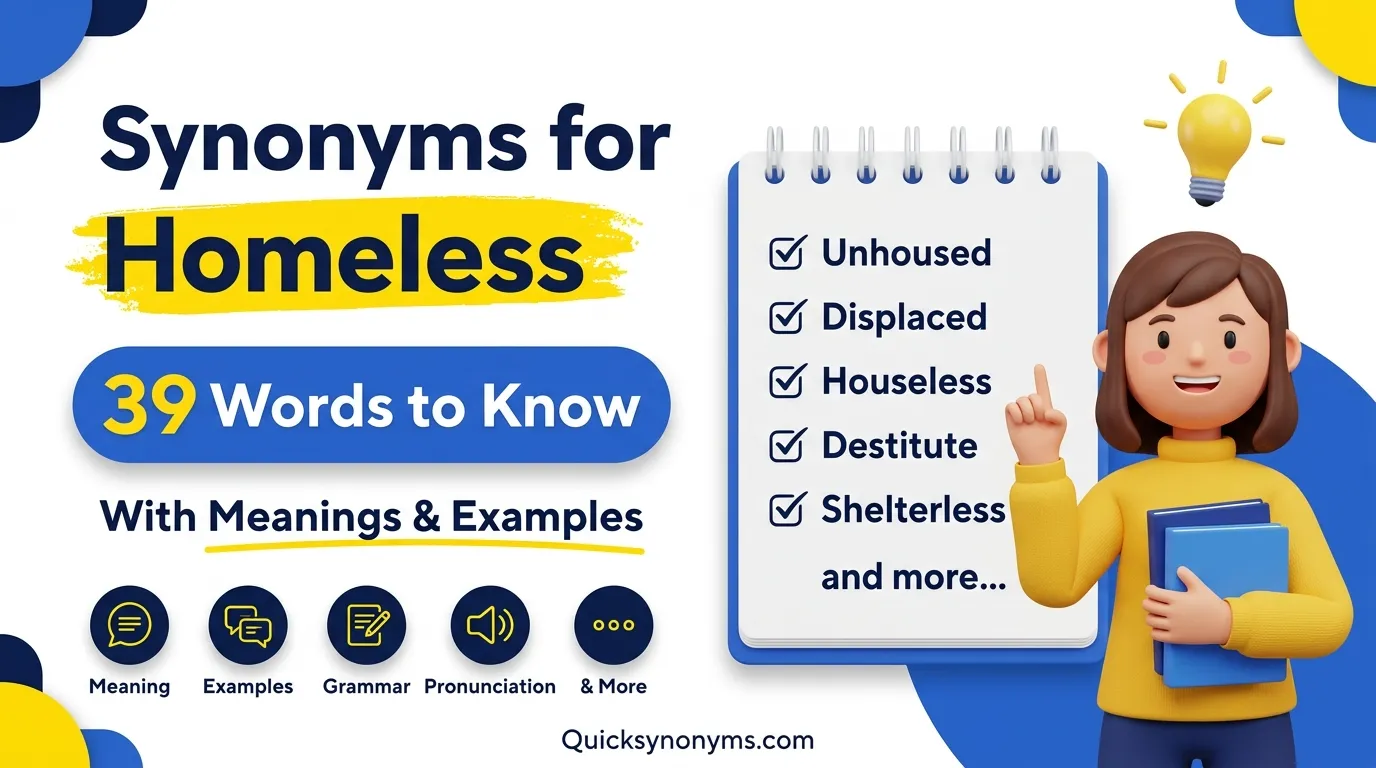
Synonyms for Homeless are words that describe people who do not have a stable or permanent place to live. The word is often used when talking about housing, poverty, shelters, and people without secure homes.
Synonyms help English learners understand different ways to discuss housing and living conditions. They also help writers choose respectful and accurate terms while avoiding repetition.
This article covers the meaning of homeless, examples, grammar, history, pronunciation, and 39 related terms. It also groups the words by meaning to make them easier to understand and use.
Meaning of Homeless
Definition
Homeless (adjective): having no home or permanent place to live.
Examples
- The charity helps homeless families find housing.
- Several homeless people stayed at the shelter overnight.
Connotative Meaning
- Positive tone: Compassion, support, and resilience.
- Negative tone: Hardship, insecurity, and vulnerability.
- Neutral tone: Having no stable or permanent home.
Etymology
Homeless is formed from home and the suffix -less, meaning without.
- Old English: Hām meant a home, dwelling, or village.
- Middle English: Forms of home developed from Old English hām.
- Modern English: Homeless combines home with -less to mean without a home.
Pronunciation (IPA)
- IPA: /ˈhoʊmləs/
- Syllables: home-less
Affixation Pattern of Homeless
- Root: home
- Prefix: None
- Suffix: -less
- Word formations:
- home: noun
- homeless: adjective, noun
- homelessness: noun
- homelessly: adverb
39 Synonyms of Homeless: With Meaning and Examples
1. Unhoused (adjective)
Meaning: Having no permanent or stable home.
Examples:
- The program supports unhoused families.
- Local groups provide meals for unhoused people.
2. Displaced (adjective)
Meaning: Forced to leave a home or usual place.
Examples:
- The flood left many families displaced.
- Aid groups helped displaced residents.
3. Houseless (adjective)
Meaning: Without a house or permanent home.
Examples:
- The shelter provides meals for houseless people.
- The program supports houseless residents.
4. Destitute (adjective)
Meaning: Having very little money, food, or other basic needs.
Examples:
- The charity helps destitute families.
- They provided food to destitute people.
5. Shelterless (adjective)
Meaning: Having no shelter or safe place to stay.
Examples:
- The storm left many people shelterless.
- Aid workers helped shelterless families.
6. Roofless (adjective)
Meaning: Without a home or roof over one’s head.
Examples:
- The fire left several families roofless.
- The organization helps roofless people find housing.
7. Dispossessed (adjective)
Meaning: Forced to leave a home or property.
Examples:
- The conflict left many families dispossessed.
- Aid was provided to dispossessed residents.
8. Evicted (adjective)
Meaning: Forced to leave a home or property.
Examples:
- The evicted family needed temporary housing.
- Several evicted tenants sought help.
9. Rootless (adjective)
Meaning: Having no settled home or strong connection to a place.
Examples:
- He lived a rootless life for years.
- The novel follows a rootless traveler.
10. Wandering (adjective)
Meaning: Moving from place to place without a fixed home.
Examples:
- The wandering family needed a safe place.
- He spent years as a wandering worker.
11. Nomadic (adjective)
Meaning: Moving from place to place instead of living permanently in one place.
Examples:
- They lived a nomadic lifestyle.
- His nomadic life took him across several countries.
12. Transient (adjective)
Meaning: Staying in a place only for a short time.
Examples:
- The town has a large transient population.
- He lived a transient lifestyle.
13. Itinerant (adjective)
Meaning: Traveling from place to place, often for work.
Examples:
- He worked as an itinerant laborer.
- The itinerant worker moved between towns.
14. Vagrant (adjective)
Meaning: Living without a settled home and moving from place to place.
Examples:
- The old law targeted vagrant people.
- The novel describes a vagrant traveler.
15. Drifting (adjective)
Meaning: Moving through life without a fixed place or plan.
Examples:
- He spent years drifting from city to city.
- The story follows a drifting young man.
16. Unsettled (adjective)
Meaning: Not living in a stable or permanent place.
Examples:
- The family had an unsettled life.
- Their unsettled situation lasted for months.
17. Destitute (adjective)
Meaning: Extremely poor and lacking basic needs.
Examples:
- The shelter offers meals to destitute people.
- The charity supports destitute families.
18. Impoverished (adjective)
Meaning: Very poor or lacking enough money for basic needs.
Examples:
- The program supports impoverished families.
- Aid reached impoverished communities.
19. Needy (adjective)
Meaning: Lacking basic resources or financial support.
Examples:
- The charity provides meals to needy families.
- Donations help needy people in the area.
20. Indigent (adjective)
Meaning: Very poor and unable to meet basic needs.
Examples:
- The fund assists indigent residents.
- Free services are available to indigent families.
21. Penniless (adjective)
Meaning: Having no money.
Examples:
- He arrived in the city penniless.
- The traveler became penniless after losing his job.
22. Poor (adjective)
Meaning: Having little money or few resources.
Examples:
- The program supports poor families.
- Many poor households need affordable housing.
23. Underprivileged (adjective)
Meaning: Lacking the advantages and resources that many others have.
Examples:
- The charity supports underprivileged children.
- The program helps underprivileged families.
24. Vulnerable (adjective)
Meaning: More likely to suffer harm or hardship.
Examples:
- Vulnerable people need safe housing.
- The shelter protects vulnerable adults.
25. Housing insecure (adjective)
Meaning: Lacking stable, safe, or reliable housing.
Examples:
- The survey included housing insecure families.
- Many housing insecure workers need support.
26. Without shelter (phrase)
Meaning: Having no safe place to live or stay.
Examples:
- The storm left hundreds without shelter.
- Volunteers helped people without shelter.
27. Without housing (phrase)
Meaning: Having no stable housing.
Examples:
- The program helps people without housing.
- Services are available for families without housing.
28. Dislodged (adjective)
Meaning: Forced or moved away from a home or place.
Examples:
- The disaster left families dislodged.
- Several residents were dislodged by the fire.
29. Refugee (noun)
Meaning: A person forced to leave their country because of danger or persecution.
Examples:
- The refugee family needed temporary housing.
- The center provides services for refugees.
30. Exile (noun)
Meaning: A person forced to live away from their home or country.
Examples:
- The writer lived in exile for many years.
- The exile hoped to return home.
31. Runaway (noun)
Meaning: A person who has left home without permission or plans to return.
Examples:
- The shelter helps runaway teenagers.
- The runaway was safely reunited with family.
32. Squatter (noun)
Meaning: A person who lives in a building or property without legal permission.
Examples:
- The squatter lived in the empty building.
- Officials offered help to some squatters.
33. Drifter (noun)
Meaning: A person who moves from place to place without a settled home.
Examples:
- The novel follows a young drifter.
- A drifter arrived in the small town.
34. Vagrant (noun)
Meaning: A person without a settled home who moves from place to place.
Examples:
- The story describes a vagrant traveling alone.
- The old law used the term vagrant.
35. Nomad (noun)
Meaning: A person who moves from place to place instead of living permanently in one location.
Examples:
- The nomad traveled across the desert.
- The family lived as nomads for generations.
36. Itinerant (noun)
Meaning: A person who travels from place to place, often for work.
Examples:
- The itinerant moved between towns.
- An itinerant worker found temporary jobs.
37. Refugee (noun)
Meaning: A person who has been forced to leave their home or country for safety.
Examples:
- The refugee found temporary shelter.
- The center supports refugees seeking safety.
38. Evacuee (noun)
Meaning: A person moved from a dangerous place to a safer one.
Examples:
- Each evacuee received food and water.
- The shelter welcomed hundreds of evacuees.
39. Displaced person (noun)
Meaning: A person forced to leave their home because of danger or disaster.
Examples:
- The camp provided aid to each displaced person.
- Many displaced people needed temporary housing.
Prototype Meaning
The most typical meaning of homeless is having no stable or permanent place to live. People often imagine someone who lacks secure housing and may rely on shelters, temporary accommodation, or support services.
Prototype Categorization
- Direct housing terms: Unhoused, Houseless, Shelterless, Roofless, Without shelter, Without housing, Housing insecure. Use these when directly describing a lack of stable housing.
- Forced displacement: Displaced, Dispossessed, Evicted, Dislodged, Refugee, Exile, Evacuee, Displaced person. Use these when someone has been forced to leave their home.
- Poverty and hardship: Destitute, Impoverished, Needy, Indigent, Penniless, Poor, Underprivileged, Vulnerable. Use these when focusing on financial hardship or lack of resources.
- Unsettled living: Rootless, Wandering, Nomadic, Transient, Itinerant, Drifting, Unsettled. Use these when describing people who move from place to place.
- People without settled homes: Vagrant, Drifter, Nomad, Itinerant, Runaway, Squatter. Use these for specific types of people without stable housing, noting that some terms can be dated or carry negative associations.
Grouping these words helps writers choose respectful and accurate terms. It also shows that not every word is a direct replacement for homeless.
Antonyms of Homeless
- Housed (adjective): Having a place to live.
- Sheltered (adjective): Having a safe place to stay.
- Settled (adjective): Living in a stable place.
- Resident (noun): A person who lives in a particular place.
- Homeowner (noun): A person who owns a home.
- Established (adjective): Having a stable place or position.
- Secure (adjective): Safe and stable.
Short Questions and Answers
What does Homeless mean?
Homeless means having no stable or permanent place to live.
When should Homeless be used?
Use homeless when referring to people who lack stable housing. In some contexts, unhoused or housing insecure may provide more specific wording.
Is Homeless positive or negative?
Homeless describes a difficult living condition and is generally associated with hardship. The word itself is mainly descriptive.
How is it different from similar words?
Unhoused directly describes a lack of housing. Displaced focuses on being forced away from home, while destitute focuses mainly on severe poverty.
Conclusion
Learning homeless and its related terms can improve your vocabulary for housing, travel, poverty, and social issues. Words such as unhoused, displaced, shelterless, and housing insecure can describe different situations.
The right word depends on the person’s situation. Unhoused focuses on housing, displaced focuses on being forced away, and destitute focuses on severe poverty. Careful word choice can make your writing clearer and more respectful.
Practice these terms in short sentences each day. Read how they are used in real English, write your own examples, and learn a few new words at a time. Regular vocabulary practice can strengthen your English and build confidence.
Explore More: Synonyms for Regal: 30 Words to Know

Content Editor & Language Researcher
Daniel Foster specializes in editing educational content and researching English language topics. He is committed to creating well-structured, reader-friendly articles that make learning easier.