Clumsy means awkward in movement or unable to do things with ease or skill. Imagine carrying a cup of tea, bumping into a chair, and spilling a few drops. People often use this word to describe someone who moves poorly, handles things badly, or makes simple tasks look hard. It is a common word in daily speech, stories, and casual writing.
Learning synonyms for clumsy helps English learners express ideas with greater care. Some words describe poor body control, while others suggest a lack of skill, grace, or care. Content writers can also use these words to avoid repetition and make their writing more vivid.
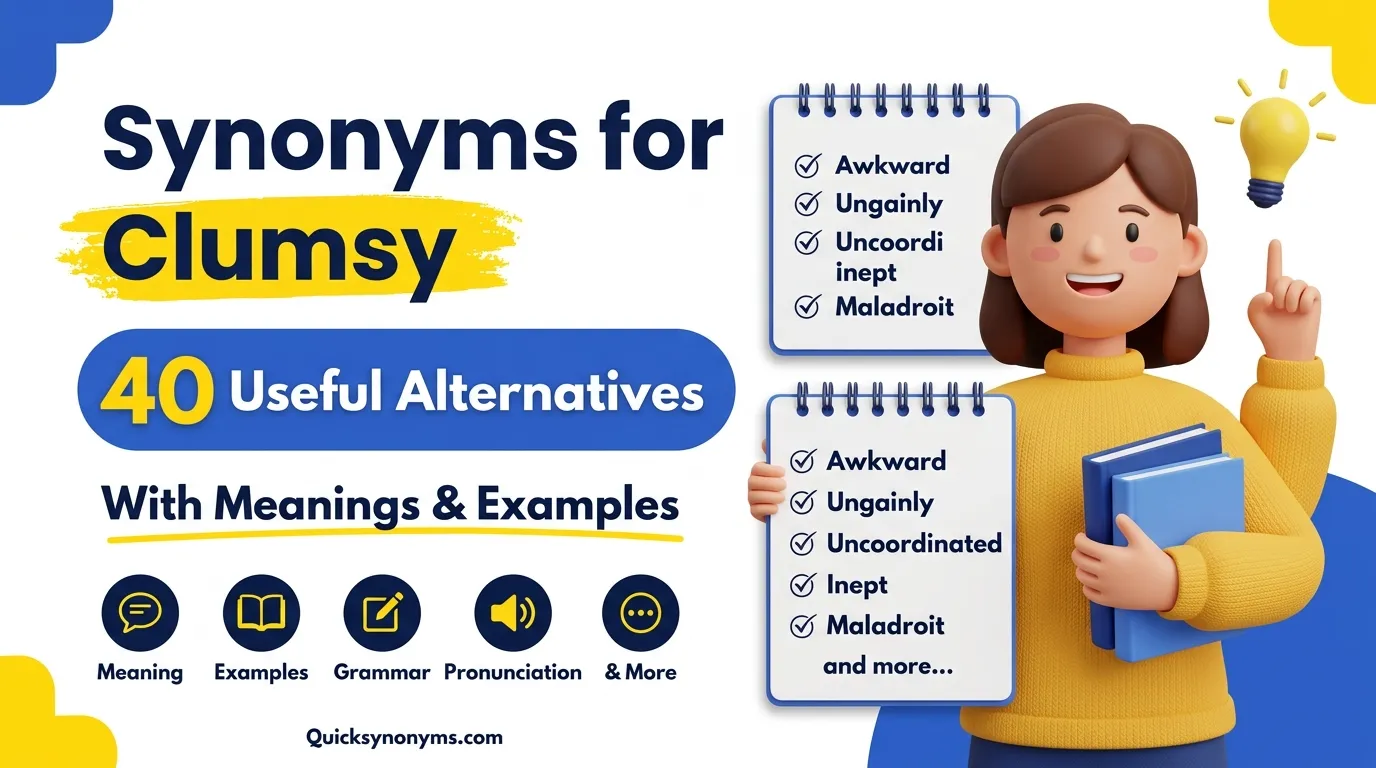
This guide covers the meaning of clumsy, its examples, emotional tone, word history, pronunciation, grammar, and 40 useful synonyms. It also groups related words by meaning, explains common antonyms, and answers key questions to help you choose the right word.
Meaning of Clumsy
Definition
Clumsy (adjective): Moving or acting in an awkward way, often because of poor coordination or a lack of skill.
Examples
- The clumsy boy knocked over a glass while reaching for his bag.
- I felt clumsy when I tried to dance in new shoes.
Connotative Meaning
- Positive tone: Can suggest innocence or charm when someone makes a harmless mistake.
- Negative tone: Can suggest poor control, weak skills, or careless actions.
- Neutral tone: Can simply describe awkward movement or an action that lacks ease.
(Connotation: the emotional or cultural feeling a word carries beyond its literal meaning.)
Etymology
The exact origin of clumsy is uncertain. The word appeared in English in the 16th century and was used to describe things or people that were stiff, awkward, or difficult to handle.
- Old English (450 to 1100): Not applicable. The known English word is recorded much later.
- Middle English (1100 to 1500): The exact earlier path is uncertain.
- Modern English (1500 to present): Clumsy developed to describe awkward movement, poor handling, and a lack of skill or grace.
Pronunciation (IPA)
- IPA: /ˈklʌm.zi/
- Syllables: clum-sy
Affixation Pattern of Clumsy
- Root: Clums, from the older word form associated with clumsy.
- Prefix: None.
- Suffix: -y, which helps form an adjective.
- Word formations:
- Clumsy (adjective): Awkward or lacking skill.
- Clumsily (adverb): In an awkward way.
- Clumsiness (noun): The state of being awkward or lacking coordination.
40 Synonyms of Clumsy: With Meaning and Examples
1. Awkward (adjective)
Meaning: Moving or acting in a way that lacks ease or skill.
Examples:
- He made an awkward move and hit the table.
- Her awkward steps made the dance look difficult.
2. Ungainly (adjective)
Meaning: Moving in a way that looks heavy, awkward, or lacking grace.
Examples:
- The ungainly puppy stumbled over its own feet.
- He made an ungainly jump across the puddle.
3. Uncoordinated (adjective)
Meaning: Unable to control body movements smoothly.
Examples:
- The uncoordinated player missed the ball.
- She felt uncoordinated during her first dance lesson.
4. Inept (adjective)
Meaning: Lacking the skill needed to do something well.
Examples:
- His inept handling of the tools caused a small mess.
- The inept worker struggled to fix the broken shelf.
5. Maladroit (adjective)
Meaning: Not skilled or graceful in movement or action.
Examples:
- His maladroit attempt to catch the cup sent it to the floor.
- She gave a maladroit reply that made the meeting tense.
6. Graceless (adjective)
Meaning: Moving or acting without smoothness or grace.
Examples:
- His graceless landing made the audience gasp.
- She gave a graceless bow before leaving the stage.
7. Bumbling (adjective)
Meaning: Acting in a confused or awkward way while trying to do something.
Examples:
- The bumbling waiter dropped a spoon beside the table.
- A bumbling detective missed the clue right in front of him.
8. Fumbling (adjective)
Meaning: Handling things awkwardly, often because of poor control or nervousness.
Examples:
- His fumbling hands could not open the small box.
- She gave a fumbling answer to the teacher’s question.
9. Bungling (adjective)
Meaning: Doing a task badly because of poor skill or judgment.
Examples:
- The bungling repair left the door stuck.
- A bungling attempt to cook dinner ruined the sauce.
10. Blundering (adjective)
Meaning: Making careless or foolish mistakes while acting.
Examples:
- The blundering player passed the ball to the wrong team.
- His blundering effort made a simple task much harder.
11. Gauche (adjective)
Meaning: Lacking social ease or knowing how to behave well around others.
Examples:
- His gauche greeting made the guests feel uneasy.
- She made a gauche comment during the formal dinner.
12. Inelegant (adjective)
Meaning: Lacking grace, style, or smoothness.
Examples:
- His inelegant movements stood out during the ballet.
- She used an inelegant method to lift the heavy box.
13. Gawky (adjective)
Meaning: Moving awkwardly, often because of a tall or poorly coordinated body.
Examples:
- The gawky teenager struggled to fit into the small chair.
- His gawky walk made him look unsure on the stage.
14. Lumbering (adjective)
Meaning: Moving slowly and heavily, with little grace.
Examples:
- The lumbering bear crossed the narrow path.
- He made a lumbering turn while carrying the large bag.
15. Ponderous (adjective)
Meaning: Moving in a slow, heavy, and awkward way.
Examples:
- The ponderous robot struggled to climb the steps.
- His ponderous movements made the simple task take longer.
16. Clunky (adjective)
Meaning: Awkward or heavy in movement, shape, or use.
Examples:
- The clunky machine shook as it moved across the floor.
- These clunky gloves made it hard to pick up coins.
17. Cumbersome (adjective)
Meaning: Difficult to carry, handle, or use because of its size or weight.
Examples:
- The cumbersome suitcase was hard to lift onto the train.
- She found the cumbersome tool difficult to use.
18. Unwieldy (adjective)
Meaning: Hard to control or move because something is large or awkward.
Examples:
- The unwieldy ladder was hard to turn in the hallway.
- He carried the unwieldy package with both arms.
19. Heavy-handed (adjective)
Meaning: Using too much force or acting without enough care or control.
Examples:
- His heavy-handed touch broke the delicate model.
- The heavy-handed repair damaged the wooden frame.
20. Ham-fisted (adjective)
Meaning: Acting with little skill, care, or control.
Examples:
- His ham-fisted attempt to fix the clock made it worse.
- The ham-fisted player knocked the pieces off the board.
21. Unskillful (adjective)
Meaning: Lacking the ability to perform a task well.
Examples:
- Her unskillful handling of the paint left uneven marks.
- The unskillful driver struggled to park between two cars.
22. Inexpert (adjective)
Meaning: Lacking practice or knowledge in a particular task.
Examples:
- His inexpert use of the knife made chopping slow.
- The inexpert repair did not solve the problem.
23. Unpracticed (adjective)
Meaning: Lacking experience or practice in an activity.
Examples:
- Her unpracticed fingers moved slowly over the piano keys.
- The unpracticed skater wobbled across the ice.
24. Amateurish (adjective)
Meaning: Showing a lack of skill or professional care.
Examples:
- The amateurish paint job left marks on the wall.
- His amateurish attempt at sewing came apart at the seam.
25. Unpolished (adjective)
Meaning: Lacking the smoothness or skill that comes with practice.
Examples:
- His unpolished movements showed that he was new to the sport.
- The unpolished presentation needed more practice.
26. Crude (adjective)
Meaning: Made or done in a rough way without much care or skill.
Examples:
- He built a crude stand from scraps of wood.
- The crude repair held the handle in place for only a day.
27. Rough (adjective)
Meaning: Done without smoothness, care, or fine skill.
Examples:
- Her rough brushwork made the picture look uneven.
- He gave the wooden chair a rough repair.
28. Stiff (adjective)
Meaning: Moving in a way that lacks ease or flexibility.
Examples:
- His stiff walk showed that he was not used to the boots.
- She made a stiff turn during the dance.
29. Rigid (adjective)
Meaning: Not bending or moving easily, often making movement awkward.
Examples:
- His rigid posture made it hard to reach the shelf.
- She moved with rigid arms during the warm-up.
30. Unsteady (adjective)
Meaning: Not moving or standing with firm control.
Examples:
- The unsteady child held the rail while climbing the stairs.
- His unsteady hands made the drawing hard to finish.
31. Shaky (adjective)
Meaning: Not firm or well controlled.
Examples:
- Her shaky grip made the glass wobble.
- He took a shaky step onto the wet floor.
32. Stumbling (adjective)
Meaning: Moving with difficulty, as if about to fall.
Examples:
- His stumbling walk showed how tired he was.
- The stumbling runner struggled to cross the finish line.
33. Faltering (adjective)
Meaning: Losing steadiness or confidence while moving or acting.
Examples:
- Her faltering steps slowed as the path grew steep.
- He made a faltering attempt to lift the heavy lid.
34. Tactless (adjective)
Meaning: Saying or doing things without enough care for other people’s feelings.
Examples:
- His tactless remark upset his friend.
- She made a tactless joke during a serious talk.
35. Insensitive (adjective)
Meaning: Not noticing or caring enough about how others feel.
Examples:
- His insensitive reply made the upset child cry.
- The insensitive comment hurt her feelings.
36. Indiscreet (adjective)
Meaning: Not careful about what one says or does in a social setting.
Examples:
- Her indiscreet question made the guest uncomfortable.
- He made an indiscreet remark about a private matter.
37. Incompetent (adjective)
Meaning: Not having the skills needed to do a job properly.
Examples:
- The incompetent repair worker left the sink leaking.
- An incompetent handler dropped the fragile package.
38. Incapable (adjective)
Meaning: Unable to do something well or at all.
Examples:
- He seemed incapable of using the tool safely.
- She felt incapable of controlling the large bicycle.
39. Ineffectual (adjective)
Meaning: Not producing the result that is needed.
Examples:
- His ineffectual efforts failed to stop the rolling cart.
- The ineffectual repair did little to fix the loose handle.
40. Unhandy (adjective)
Meaning: Not skilled at using the hands or handling practical tasks.
Examples:
- He was unhandy with tools and needed help fixing the shelf.
- Her unhandy attempt to wrap the gift left the paper torn.
Prototype Meaning
The typical meaning of clumsy is moving or handling things in an awkward way. People often imagine someone dropping a cup, tripping over a chair, or struggling to carry several items at once. The word can also describe a person who lacks skill or makes mistakes while doing a task.
Prototype Categorization
– Awkward movement and poor coordination: Awkward, ungainly, uncoordinated, graceless, gawky, lumbering, ponderous, clunky, stiff, rigid, unsteady, shaky, stumbling, faltering. Use these words when describing movement, posture, balance, or body control.
– Poor skill and careless action: Inept, maladroit, bumbling, fumbling, bungling, blundering, unskillful, inexpert, unpracticed, amateurish, unpolished, incompetent, incapable, unhandy. Use these words when someone struggles to complete a task or lacks the needed skill.
– Rough handling and difficult objects: Cumbersome, unwieldy, heavy-handed, ham-fisted, crude, rough. Use these words for objects that are hard to handle or actions that lack care and control.
– Lack of grace or smoothness: Inelegant. Use this word when a movement, method, or design lacks a smooth and pleasing style.
– Social mistakes and poor judgment: Gauche, tactless, insensitive, indiscreet. Use these words when someone acts awkwardly in social situations or fails to consider other people’s feelings.
– Weak or ineffective action: Ineffectual. Use this word when an attempt lacks the force or skill needed to achieve a result.
Grouping synonyms helps writers choose words that match the exact situation. It also helps English learners understand why similar words are not always interchangeable.
Antonyms of Clumsy
- Graceful (adjective): Moving in a smooth and pleasing way.
- Agile (adjective): Moving quickly and easily.
- Dexterous (adjective): Using the hands with skill.
- Coordinated (adjective): Moving different body parts smoothly together.
- Skillful (adjective): Doing a task well.
- Adroit (adjective): Showing skill and ease in action.
- Nimble (adjective): Moving quickly and lightly.
- Adept (adjective): Very good at doing something.
Short Questions and Answers
What does Clumsy mean?
Clumsy means moving or acting awkwardly, often because of poor coordination, limited skill, or a lack of care.
When should Clumsy be used?
Use clumsy when someone drops things, trips, moves awkwardly, or struggles with a task. It can also describe an action or method that is poorly handled.
Is Clumsy positive or negative?
Clumsy is usually negative because it points to mistakes or poor control. However, it can sound playful or affectionate when describing harmless mistakes.
How is it different from similar words?
Awkward is a broad word for actions that lack ease. Ungainly focuses on heavy or unattractive movement. Inept focuses more on a lack of skill in doing a task.
Conclusion
Learning the meaning of clumsy and its synonyms helps you express ideas with greater accuracy. Words such as awkward, ungainly, and uncoordinated describe movement, while inept, bungling, and unskillful focus on poor performance. Other words, such as tactless and insensitive, describe mistakes in social behavior.
Using the right synonym makes your writing clearer and your speech more natural. It also helps you avoid repeating the same word in essays, stories, emails, and everyday conversations. Understanding each word’s meaning and tone is just as important as learning its definition.
Build your vocabulary a little each day. Learn a few synonyms, write your own examples, and use the new words in real conversations. With daily practice, you can become a more confident English speaker and writer.
See Synonyms: Synonyms for Guild: 32 Useful Alternatives

Lexicographer & Vocabulary Specialist
Nathan Carter focuses on English vocabulary, synonyms, antonyms, and word meanings. He is passionate about producing clear, accurate, and easy-to-understand language guides for readers of all levels.