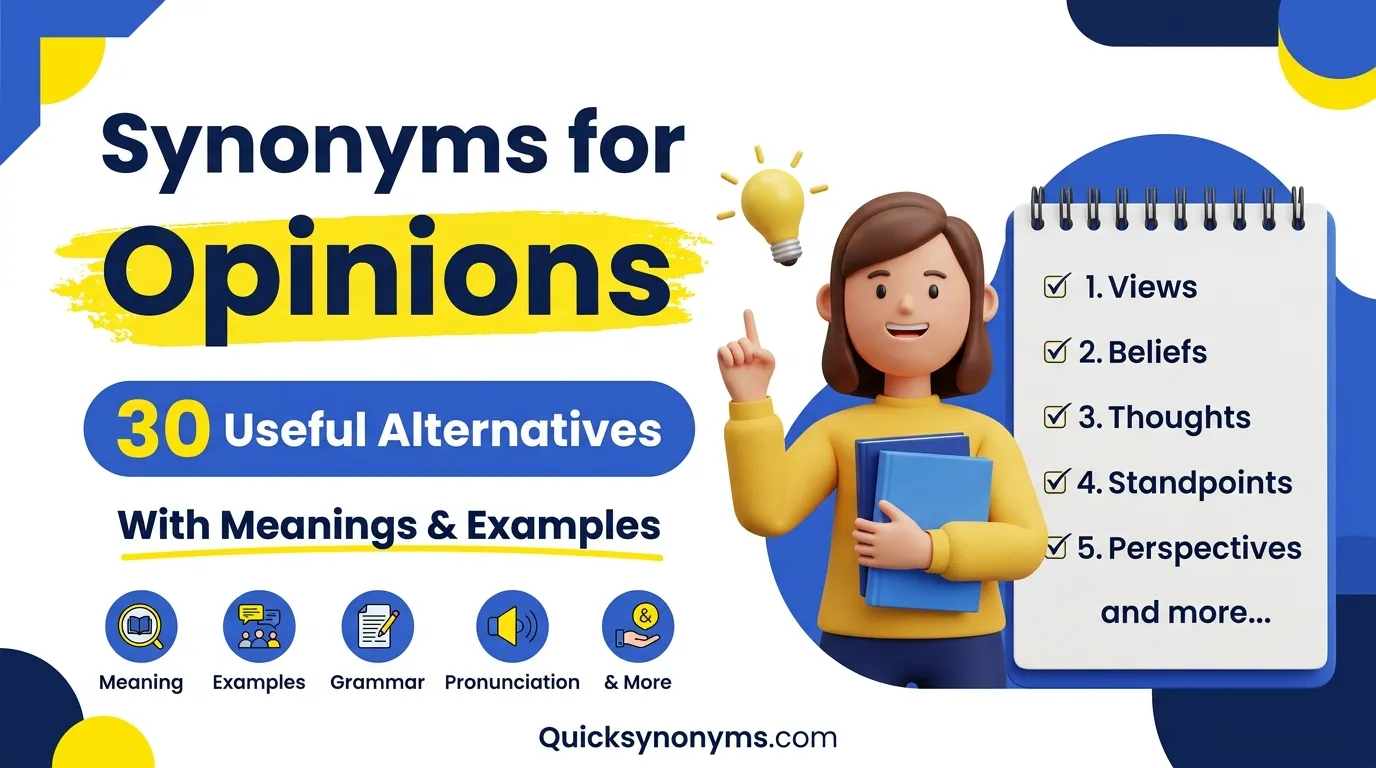
Opinions are ideas or beliefs that people have about a person, thing, or situation. For example, you may share your opinions about a movie, a school rule, or a new phone. People use opinions every day to express what they think and feel.
Learning synonyms for opinions helps you speak and write in a clear and interesting way. Instead of using the same word again and again, you can choose words that fit your meaning. These words also help English learners understand discussions, write essays, and share ideas with confidence.
In this guide, you will learn the meaning of opinions, 30 useful synonyms, simple examples, pronunciation, grammar, word history, and common antonyms. You will also explore groups of related words to help you choose the best word for each situation.
Meaning of Opinions
Definition
Opinions (noun): Beliefs, ideas, or views that people have about something, which may not be proven facts.
Examples
- My opinions about the new school rules are different from yours.
- We shared our opinions about the movie after watching it.
Connotative Meaning
- Positive tone: Opinions can show thoughtful ideas, personal insight, or useful advice.
- Negative tone: Opinions can sound unfair, biased, or too strong when people refuse to listen to others.
- Neutral tone: Opinions can simply express what someone thinks about a topic.
Connotation means the feeling or idea a word carries beyond its basic meaning.
Etymology
The word opinion came into English through Old French opinion, from Latin opinio, meaning a belief, judgment, or idea. Opinions is the plural form of opinion.
- Latin: Opinio referred to a belief or judgment.
- Old French: Opinion carried a similar meaning.
- Middle English: English adopted the word from French.
- Modern English: Opinion means a personal belief, view, or judgment. Opinions refers to more than one.
Pronunciation (IPA)
- IPA: /əˈpɪnjənz/
- Syllables: o-pin-ions
Affixation Pattern of Opinions
- Root: Opin, linked to the Latin word for belief or judgment.
- Prefix: None.
- Suffix: -ion forms the noun opinion. The ending -s makes it plural.
- Word formations:
- Opinion (noun): A personal belief or view.
- Opinions (plural noun): More than one belief or view.
- Opinionated (adjective): Having strong views and expressing them often.
- Opinionatedly (adverb): In a way that shows strong personal views.
- Opinionatedness (noun): The quality of having and expressing strong views.
30 Synonyms of Opinions: With Meaning and Examples
1. Views (noun)
Meaning: Ideas or beliefs about a person, thing, or topic.
Examples:
- Her views on education are clear.
- We discussed our views about the new policy.
2. Beliefs (noun)
Meaning: Ideas that someone accepts as true.
Examples:
- His beliefs guide his daily choices.
- Their beliefs about success are different.
3. Thoughts (noun)
Meaning: Ideas that come into someone’s mind.
Examples:
- I shared my thoughts about the book.
- Her thoughts on the plan were helpful.
4. Judgments (noun)
Meaning: Decisions or views formed after thinking about something.
Examples:
- His judgments about the case were fair.
- We should not make quick judgments about others.
5. Perspectives (noun)
Meaning: Ways of looking at or understanding something.
Examples:
- Both writers offer different perspectives.
- Travel can change your perspectives on life.
6. Ideas (noun)
Meaning: Thoughts or beliefs about something.
Examples:
- She has fresh ideas about teaching.
- We exchanged ideas during the meeting.
7. Standpoints (noun)
Meaning: Positions or views from which people consider an issue.
Examples:
- The two teams explained their standpoints.
- From my standpoint, the plan is fair.
8. Attitudes (noun)
Meaning: Feelings or ways of thinking about something.
Examples:
- Her attitudes toward learning are positive.
- People’s attitudes about change can differ.
9. Convictions (noun)
Meaning: Strong beliefs that someone feels sure about.
Examples:
- He spoke with confidence about his convictions.
- Her convictions helped her stand up for fairness.
10. Assessments (noun)
Meaning: Judgments made after examining something.
Examples:
- The teacher shared her assessments of the projects.
- Their assessments of the risk were different.
11. Conclusions (noun)
Meaning: Decisions or beliefs reached after thinking about facts or evidence.
Examples:
- We reached different conclusions after reading the report.
- Her conclusions were based on careful study.
12. Impressions (noun)
Meaning: Feelings or ideas formed about someone or something.
Examples:
- My first impressions of the school were positive.
- She shared her impressions of the new manager.
13. Feelings (noun)
Meaning: Personal emotions or views about something.
Examples:
- He explained his feelings about the decision.
- Her feelings about moving abroad changed over time.
14. Notions (noun)
Meaning: Ideas or beliefs about something, sometimes without much evidence.
Examples:
- He has strange notions about success.
- Their notions of beauty are quite different.
15. Interpretations (noun)
Meaning: Explanations of what something means.
Examples:
- The students offered different interpretations of the poem.
- Her interpretation of the rule was reasonable.
16. Estimations (noun)
Meaning: Judgments about the size, value, or amount of something.
Examples:
- Their estimations of the cost were close.
- We compared our estimations of the time needed.
17. Takes (noun)
Meaning: Informal views or opinions about a topic.
Examples:
- Her take on the film was funny.
- Everyone had a different take on the news.
18. Stances (noun)
Meaning: Firm positions or opinions on an issue.
Examples:
- The group explained its stance on climate change.
- His stance on school uniforms remained firm.
19. Preferences (noun)
Meaning: Choices or likes that show what someone favors.
Examples:
- We discussed our preferences for the trip.
- Her preferences in music have changed.
20. Evaluations (noun)
Meaning: Judgments about the quality or value of something.
Examples:
- The manager gave evaluations of each proposal.
- Their evaluations of the service were mixed.
21. Positions (noun)
Meaning: Opinions or sides that people take on an issue.
Examples:
- Both leaders explained their positions clearly.
- The debate revealed their positions on the issue.
22. Beliefs (noun)
Meaning: Ideas that people think are true or right.
Examples:
- Our beliefs can shape our actions.
- She shared her beliefs about equal rights.
23. Assumptions (noun)
Meaning: Ideas accepted as true without complete proof.
Examples:
- We should test our assumptions before deciding.
- His assumptions about the job were wrong.
24. Convictions (noun)
Meaning: Deeply held views that someone strongly supports.
Examples:
- She defended her convictions during the debate.
- His convictions shaped his choices.
25. Appraisals (noun)
Meaning: Judgments about the value, quality, or condition of something.
Examples:
- The experts gave their appraisals of the artwork.
- Their appraisals of the project differed.
26. Reflections (noun)
Meaning: Thoughts formed after careful consideration.
Examples:
- Her reflections on the trip were thoughtful.
- He shared his reflections on the past year.
27. Recommendations (noun)
Meaning: Suggestions about what someone should choose or do.
Examples:
- The doctor gave recommendations for better sleep.
- We considered her recommendations before choosing a school.
28. Assertions (noun)
Meaning: Statements that express something as true or certain.
Examples:
- His assertions about the problem needed proof.
- The report included several strong assertions.
29. Arguments (noun)
Meaning: Reasons or claims used to support a view.
Examples:
- The students presented arguments for their views.
- Her arguments helped explain the proposal.
30. Speculations (noun)
Meaning: Ideas or guesses about something without enough proof.
Examples:
- The news caused much speculation about the future.
- His speculations about the result were uncertain.
Note: Some synonyms above overlap in meaning, but they are not interchangeable in every sentence. Choose the word that best matches your intended meaning.
Prototype Meaning
The most common meaning of opinions is personal views or beliefs about a subject. When people hear this word, they often think of a discussion in which people share what they think about a movie, a rule, a person, or a public issue.
Opinions may come from personal experience, feelings, knowledge, or careful thought. However, an opinion is not always a proven fact.
Prototype Categorization
- Personal views: Views, thoughts, ideas, perspectives, standpoints. Use these words to share how someone sees or understands a topic.
- Strong beliefs: Beliefs, convictions, stances, positions, attitudes. Use these words when discussing values or firm views.
- Careful judgments: Judgments, assessments, conclusions, evaluations, estimations, appraisals. Use these words when a view comes from review or analysis.
- Personal reactions: Impressions, feelings, preferences, reflections. Use these words to describe reactions, likes, or thoughts shaped by experience.
- Ideas and explanations: Notions, interpretations, assumptions, speculations. Use these words for ideas, explanations, or guesses that may need checking.
- Informal views: Takes. Use this word in casual talks, reviews, and online discussions.
- Statements and support: Assertions, arguments. Use these words when someone states a claim or gives reasons to support a view.
- Advice and suggestions: Recommendations. Use this word when someone offers guidance or suggests a choice.
Grouping synonyms makes it easier to find a word that fits your meaning. It also helps you avoid repetition and make your writing more precise.
Antonyms of Opinions
Opinions do not have one exact opposite in every context. However, these words contrast with personal views by pointing to facts, proof, or established knowledge.
- Facts (noun): Things that are known or proven to be true.
- Evidence (noun): Information that helps show whether something is true.
- Proof (noun): Evidence that establishes something as true.
- Certainties (noun): Things known or accepted as definite.
- Knowledge (noun): Information or understanding gained through learning or experience.
- Truths (noun): Things that match reality or the facts.
- Realities (noun): The actual state of things, rather than personal beliefs.
Short Questions and Answers
What does Opinions mean?
Opinions are personal beliefs, ideas, or views about something. They may be based on feelings, experience, or thought rather than proven facts.
When should Opinions be used?
Use opinions when talking about what people think or believe about a topic. For example, you can share opinions about books, school rules, news, or everyday choices.
Is Opinions positive or negative?
Opinions is a neutral word. It can have a positive tone when someone shares helpful views, or a negative tone when those views are unfair or too forceful.
How is it different from similar words?
Views are general ways of thinking about a topic. Beliefs are ideas someone accepts as true. Judgments are views formed after considering information or making a decision.
Conclusion
Learning synonyms for opinions helps you express your thoughts in a clear and natural way. Words such as views, beliefs, perspectives, and judgments can make your writing more varied. However, each word has its own meaning, so it is important to choose one that fits the context.
These words are useful in school essays, work reports, online discussions, and everyday conversations. They also help English learners understand what other people mean when they share their ideas. As you practice, you will find it easier to explain your views without repeating the same words.
Start by learning a few synonyms each day. Write simple sentences with them, use them in conversation, and review their meanings often. With daily practice, you can build a stronger vocabulary and speak and write with more confidence.
Explore More: Synonyms for Thinks: 30 Words to Know

Content Editor & Language Researcher
Daniel Foster specializes in editing educational content and researching English language topics. He is committed to creating well-structured, reader-friendly articles that make learning easier.