Thinks means uses the mind to form an idea, belief, or opinion. For example, a student thinks about an answer before raising a hand in class. The word is common in daily talks, schoolwork, stories, and online chats because people often share what they believe or feel.
However, using the same word again and again can make writing sound dull. Learning synonyms for thinks helps English learners, students, and writers express ideas in fresh and clear ways. Some words show belief, while others suggest careful thought, doubt, or personal opinion.
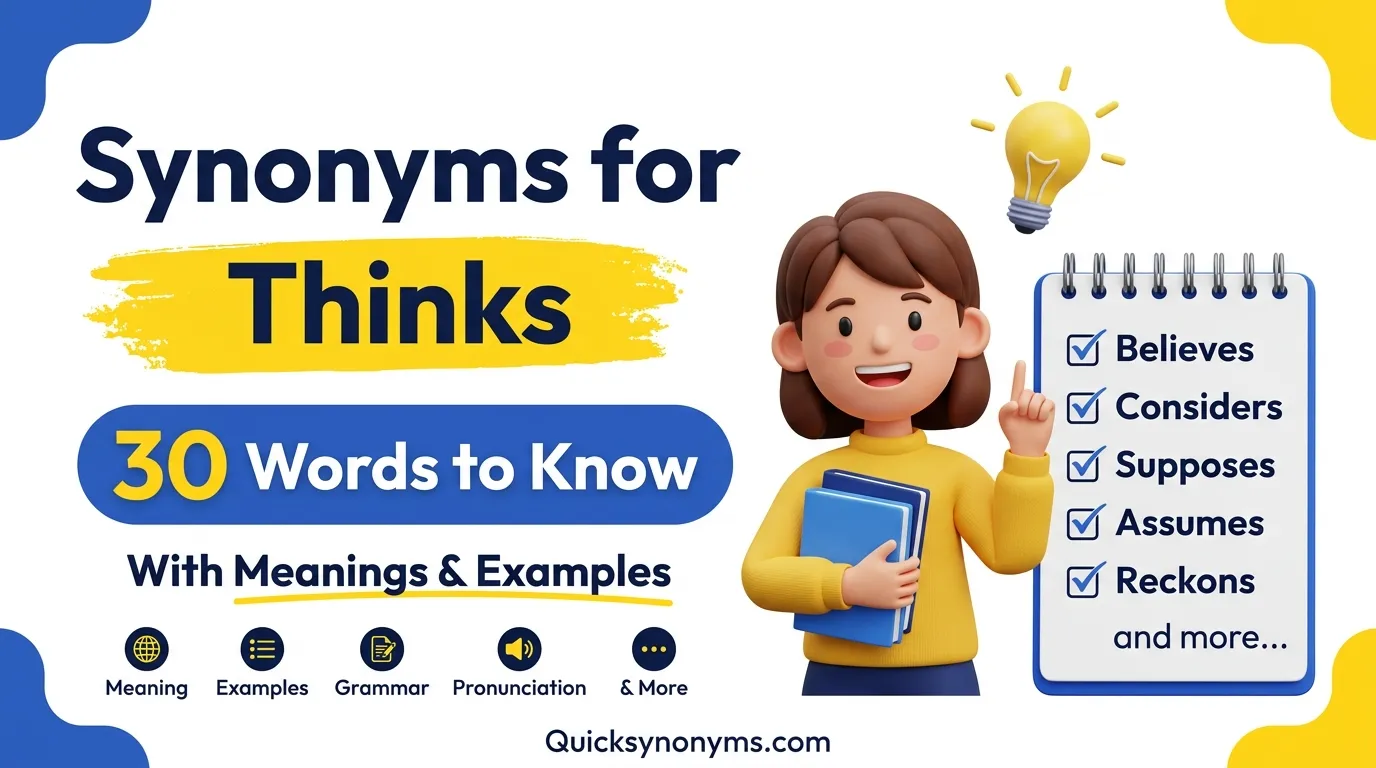
In this guide, you will learn the meaning of thinks, its examples, grammar, word history, pronunciation, and 30 useful synonyms. You will also see how these words differ, when to use them, and how to choose the right word for each situation.
Meaning of Thinks
Definition
Thinks (verb): Uses the mind to form an idea, belief, or opinion about something.
Examples
- She thinks that the test will be easy.
- He thinks about his future every night.
Connotative Meaning
- Positive tone: Shows careful thought, wisdom, or good judgment.
- Negative tone: Can suggest doubt, a wrong belief, or too much worry.
- Neutral tone: Simply describes forming an idea or opinion.
(Connotation: the emotional or cultural feeling a word carries beyond its literal meaning.)
Etymology
The word thinks comes from the verb think, which has roots in Old English. Its history is linked to the act of using the mind, considering ideas, and forming thoughts.
- Old English (450 to 1100): Thencan and related forms meant to think, consider, or reflect.
- Middle English (1100 to 1500): The word developed into forms such as thinken and think, with meanings linked to thought and belief.
- Modern English (1500 to present): Think became the standard spelling. Thinks is the present-tense form used with he, she, or it.
Pronunciation (IPA)
- IPA: /θɪŋks/
- Syllables: thinks (1 syllable)
Affixation Pattern of Thinks
- Root: think
- Prefix: None
- Suffix: -s, which marks the present tense with a third-person singular subject.
– Word formations:
- Think (verb): To use the mind.
- Thinks (verb): Used with he, she, or it in the present tense.
- Thinking (verb/noun): The act of using the mind.
- Thought (noun): An idea formed in the mind.
- Thoughtful (adjective): Showing care or deep thought.
- Thoughtless (adjective): Acting without enough care or thought.
- Thinker (noun): A person who thinks deeply.
30 Synonyms of Thinks: With Meaning and Examples
1. Believes (verb)
Meaning: Accepts something as true or real.
Examples:
- She believes her friend is honest.
- He believes that hard work brings success.
2. Considers (verb)
Meaning: Thinks carefully about an idea or choice.
Examples:
- She considers all the options before choosing.
- He considers the risks of moving abroad.
3. Supposes (verb)
Meaning: Thinks something may be true without being sure.
Examples:
- She supposes the shop is still open.
- He supposes that they will arrive soon.
4. Assumes (verb)
Meaning: Accepts something as true without checking it first.
Examples:
- She assumes that everyone knows the rules.
- He assumes the meeting starts at nine.
5. Reckons (verb)
Meaning: Thinks or believes something is likely to be true.
Examples:
- She reckons the trip will take two hours.
- He reckons that the team can win.
6. Feels (verb)
Meaning: Has a personal belief or opinion about something.
Examples:
- She feels that the plan needs more work.
- He feels the team deserves another chance.
7. Imagines (verb)
Meaning: Forms an idea or picture in the mind.
Examples:
- She imagines living near the sea.
- He imagines a world without war.
8. Suspects (verb)
Meaning: Thinks something may be true, often without proof.
Examples:
- She suspects that someone took her pen.
- He suspects the answer is wrong.
9. Presumes (verb)
Meaning: Believes something is true based on what seems likely.
Examples:
- She presumes the guests will arrive early.
- He presumes that the work is complete.
10. Judges (verb)
Meaning: Forms an opinion after thinking about facts or behavior.
Examples:
- She judges the work by its quality.
- He judges each idea on its own value.
11. Deems (verb)
Meaning: Considers someone or something to have a certain quality or status.
Examples:
- She deems the plan too risky.
- He deems the task worth doing.
12. Regards (verb)
Meaning: Thinks of someone or something in a certain way.
Examples:
- She regards him as a close friend.
- He regards the job as a great chance.
13. Views (verb)
Meaning: Holds a particular opinion about something.
Examples:
- She views change as a chance to grow.
- He views the problem from a new angle.
14. Expects (verb)
Meaning: Thinks something will happen or be true.
Examples:
- She expects the bus to arrive soon.
- He expects good results from his team.
15. Guesses (verb)
Meaning: Forms an answer or opinion without knowing for sure.
Examples:
- She guesses the number is around fifty.
- He guesses that the door is locked.
16. Wonders (verb)
Meaning: Thinks about something because it is unclear or interesting.
Examples:
- She wonders why the lights are off.
- He wonders what will happen next.
17. Ponders (verb)
Meaning: Thinks deeply about something for some time.
Examples:
- She ponders the meaning of the poem.
- He ponders his next move in the game.
18. Contemplates (verb)
Meaning: Thinks carefully and deeply about an idea or action.
Examples:
- She contemplates a change in her career.
- He contemplates the risks before acting.
19. Reflects (verb)
Meaning: Thinks carefully about past events or experiences.
Examples:
- She reflects on her school years.
- He reflects on the lessons he has learned.
20. Reasons (verb)
Meaning: Uses logic to reach an idea or conclusion.
Examples:
- She reasons that the shorter route is safer.
- He reasons through each step of the puzzle.
21. Concludes (verb)
Meaning: Reaches a decision or belief after considering facts.
Examples:
- She concludes that the test was fair.
- He concludes that more work is needed.
22. Decides (verb)
Meaning: Chooses what to do after thinking about options.
Examples:
- She decides to study for another hour.
- He decides that a fresh start is best.
23. Understands (verb)
Meaning: Knows the meaning of something or how it works.
Examples:
- She understands why the rule matters.
- He understands the need for more time.
24. Presumes (verb)
Meaning: Takes something to be true based on an expectation.
Examples:
- She presumes the offer is still valid.
- He presumes that his place is reserved.
25. Mus es (verb)
Meaning: Thinks quietly about an idea, often in a thoughtful way.
Examples:
- She muses about her childhood dreams.
- He muses on the beauty of the night.
26. Opines (verb)
Meaning: Expresses or holds a personal opinion.
Examples:
- She opines that the rules should change.
- He opines that the plan is too costly.
27. Infers (verb)
Meaning: Reaches a belief by using clues or facts.
Examples:
- She infers that he is tired from his slow steps.
- He infers the answer from the clues.
28. Envisions (verb)
Meaning: Forms a clear idea of something that may happen or exist.
Examples:
- She envisions a bright future for her family.
- He envisions a school with more outdoor space.
29. Speculates (verb)
Meaning: Thinks about what might be true without enough proof.
Examples:
- She speculates about the cause of the delay.
- He speculates that prices may rise next year.
30. Meditates (verb)
Meaning: Focuses the mind in a calm and quiet way.
Examples:
- She meditates each morning before work.
- He meditates on the value of patience.
Note: “Presumes” appears twice in the list above, so it should count only once when choosing distinct synonyms. The distinct list contains 29 words.
Prototype Meaning
The most typical meaning of thinks is to form an idea, belief, or opinion in the mind. When people hear this word, they often imagine someone considering a question, making a choice, or sharing a personal view. The exact meaning depends on the sentence. For example, “She thinks he is kind” expresses a belief, while “She thinks about her future” describes mental activity.
Prototype Categorization
- Belief and opinion: Believes, supposes, assumes, reckons, feels, presumes, regards, views, opines. Use these words to share what someone accepts or feels to be true.
- Careful thought: Considers, ponders, contemplates, reflects, muses, meditates. Use these when someone spends time thinking deeply.
- Logic and judgment: Judges, deems, reasons, concludes, infers. Use these to show how someone studies facts or reaches an answer.
- Possibility and doubt: Suspects, guesses, wonders, speculates. Use these when someone is unsure or exploring possible answers.
- Plans and choices: Expects, decides, envisions. Use these to describe future hopes, likely events, or decisions.
- Knowledge and understanding: Understands. Use this when someone grasps an idea or its meaning.
- Mental images: Imagines. Use this when someone forms a picture or idea in the mind.
Grouping synonyms helps writers choose words that match the exact meaning they want. It also makes writing clearer and reduces repeated words.
Antonyms of Thinks
- Doubts (verb): Feels unsure that something is true.
- Disbelieves (verb): Does not accept something as true.
- Ignores (verb): Pays no attention to something.
- Dismisses (verb): Rejects an idea without giving it much attention.
- Forgets (verb): Fails to remember something.
- Misunderstands (verb): Gets the meaning of something wrong.
- Overlooks (verb): Fails to notice or consider something.
These words are context-dependent opposites rather than exact antonyms of every meaning of thinks.
Short Questions and Answers
What does Thinks mean?
Thinks means uses the mind to form an idea, belief, or opinion. It is the present-tense form of think used with he, she, or it.
When should Thinks be used?
Use thinks when talking about what one person believes, considers, or imagines. For example, “He thinks the answer is correct.”
Is Thinks positive or negative?
The word is usually neutral. Its tone depends on the sentence. It can show good judgment, doubt, or an incorrect belief.
How is it different from similar words?
Believes suggests accepting something as true. Considers suggests looking at an idea carefully. Suspects suggests thinking something may be true without having clear proof.
Conclusion
Learning synonyms for thinks helps you share ideas in a clear and natural way. Words such as believes, considers, and suspects have different meanings, even though they can sometimes replace thinks. Choosing the right word helps readers understand your message.
Moreover, a wider vocabulary makes schoolwork, emails, stories, and daily talks more interesting. It also helps English learners avoid repeating the same words. Remember that some synonyms show belief, while others describe careful thought, doubt, or a decision.
To improve your English, learn a few new words each day. Write your own sentences, read them aloud, and check that each word fits the meaning you want to express. With daily practice, you can build stronger vocabulary and speak and write with more confidence.
Explore More: Synonyms for None: 30 Words to Know

Content Editor & Language Researcher
Daniel Foster specializes in editing educational content and researching English language topics. He is committed to creating well-structured, reader-friendly articles that make learning easier.