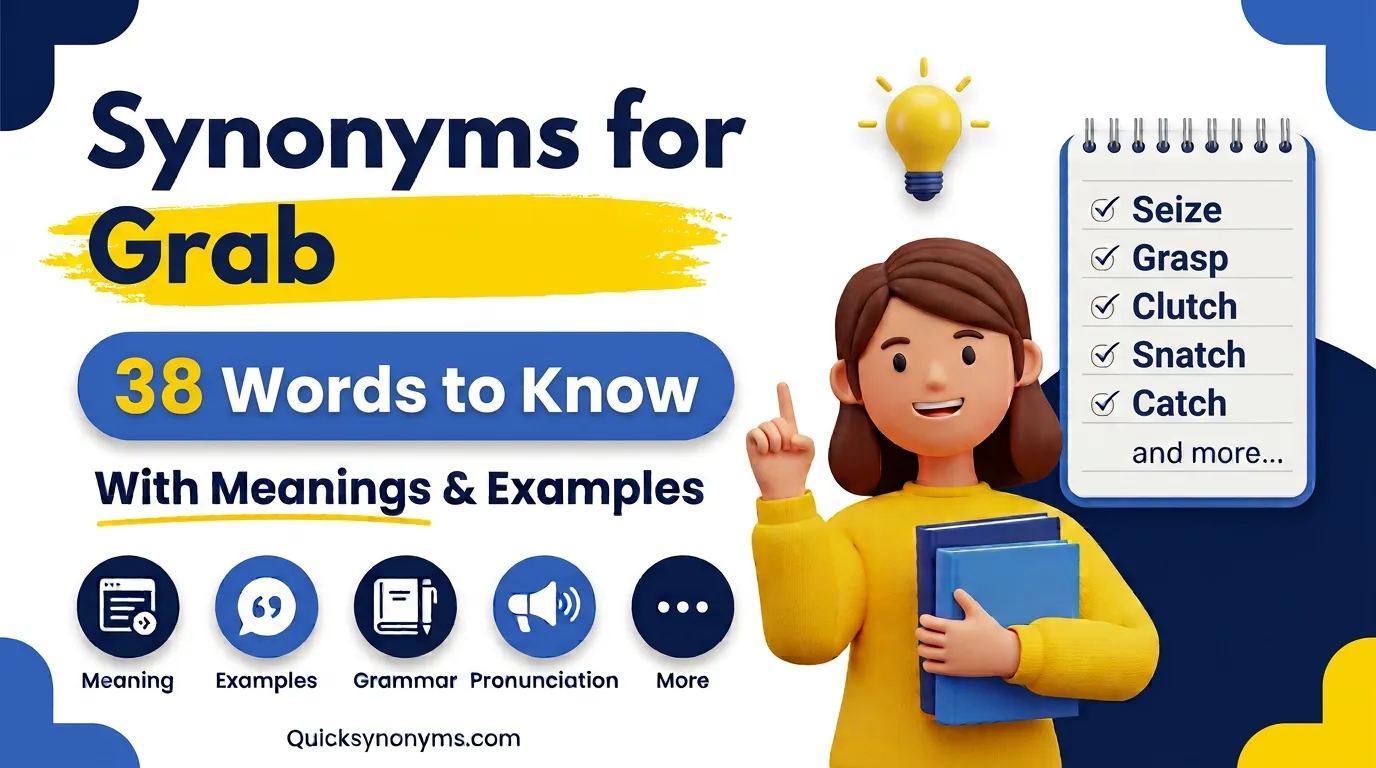
Synonyms for Grab help you find better words for taking, holding, or catching something quickly. You might grab your phone before leaving home, grab a snack when you are hungry, or grab someone’s hand to stop them from falling. The word is common because it is short, clear, and useful in daily English.
Learning synonyms helps English learners build a stronger vocabulary and avoid using the same word again and again. Content writers can also choose a more exact word based on the action or feeling they want to show.
This guide covers the meaning of grab, examples, grammar, history, pronunciation, and 38 useful synonyms. It also groups the words by meaning so you can choose the best word for each situation.
Meaning of Grab
Definition
Grab (verb): to take or hold something quickly and firmly.
Examples
- She grabbed her bag and ran outside.
- He grabbed my hand before I fell.
Connotative Meaning
- Positive tone: Can suggest quick action or getting something useful.
- Negative tone: Can suggest taking something roughly or without permission.
- Neutral tone: Can simply mean taking or holding something quickly.
Etymology
The verb grab entered English in the 16th century. Its exact earlier source is uncertain, but it is linked to Germanic words meaning to seize or grasp.
- Old English (450 to 1100): Not applicable.
- Middle English (1100 to 1500): Not clearly recorded in the modern form.
- Modern English (1500 to present): Recorded in English in the late 16th century, with links to Germanic words meaning to seize or grasp.
Pronunciation (IPA)
- IPA: /ɡræb/
- Syllables: grab
Affixation Pattern of Grab
- Root: grab
- Prefix: None
- Suffix: None
- Word formations:
- grab: verb
- grabs: verb
- grabbed: verb
- grabbing: verb
- grabber: noun
38 Synonyms of Grab: With Meaning and Examples
1. Seize (verb)
Meaning: To take or hold something suddenly and firmly.
Examples:
- The guard seized the thief’s arm.
- She seized the chance to speak.
2. Grasp (verb)
Meaning: To hold something firmly with your hand.
Examples:
- He grasped the rope tightly.
- She grasped the handle.
3. Clutch (verb)
Meaning: To hold something tightly, often because of fear or urgency.
Examples:
- She clutched her purse tightly.
- He clutched the rail during the ride.
4. Snatch (verb)
Meaning: To take something quickly and suddenly.
Examples:
- Someone snatched her phone.
- He snatched the ball from the floor.
5. Catch (verb)
Meaning: To take hold of something moving through the air.
Examples:
- She caught the falling cup.
- He caught the ball with one hand.
6. Take (verb)
Meaning: To get or hold something with your hand.
Examples:
- Please take this book with you.
- She took the keys from the table.
7. Grip (verb)
Meaning: To hold something tightly.
Examples:
- He gripped the wheel firmly.
- She gripped the handle.
8. Hold (verb)
Meaning: To keep something firmly in your hand.
Examples:
- Please hold my bag.
- He held the rope tightly.
9. Sequester (verb)
Meaning: To take something away or keep it apart.
Examples:
- The officer sequestered the evidence.
- The court sequestered the documents.
10. Snag (verb)
Meaning: To get or catch something quickly or unexpectedly.
Examples:
- I snagged the last ticket.
- She snagged a seat near the window.
11. Pluck (verb)
Meaning: To take something quickly with your fingers.
Examples:
- He plucked a flower from the garden.
- She plucked the note from his hand.
12. Pick (verb)
Meaning: To take something with your hand.
Examples:
- She picked the book off the desk.
- He picked the coin from the floor.
13. Collect (verb)
Meaning: To take something and keep it.
Examples:
- She collected the package from the office.
- He collected his keys before leaving.
14. Acquire (verb)
Meaning: To get something for yourself.
Examples:
- The museum acquired a rare painting.
- She acquired a new laptop.
15. Obtain (verb)
Meaning: To get something that you want or need.
Examples:
- He obtained permission from his manager.
- She obtained a copy of the report.
16. Secure (verb)
Meaning: To get or take something successfully.
Examples:
- She secured a place on the team.
- He secured the final ticket.
17. Capture (verb)
Meaning: To take or catch something successfully.
Examples:
- The camera captured the moment.
- The team captured the flag.
18. Arrest (verb)
Meaning: To take someone into legal custody.
Examples:
- Police arrested the suspect.
- Officers arrested the man outside.
19. Collar (verb)
Meaning: To catch or arrest someone.
Examples:
- The police collared the suspect.
- Officers collared the thief nearby.
20. Catch (verb)
Meaning: To capture or stop someone or something.
Examples:
- The police caught the robber.
- She caught the escaping dog.
21. Ambush (verb)
Meaning: To attack someone suddenly from a hidden place.
Examples:
- The soldiers ambushed the patrol.
- The group ambushed the enemy at night.
22. Take hold (verb)
Meaning: To begin holding something firmly.
Examples:
- She took hold of the rope.
- He took hold of the handle.
23. Handle (verb)
Meaning: To take or hold something with your hands.
Examples:
- Please handle the glass carefully.
- She handled the package with care.
24. Touch (verb)
Meaning: To put your hand or another body part on something.
Examples:
- He touched the button.
- She touched the box gently.
25. Reach (verb)
Meaning: To extend your hand toward something.
Examples:
- She reached for the cup.
- He reached toward the shelf.
26. Pull (verb)
Meaning: To move something toward you with force.
Examples:
- She pulled the handle.
- He pulled the bag closer.
27. Yank (verb)
Meaning: To pull something suddenly and strongly.
Examples:
- He yanked the door open.
- She yanked the cable from the wall.
28. Tear (verb)
Meaning: To move quickly and suddenly toward something or take it forcefully.
Examples:
- He tore the paper from her hand.
- She tore the letter open.
29. Wrest (verb)
Meaning: To take something from someone by force.
Examples:
- He wrested the weapon away.
- She wrested the bag from him.
30. Appropriate (verb)
Meaning: To take something for your own use, often without permission.
Examples:
- The group appropriated the unused room.
- He appropriated company property.
31. Confiscate (verb)
Meaning: To officially take something away.
Examples:
- The teacher confiscated the phone.
- Officers confiscated the illegal goods.
32. Remove (verb)
Meaning: To take something away from a place.
Examples:
- Workers removed the damaged sign.
- She removed the old cover.
33. Lift (verb)
Meaning: To take something by raising it with your hands.
Examples:
- He lifted the box from the floor.
- She lifted the child carefully.
34. Pick up (verb)
Meaning: To take something from a surface or place.
Examples:
- Please pick up the paper.
- She picked up her keys.
35. Get (verb)
Meaning: To take or obtain something.
Examples:
- I will get the book from the shelf.
- She got a drink from the kitchen.
36. Fetch (verb)
Meaning: To go and bring something back.
Examples:
- Please fetch my coat.
- He fetched a glass of water.
37. Take away (verb)
Meaning: To remove something from a place or person.
Examples:
- The waiter took away the empty plates.
- The nurse took away the old medicine.
38. Appropriate (verb)
Meaning: To take something for a particular use, especially without permission.
Examples:
- The company appropriated the unused space.
- He appropriated the equipment for his project.
Prototype Meaning
The most typical meaning of grab is to take or hold something quickly and firmly. People often imagine a fast hand movement, such as grabbing a phone, bag, handle, or person’s arm.
Prototype Categorization
- Quick or sudden taking: seize, snatch, snag, pluck, pick, grab. Use these when something is taken quickly.
- Firm holding: grasp, clutch, grip, hold, handle. Use these when the focus is on holding something.
- Getting or obtaining: take, collect, acquire, obtain, secure, get, fetch. Use these when the focus is on getting something.
- Catching or capturing: catch, capture, arrest, collar, ambush. Use these when someone or something is caught.
- Forceful action: pull, yank, wrest, tear, lift. Use these when force or sudden movement is important.
- Taking away: remove, confiscate, take away, appropriate. Use these when something is taken from a person or place.
- Reaching or contact: touch, reach, take hold, pick up. Use these when the action involves reaching for or making contact with something.
Grouping synonyms helps writers see small differences between similar words. It also makes it easier to choose a word that matches the exact action.
Antonyms of Grab
- Release (verb): to let something go.
- Drop (verb): to let something fall.
- Give (verb): to hand something to another person.
- Return (verb): to give something back.
- Free (verb): to let someone or something go.
- Loosen (verb): to make a grip or hold less tight.
- Let go (verb): to stop holding something.
Short Questions and Answers
What does Grab mean?
Grab means to take or hold something quickly and firmly.
When should Grab be used?
Use grab when you want to describe a quick or sudden act of taking or holding something.
Is Grab positive or negative?
It depends on the context. Grab can sound neutral when you grab your bag, but it can sound negative when you grab something without permission.
How is it different from similar words?
Seize often sounds stronger or more forceful than grab. Grasp focuses more on holding firmly, while snatch suggests taking something suddenly and quickly.
Conclusion
Learning grab and its synonyms gives you more ways to describe quick actions. Words such as seize, grasp, clutch, snatch, and snag can make your English more exact and interesting.
These words also help you avoid repetition in writing and speaking. Knowing when to use each synonym can make your sentences clearer and help you express actions with confidence.
Keep practicing these words in short sentences each day. Regular vocabulary practice will help you remember their meanings and use them naturally.
Keep Reading: Synonyms for Quit: 35 Useful Alternatives.

English Teacher & Linguistics Writer
Grace Whitmore creates engaging educational content on vocabulary, word usage, and effective communication. Her goal is to help learners build confidence through clear and practical English guidance.