The phrase “this means” explains what something shows, tells us, or implies. For example, if your friend says the shop is closed, this means you cannot buy anything there right now. People use this phrase every day to explain facts, ideas, results, and changes.
Learning synonyms for “this means” helps you express ideas in different ways. English learners can use these alternatives to build vocabulary and speak with more confidence. Content writers can also use them to make articles clearer and avoid repeating the same phrase.
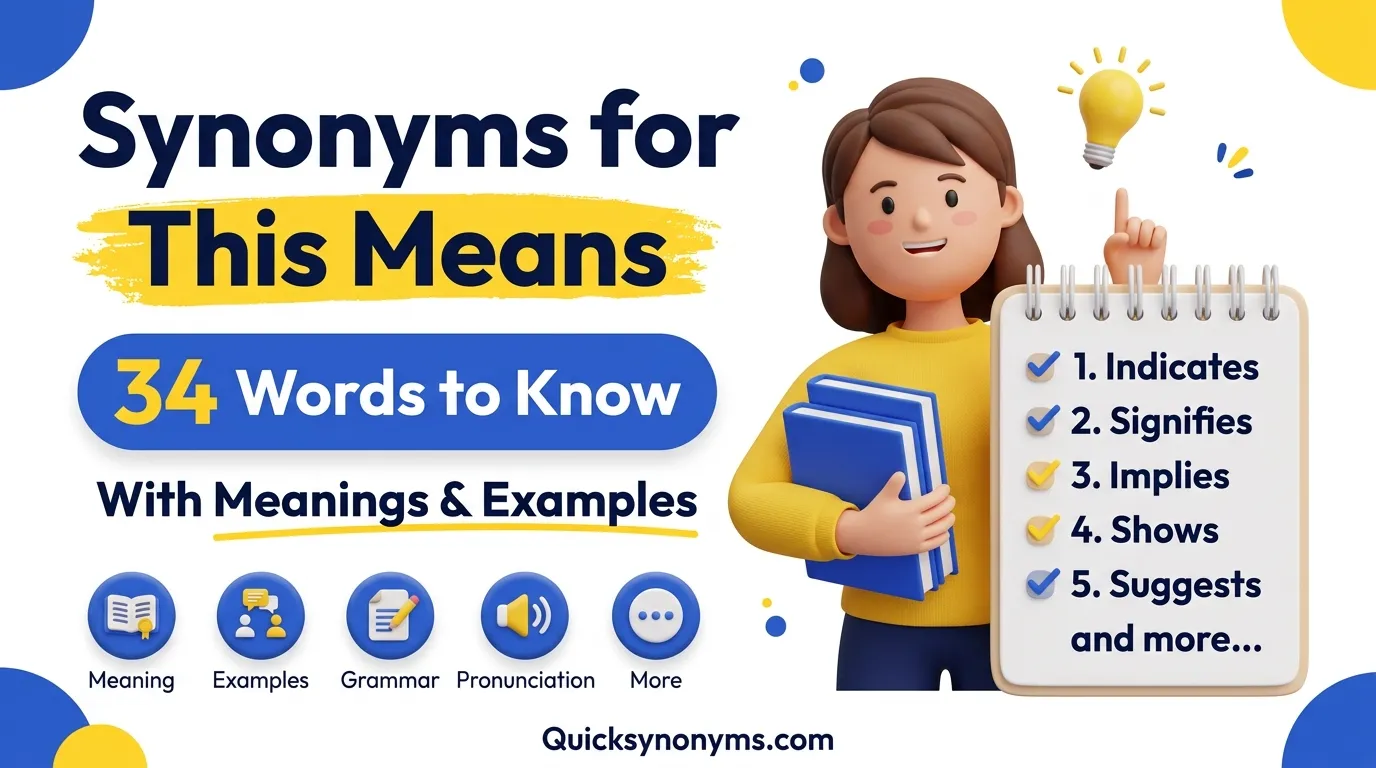
This guide covers 34 alternatives with simple meanings and examples. You will also learn how to use the phrase, understand its grammar and history, explore related expressions, and choose the right alternative for formal writing, daily speech, and schoolwork.
Meaning of This Means
Definition
This means (verb phrase): This shows, explains, or suggests what something means or what result follows from it.
Examples
- The road is wet. This means it may have rained.
- She passed the test. This means she did well.
Connotative Meaning
- Positive tone: This shows a good result or a helpful fact.
- Negative tone: This suggests a problem or an unwanted result.
- Neutral tone: This explains a fact without showing a strong feeling.
(Connotation is the feeling or idea that a word or phrase carries beyond its basic meaning.)
Etymology
“This means” is a modern English phrase made from two old English words.
- Old English (450 to 1100): “This” came from Old English forms such as þis. The verb mean came from Old English mǣnan, which could mean to signify, tell, or express.
- Middle English (1100 to 1500): Both words developed into forms closer to the ones used today. The verb mean kept its sense of expressing or showing an idea.
- Modern English (1500 to present): “This means” became a common way to explain facts, results, and ideas. The final s marks the present-tense verb used with this.
Pronunciation (IPA)
- IPA: /ðɪs miːnz/
- Syllables: this-means, 2 syllables.
Affixation Pattern of This Means
- Root: this is a demonstrative word; mean is the main verb.
- Prefix: None.
- Suffix: -s is added to mean for the third-person singular present tense.
- Word formations:
- Mean (verb): to express or signify something.
- Meaning (noun): the idea expressed by a word or action.
- Meaningful (adjective): having importance or purpose.
- Meaningless (adjective): having no clear meaning or purpose.
- Meaningfully (adverb): in a way that has meaning.
34 Synonyms of This Means: With Meaning and Examples
1. Indicates (verb)
Meaning: Shows that something is true or likely.
Examples:
- A red light indicates danger.
- Her smile indicates that she is happy.
2. Signifies (verb)
Meaning: Shows or represents a particular idea.
Examples:
- A white flag signifies peace.
- The award signifies great success.
3. Implies (verb)
Meaning: Suggests an idea without saying it directly.
Examples:
- His silence implies doubt.
- The message implies that we should wait.
4. Shows (verb)
Meaning: Makes a fact or result clear.
Examples:
- The chart shows a steady rise.
- Her work shows real care.
5. Suggests (verb)
Meaning: Gives a reason to think something may be true.
Examples:
- The dark sky suggests rain.
- His answer suggests some confusion.
6. Denotes (verb)
Meaning: Stands for a clear idea, sign, or thing.
Examples:
- The symbol denotes strength.
- A zero score denotes no points.
7. Conveys (verb)
Meaning: Communicates an idea or feeling.
Examples:
- Her letter conveys deep thanks.
- The song conveys a sense of hope.
8. Expresses (verb)
Meaning: Puts an idea or feeling into words or actions.
Examples:
- His poem expresses sadness.
- Her face expresses pure joy.
9. Signals (verb)
Meaning: Gives a sign that something is happening or will happen.
Examples:
- Dark clouds signal a storm.
- The bell signals the end of class.
10. Represents (verb)
Meaning: Stands for or describes something.
Examples:
- The dove represents peace.
- This picture represents our town.
11. Reveals (verb)
Meaning: Makes something known that was not clear before.
Examples:
- The report reveals a major problem.
- Her diary reveals her hopes.
12. Explains (verb)
Meaning: Makes an idea or fact easier to understand.
Examples:
- The teacher explains the rule.
- This note explains the delay.
13. Demonstrates (verb)
Meaning: Shows something clearly through facts or actions.
Examples:
- The test demonstrates the device’s strength.
- Her work demonstrates great skill.
14. Illustrates (verb)
Meaning: Makes an idea clear through an example or picture.
Examples:
- This story illustrates the value of trust.
- The diagram illustrates how the engine works.
15. Communicates (verb)
Meaning: Shares information, thoughts, or feelings.
Examples:
- His email communicates the main points.
- Her speech communicates hope.
16. Reflects (verb)
Meaning: Shows a quality, fact, or state.
Examples:
- His choice reflects his values.
- The result reflects months of hard work.
17. Defines (verb)
Meaning: States the exact meaning or nature of something.
Examples:
- This rule defines fair play.
- The law defines the limits of power.
18. States (verb)
Meaning: Gives information or an idea in clear words.
Examples:
- The notice states the new hours.
- Her letter states the reason for leaving.
19. Says (verb)
Meaning: Gives a message or expresses an idea.
Examples:
- The sign says the park is closed.
- The note says we must call first.
20. Entails (verb)
Meaning: Involves something as a necessary result or part.
Examples:
- The job entails long hours.
- Moving abroad entails many changes.
21. Means That (verb phrase)
Meaning: Introduces an explanation or result.
Examples:
- The bus is late. This means that we must wait.
- The price fell. This means that buyers can save money.
22. Points To (verb phrase)
Meaning: Suggests that a fact or result is likely.
Examples:
- The clues point to a simple answer.
- The data points to a change in demand.
23. Stands For (verb phrase)
Meaning: Represents a word, idea, or thing.
Examples:
- ASAP stands for “as soon as possible.”
- The heart stands for love in many images.
24. Adds Up (verb phrase)
Meaning: Makes sense when facts or details are considered together.
Examples:
- His story adds up.
- The clues add up to a clear answer.
25. Comes To (verb phrase)
Meaning: Leads to a result or total in a given context.
Examples:
- The bill comes to fifty dollars.
- The total comes to ten points.
26. Amounts To (verb phrase)
Meaning: Has the same effect or result as something else.
Examples:
- Ignoring the warning amounts to taking a risk.
- His promise amounts to a firm commitment.
27. Translates To (verb phrase)
Meaning: Produces a similar meaning or result in another form.
Examples:
- More practice translates to better skills.
- The phrase translates to a simple request in English.
28. Spells Out (verb phrase)
Meaning: Explains something in a clear and direct way.
Examples:
- The guide spells out every step.
- Her email spells out the new rules.
29. Makes Clear (verb phrase)
Meaning: Removes doubt or confusion about something.
Examples:
- The chart makes clear where costs have risen.
- His reply makes clear that he agrees.
30. Bears Out (verb phrase)
Meaning: Supports an idea by showing that it is true.
Examples:
- The facts bear out her claim.
- New results bear out the first report.
31. Confirms (verb)
Meaning: Shows that something believed or suspected is true.
Examples:
- The test confirms the result.
- Her reply confirms the meeting time.
32. Proves (verb)
Meaning: Shows with strong evidence that something is true.
Examples:
- The evidence proves his claim.
- The test proves that the tool works.
33. Equates To (verb phrase)
Meaning: Treats two things as equal in value, meaning, or effect.
Examples:
- One hour of work equates to sixty minutes.
- The loss equates to a major setback.
34. Is Evidence (noun phrase)
Meaning: Provides a sign or fact that supports an idea.
Examples:
- Her high score is evidence of strong skills.
- The broken lock is evidence of forced entry.
Prototype Meaning
The most typical meaning of “this means” is to explain what a fact, action, or result tells us. People often use it when they want to connect one idea to another. For example, “The shop is closed. This means we must come back tomorrow.” The phrase helps readers and listeners understand the link between two statements.
Prototype Categorization
- Direct explanation: shows, explains, states, says, makes clear, spells out. Use these when you want to explain a fact in simple words.
- Signs and clues: indicates, signifies, suggests, implies, signals, points to, reveals. Use these when something gives a clue or hints at a result.
- Meaning and representation: denotes, conveys, expresses, represents, stands for, translates to, equates to. Use these when explaining symbols, words, or ideas.
- Evidence and proof: demonstrates, illustrates, confirms, proves, bears out, is evidence. Use these when facts or examples support a claim.
- Results and consequences: entails, amounts to, comes to, adds up, means that. Use these when explaining an outcome or effect.
- Qualities and information: communicates, reflects, defines. Use these when describing what a message, action, or feature tells us.
Grouping synonyms helps you choose words that fit the exact situation. It also makes your writing clearer and more varied.
Antonyms of This Means
“This means” does not have one exact opposite in every context. These words and phrases can express an opposing idea.
- Contradicts (verb): States the opposite of a claim.
- Denies (verb): Says that something is not true.
- Refutes (verb): Shows that a claim is wrong.
- Disproves (verb): Shows that something is false.
- Excludes (verb): Leaves something out.
- Conceals (verb): Keeps information hidden.
- Obscures (verb): Makes an idea harder to understand.
- Misleads (verb): Gives a false or confusing impression.
Short Questions and Answers
What does This Means mean?
“This means” introduces an explanation of a fact, idea, or result. It helps show what something tells us or why it matters.
When should This Means be used?
Use “this means” when explaining a result or making an idea clear. In formal writing, you can often replace it with “indicates,” “suggests,” or “implies” when the meaning fits.
Is This Means positive or negative?
It is neutral by itself. The meaning can sound positive, negative, or neutral depending on the information that follows.
How is it different from similar words?
“Indicates” points to a sign or fact. “Implies” suggests something without stating it directly. “Shows” is a simple, general choice that works in many everyday situations.
Conclusion
Learning “this means” and its synonyms helps you explain ideas in clear and varied ways. Words such as “indicates,” “suggests,” and “shows” work well in daily speech, while “denotes,” “entails,” and “demonstrates” may suit more formal writing.
However, not every synonym fits every sentence. Choose a word based on what you want to express, such as a clue, a clear fact, or a result. This small choice can make your writing more natural and easier to read.
Practice by replacing “this means” in a few sentences each day. Read the new sentences aloud and check that they still express the right idea. With daily practice, you can grow your vocabulary, avoid repetition, and build confidence in English.
Learn More: Synonyms for Mess: 32 Useful Alternatives

Lexicographer & Vocabulary Specialist
Nathan Carter focuses on English vocabulary, synonyms, antonyms, and word meanings. He is passionate about producing clear, accurate, and easy-to-understand language guides for readers of all levels.