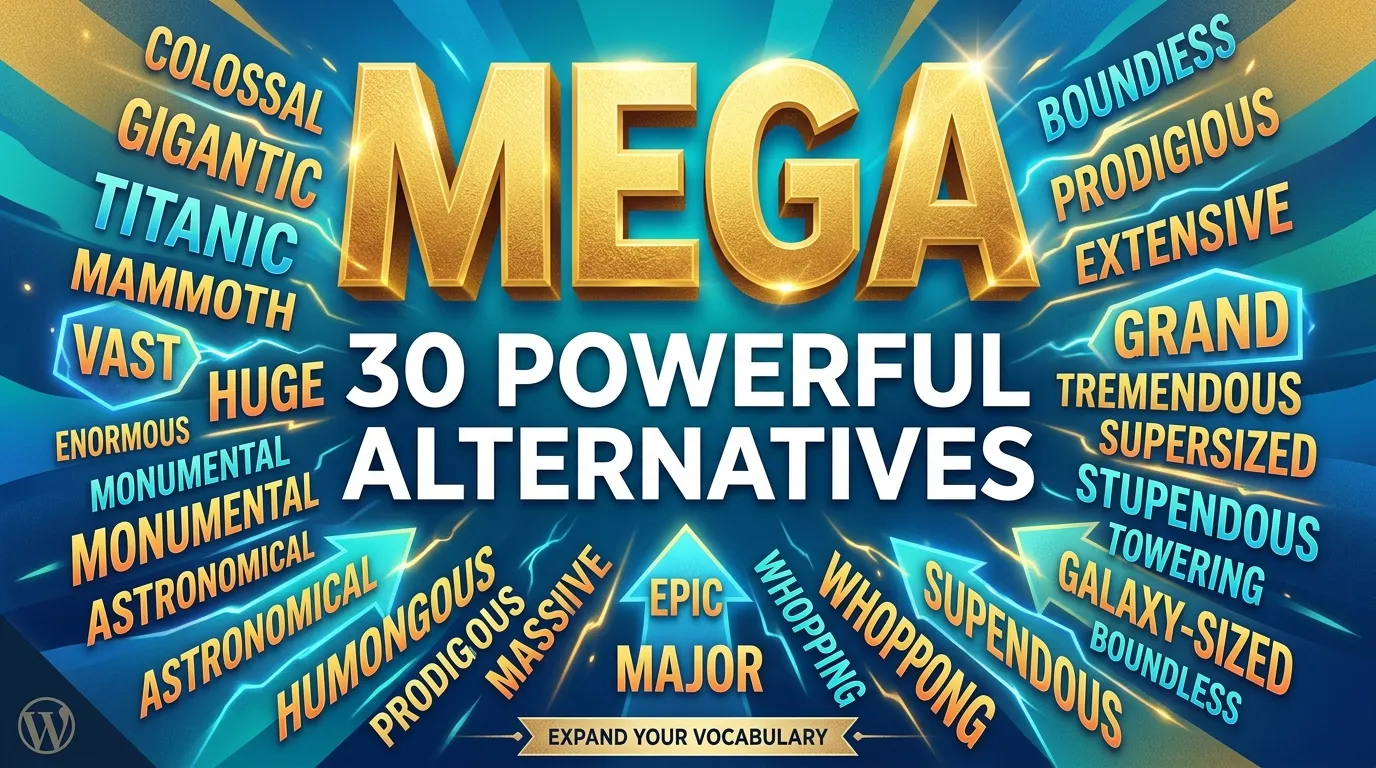
Mega means very large, powerful, impressive, or exciting. Imagine a friend saying, “That was a mega concert!” They mean the concert was not just good. It was huge, exciting, and memorable. The word mega is common in casual English because it is short, strong, and easy to use. It can describe things, events, success, size, or even a person’s level of excitement. Learning synonyms for mega helps English learners add variety to their speech and writing. It also helps content writers choose words that match the right tone. In this guide, we will explore the meaning of mega, its synonyms, examples, grammar, history, pronunciation, word formation, and semantic categories. By the end, you will know which alternative works best in different situations.
Meaning of Mega
Definition
Mega (Adjective / Combining Form):
Mega means extremely large, powerful, important, impressive, or exciting.
Examples
- She planned a mega birthday party for her brother.
- The company achieved mega success with its new product.
Connotative Meaning
Connotation: The feeling or idea that a word suggests beyond its basic meaning.
- Positive tone: Mega often suggests something exciting, impressive, successful, or powerful.
- Negative tone: In some contexts, mega can suggest something excessive, oversized, or too extreme.
- Neutral tone: It can simply describe something as very large or high in degree.
Etymology
The word mega comes from the Greek word megas, meaning “great” or “large.” It entered English through scientific and technical use as the metric prefix mega-, meaning one million. Later, informal English began using mega on its own to mean very large, powerful, or impressive.
- Old English (450 to 1100): Mega was not part of Old English. English instead used native words such as great and large.
- Middle English (1100 to 1500): Mega was still not a common English word. Words such as great, large, and huge carried similar meanings.
- Modern English (1500 to Present): Greek-derived mega- became important in scientific vocabulary. In modern informal English, mega developed as a standalone adjective meaning extremely large, impressive, or exciting.
Pronunciation (IPA)
- IPA: /ˈmeɡə/
- Syllables: meg-a
Affixation Pattern of Mega
- Root: meg- or mega- from Greek megas, meaning “great” or “large”
- Prefix: mega- when used as a combining form
- Suffix: None in the standalone word mega
- Word formations:
- megabyte: noun
- megawatt: noun
- megastore: noun
- megastar: noun
- megacity: noun
- megaphone: noun
- megahit: noun
- megaproject: noun
- megachurch: noun
- megatrend: noun
30 Synonyms of Mega With Meaning & Examples
1. Huge (Adjective)
Meaning: Very large in size, amount, or degree.
Examples:
- They live in a huge house.
- The project needs a huge amount of money.
2. Enormous (Adjective)
Meaning: Extremely large in size or quantity.
Examples:
- The company made an enormous profit.
- An enormous crowd filled the stadium.
3. Gigantic (Adjective)
Meaning: Extremely large and often much bigger than normal.
Examples:
- A gigantic ship entered the harbor.
- They built a gigantic shopping center.
4. Massive (Adjective)
Meaning: Very large, heavy, or important.
Examples:
- The building has a massive entrance.
- The project received massive public support.
5. Immense (Adjective)
Meaning: Extremely large or great.
Examples:
- The ocean looks immense from the shore.
- She felt immense joy after winning.
6. Colossal (Adjective)
Meaning: Extremely large or impressive.
Examples:
- The company faced a colossal challenge.
- A colossal statue stood in the center of the city.
7. Mammoth (Adjective)
Meaning: Extremely large and requiring great effort.
Examples:
- They began a mammoth construction project.
- Finishing the task was a mammoth job.
8. Tremendous (Adjective)
Meaning: Very great in size, strength, amount, or effect.
Examples:
- She has tremendous energy.
- The team achieved tremendous success.
9. Vast (Adjective)
Meaning: Very large in area, amount, or range.
Examples:
- The desert covers a vast area.
- The company has a vast customer base.
10. Great (Adjective)
Meaning: Large, important, or impressive.
Examples:
- The event was a great success.
- They made a great effort to help.
11. Major (Adjective)
Meaning: Very important, serious, or significant.
Examples:
- The company announced a major change.
- This was a major achievement.
12. Significant (Adjective)
Meaning: Important or large enough to have an effect.
Examples:
- The business saw a significant increase in sales.
- This discovery was significant for science.
13. Substantial (Adjective)
Meaning: Large in amount, size, or value.
Examples:
- The project requires a substantial investment.
- She made a substantial contribution.
14. Extraordinary (Adjective)
Meaning: Very unusual, impressive, or remarkable.
Examples:
- He showed extraordinary skill.
- The team achieved an extraordinary result.
15. Spectacular (Adjective)
Meaning: Extremely impressive or exciting to see.
Examples:
- The fireworks were spectacular.
- They enjoyed a spectacular performance.
16. Impressive (Adjective)
Meaning: Causing admiration because of quality, size, or achievement.
Examples:
- She gave an impressive presentation.
- The athlete achieved an impressive record.
17. Monumental (Adjective)
Meaning: Very important, large, or difficult.
Examples:
- The team made a monumental achievement.
- Building the bridge was a monumental task.
18. Outstanding (Adjective)
Meaning: Exceptionally good or impressive.
Examples:
- She delivered an outstanding speech.
- His performance was outstanding.
19. Phenomenal (Adjective)
Meaning: Extremely impressive or successful.
Examples:
- The singer enjoyed phenomenal success.
- The new product received phenomenal attention.
20. Exceptional (Adjective)
Meaning: Much better or greater than usual.
Examples:
- She has exceptional talent.
- The restaurant provides exceptional service.
21. Supreme (Adjective)
Meaning: Highest in degree, rank, or quality.
Examples:
- The athlete showed supreme confidence.
- The award recognizes supreme achievement.
22. Powerful (Adjective)
Meaning: Having great strength, influence, or effect.
Examples:
- The speech delivered a powerful message.
- The company has a powerful brand.
23. Dominant (Adjective)
Meaning: More powerful or influential than others.
Examples:
- The team became the dominant force in the league.
- The brand has a dominant position in the market.
24. Grand (Adjective)
Meaning: Large, impressive, or important in style or scale.
Examples:
- They held a grand celebration.
- The hotel has a grand entrance.
25. Monumental (Adjective)
Meaning: Extremely important, significant, or large.
Examples:
- The discovery was monumental.
- Completing the project was a monumental effort.
26. Astronomical (Adjective)
Meaning: Extremely large in amount, number, or degree.
Examples:
- The company faced astronomical costs.
- The website received an astronomical number of views.
27. Staggering (Adjective)
Meaning: So large or surprising that it is difficult to believe.
Examples:
- The project had a staggering price.
- The report showed a staggering increase in demand.
28. Outsized (Adjective)
Meaning: Larger or more important than normal.
Examples:
- The company had an outsized impact on the industry.
- He played an outsized role in the campaign.
29. Super-sized (Adjective)
Meaning: Made much larger than the normal size.
Examples:
- They ordered a super-sized meal.
- The store offers super-sized products.
30. Mega-scale (Adjective)
Meaning: Existing or operating on an extremely large scale.
Examples:
- The government launched a mega-scale infrastructure project.
- The company is planning a mega-scale expansion.
Prototype Meaning
The most typical meaning of mega is very large or extremely impressive. When people hear the word, they often imagine something far bigger, stronger, or more exciting than normal. For example, a mega event suggests a very large and important event, while mega success suggests an unusually high level of success.
Prototype Categorization
- Extreme size: huge, enormous, gigantic, massive, immense, colossal, mammoth, vast describe physical or measurable size.
- Great importance: major, significant, substantial, monumental, grand work well when something has strong importance or impact.
- Strong positive impact: tremendous, extraordinary, impressive, outstanding, phenomenal, exceptional are useful for praise and success.
- Power and influence: powerful, dominant, supreme focus more on strength, control, or status.
- Extreme amounts: astronomical, staggering, outsized are useful for unusually high numbers, costs, effects, or levels.
- Large-scale descriptions: super-sized and mega-scale focus on something being made or planned on an unusually large scale.
This grouping helps writers choose a synonym based on meaning. For example, huge fits physical size, phenomenal fits success, and astronomical fits an unusually high amount.
Antonyms of Mega
Small (Adjective)
Meaning: Not large in size or amount.
Tiny (Adjective)
Meaning: Extremely small.
Minor (Adjective)
Meaning: Less important or serious.
Limited (Adjective)
Meaning: Small in amount, size, or range.
Modest (Adjective)
Meaning: Not very large or impressive.
Insignificant (Adjective)
Meaning: Not important or meaningful.
Ordinary (Adjective)
Meaning: Normal and not special or exceptional.
Minimal (Adjective)
Meaning: Very small or as little as possible.
Short Questions and Answers
What does mega mean?
Mega usually means very large, extremely impressive, powerful, or exciting.
When should mega be used?
Use mega in informal or conversational English when you want to emphasize size, success, excitement, or importance. For formal writing, words such as enormous, substantial, or significant may be better.
Is mega positive or negative?
Mega is usually positive when it describes success, excitement, or impressive size. However, it can have a negative sense when something is excessively large or extreme.
How is mega different from similar words?
Mega is informal and flexible. Huge, enormous, and massive mainly describe size, while phenomenal, spectacular, and outstanding focus more on quality or impact.
Conclusion
Learning mega and its synonyms gives English learners more ways to describe size, success, power, and importance. Words such as huge, enormous, and massive are useful for size. Words like phenomenal, outstanding, and spectacular are better for praise and achievement. More formal choices such as significant, substantial, and extraordinary can improve professional and academic writing. Using different synonyms also helps avoid repetition and makes your writing more natural. The key is to choose a word that fits the exact meaning and tone of your sentence. Practice a few new synonyms each day, create your own examples, and use them in real conversations or writing. With regular practice, your vocabulary will grow and your English confidence will become stronger.
Related words: Synonyms For Terminated: 30 Powerful Alternatives

Content Editor & Language Researcher
Daniel Foster specializes in editing educational content and researching English language topics. He is committed to creating well-structured, reader-friendly articles that make learning easier.











1 thought on “Synonyms for Mega: 30 Powerful Alternatives”