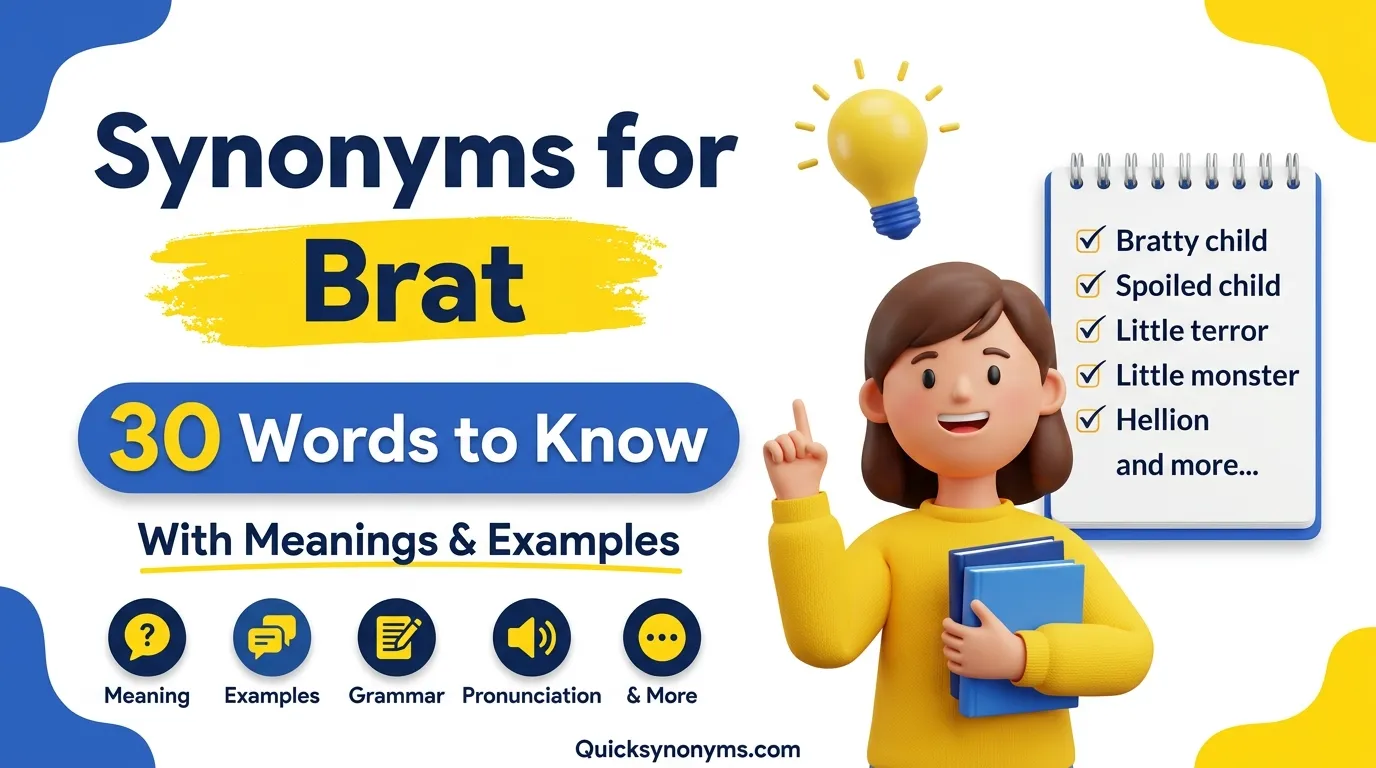
The word brat means a child who behaves badly, often by being rude, spoiled, selfish, or demanding. For example, a parent may call a child a brat after repeated tantrums or rude behavior.
Learning synonyms for brat helps English learners choose words that match the exact situation. Writers can also avoid repeating the same word and show different shades of meaning.
This article covers the meaning, examples, grammar, history, pronunciation, and 30 useful synonyms for brat. It also groups the words by meaning to make them easier to learn and use.
Meaning of Brat
Definition
Brat (noun): a child who behaves badly, especially by being rude, spoiled, or demanding.
Examples
- The spoiled child acted like a brat when he did not get the toy.
- Nobody wanted to babysit the little brat after his rude behavior.
Connotative Meaning
- Positive tone: Usually none, although it can sometimes be used playfully between people who know each other well.
- Negative tone: A badly behaved, spoiled, rude, or annoying child.
- Neutral tone: Rarely neutral because brat usually carries a negative feeling.
(Connotation: the emotional or cultural feeling a word carries beyond its literal meaning.)
Etymology
The exact history of brat is not fully certain. It first appeared in English with an older meaning connected to a child’s clothing or a ragged garment before developing its modern sense.
- Middle English: Brat referred to a coarse garment, rag, or piece of cloth.
- Early Modern English: The word began to be used for a child, often with a negative or dismissive feeling.
- Modern English: Brat commonly means a badly behaved, spoiled, or annoying child.
Pronunciation (IPA)
- IPA: /bræt/
- Syllables: brat
Affixation Pattern of Brat
- Root: brat
- Prefix: None
- Suffix: None
- Word formations:
- bratty (adjective): behaving like a brat
- brattiness (noun): the quality of being bratty
30 Synonyms of Brat: With Meaning and Examples
1. Bratty child (noun)
Meaning: A child who behaves in a spoiled or badly behaved way.
Examples:
- The bratty child refused to share his toys.
- Everyone noticed how the bratty child shouted at his parents.
2. Spoiled child (noun)
Meaning: A child who expects special treatment and gets upset when things do not go their way.
Examples:
- The spoiled child demanded another gift.
- Her spoiled child complained about the simple meal.
3. Little terror (noun)
Meaning: A child who causes trouble through difficult or wild behavior.
Examples:
- Their little terror ran through the restaurant.
- The little terror kept disturbing the other guests.
4. Little monster (noun)
Meaning: A child who behaves in a very troublesome or unpleasant way.
Examples:
- That little monster broke another toy.
- The little monster refused to listen to anyone.
5. Hellion (noun)
Meaning: A person, especially a child, who is very wild and difficult to control.
Examples:
- The young hellion raced around the house.
- That hellion never seemed to sit still.
6. Terror (noun)
Meaning: A person who causes a lot of trouble or difficulty.
Examples:
- The young terror emptied every drawer.
- Their little terror kept everyone busy.
7. Scamp (noun)
Meaning: A playful person who causes trouble, often without being seriously bad.
Examples:
- The little scamp hid his sister’s shoes.
- Everyone laughed when the young scamp appeared.
8. Rascal (noun)
Meaning: A mischievous person, especially a child, who causes minor trouble.
Examples:
- That young rascal took the cookies.
- The little rascal smiled after hiding the toy.
9. Imp (noun)
Meaning: A small, mischievous child who often causes trouble.
Examples:
- The little imp covered the table with crayons.
- That imp was always finding new ways to play tricks.
10. Mischief-maker (noun)
Meaning: A person who often causes trouble through playful or harmful actions.
Examples:
- The young mischief-maker moved all the chairs.
- Everyone knew the boy was a mischief-maker.
11. Troublemaker (noun)
Meaning: A person who regularly causes problems or trouble.
Examples:
- The troublemaker kept interrupting the class.
- Teachers warned the young troublemaker to behave.
12. Pest (noun)
Meaning: An annoying person who repeatedly causes irritation.
Examples:
- Her little brother can be a pest sometimes.
- The child became a pest during the long trip.
13. Nuisance (noun)
Meaning: A person or thing that causes annoyance or inconvenience.
Examples:
- The noisy child became a nuisance at the party.
- His constant shouting made him a nuisance.
14. Annoyance (noun)
Meaning: A person who repeatedly causes irritation.
Examples:
- The child became an annoyance during the meeting.
- His repeated interruptions made him an annoyance.
15. Menace (noun)
Meaning: A person who causes serious trouble or behaves in a threatening way.
Examples:
- The young menace knocked over the display.
- Everyone called the energetic boy a menace after the incident.
16. Hoodlum (noun)
Meaning: A person who behaves badly and causes trouble, usually in a more serious sense.
Examples:
- The older boy acted like a hoodlum in the neighborhood.
- Nobody wanted the young hoodlum near the shop.
17. Hooligan (noun)
Meaning: A person who behaves violently or causes public trouble.
Examples:
- The young hooligan damaged the park bench.
- Police warned the hooligan to stop causing trouble.
18. Delinquent (noun)
Meaning: A young person who repeatedly breaks rules or laws.
Examples:
- The delinquent was known for skipping school.
- The center worked with young delinquents.
19. Juvenile delinquent (noun)
Meaning: A young person who repeatedly commits offenses or breaks the law.
Examples:
- The program helps juvenile delinquents return to school.
- The court ordered support for the juvenile delinquent.
20. Scallywag (noun)
Meaning: A playful or mischievous person who causes trouble.
Examples:
- That little scallywag hid my keys.
- The young scallywag laughed at his harmless trick.
21. Rascality (noun)
Meaning: Mischievous behavior associated with a rascal.
Examples:
- His rascality made the family laugh.
- The child’s rascality was clear from his playful tricks.
22. Misbehaver (noun)
Meaning: A person who behaves badly or breaks expected rules.
Examples:
- The teacher spoke to the young misbehaver.
- The misbehaver was asked to leave the room.
23. Naughty child (noun)
Meaning: A child who behaves badly or does things they have been told not to do.
Examples:
- The naughty child refused to clean his room.
- Her naughty child drew on the wall.
24. Bad kid (noun)
Meaning: A child who often behaves badly or breaks rules.
Examples:
- The bad kid kept disturbing the class.
- Nobody expected the bad kid to follow the rules.
25. Problem child (noun)
Meaning: A child who frequently creates difficulties for parents, teachers, or others.
Examples:
- The school offered extra help to the problem child.
- Teachers tried different methods with the problem child.
26. Difficult child (noun)
Meaning: A child who is hard to manage or control.
Examples:
- He was a difficult child during his early years.
- The difficult child often refused simple requests.
27. Pestering child (noun)
Meaning: A child who repeatedly annoys or bothers others.
Examples:
- The pestering child kept asking for candy.
- A pestering child can make a long trip tiring.
28. Selfish child (noun)
Meaning: A child who cares mainly about their own wants or needs.
Examples:
- The selfish child refused to share the game.
- His selfish child demanded the best seat.
29. Whippersnapper (noun)
Meaning: A young person who is overly confident, disrespectful, or cheeky.
Examples:
- That young whippersnapper argued with everyone.
- The old man laughed at the confident whippersnapper.
30. Young rascal (noun)
Meaning: A young person who behaves mischievously or causes minor trouble.
Examples:
- The young rascal sneaked another cookie.
- Everyone smiled when the young rascal ran away laughing.
Prototype Meaning
The most typical meaning of brat is a child who is spoiled, rude, selfish, or difficult to control. People usually imagine a child who complains, demands things, refuses to listen, or throws tantrums.
Prototype Categorization
- Spoiled or badly behaved: bratty child, spoiled child, naughty child, bad kid, selfish child. Use these when the main issue is poor behavior, selfishness, or spoiled behavior.
- Mischievous and playful: scamp, rascal, imp, scallywag, young rascal, whippersnapper. Use these when the behavior is annoying or cheeky but not seriously harmful.
- Troublesome or annoying: little terror, little monster, terror, pest, nuisance, annoyance, difficult child, pestering child, problem child. Use these when the child repeatedly causes problems or irritation.
- Serious trouble: menace, hoodlum, hooligan, delinquent, juvenile delinquent, troublemaker, misbehaver. Use these when the behavior is more serious, disruptive, or rule-breaking.
- General negative labels: mischief-maker. Use this when someone often creates trouble through mischievous actions.
Grouping synonyms helps writers choose a word that matches the exact level of behavior. A playful word can sound softer, while a serious word can suggest much stronger trouble.
Antonyms of Brat
- Well-behaved child (noun): a child who behaves politely and follows rules.
- Angel (noun): a very good or gentle child.
- Good kid (noun): a child who behaves well.
- Gentle child (noun): a child who is calm and kind.
- Polite child (noun): a child who uses good manners.
- Obedient child (noun): a child who follows instructions.
- Model child (noun): a child whose behavior is seen as an example for others.
Short Questions and Answers
What does Brat mean?
Brat means a child who behaves badly, especially by being rude, spoiled, selfish, or demanding.
When should Brat be used?
Use brat when describing a child’s unpleasant or spoiled behavior. It is informal and usually carries a negative feeling.
Is Brat positive or negative?
Brat is usually negative. However, close friends or family members may sometimes use it playfully when talking about harmless mischief.
How is it different from similar words?
Brat usually suggests spoiled or demanding behavior. Scamp and rascal often suggest playful mischief, while troublemaker focuses more on a person’s habit of causing problems.
Conclusion
Learning brat and its synonyms gives English learners more ways to describe difficult, spoiled, playful, or mischievous behavior. Each word has its own level of meaning, so choosing the right one can make speech and writing more accurate.
These synonyms also help writers avoid repeating the same word. Understanding the difference between words such as brat, scamp, rascal, pest, and troublemaker makes vocabulary stronger and communication clearer.
Use these words in short sentences, conversations, and daily writing to remember them better. Regular vocabulary practice can build confidence and make your English more natural.
Related Synonym
You may also find these related words useful: synonyms for stingy, especially when describing someone who is unwilling to share or give.

Lexicographer & Vocabulary Specialist
Nathan Carter focuses on English vocabulary, synonyms, antonyms, and word meanings. He is passionate about producing clear, accurate, and easy-to-understand language guides for readers of all levels.


1 thought on “Synonyms for Brat: 30 Words to Know”