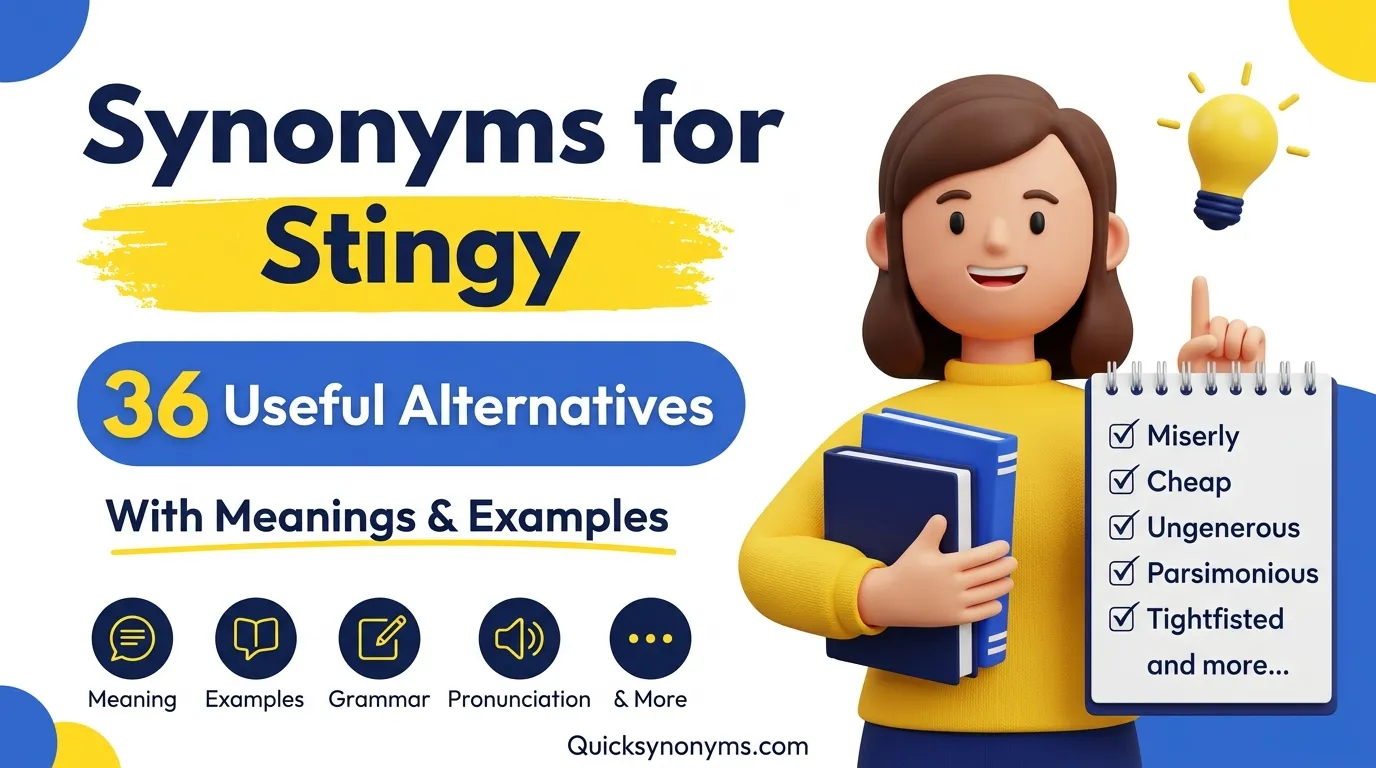
Common synonyms for stingy include miserly, cheap, ungenerous, parsimonious, tightfisted, and frugal. The best choice depends on whether you mean unwilling to spend, unwilling to share, or careful with money.
Stingy describes someone who does not like to spend, give, or share money or resources. Imagine a friend who always avoids paying their fair share at dinner, even when they can afford it. You might call that person stingy.
The word is common because it clearly describes a lack of generosity. Learning synonyms helps English learners and content writers express the same idea with more precision and less repetition. Some alternatives sound stronger, while others can be more neutral or even positive.
In this article, you will learn the meaning of stingy and 36 useful synonyms with simple examples. We will also look at its grammar, history, pronunciation, word formation, connotations, and semantic categories.
Meaning of Stingy
Definition
Stingy (Adjective): Unwilling to spend, give, or share money or resources freely.
Examples
- My stingy neighbor never shares anything with others.
- He was too stingy to leave a reasonable tip.
Connotative Meaning
Positive tone: Stingy is rarely positive, but it may sometimes suggest being very careful about spending.
Negative tone: Stingy usually suggests selfishness, unwillingness to share, or an unfair lack of generosity.
Neutral tone: In a neutral description, it can simply describe someone who spends or gives very little.
(Connotation: the feeling or idea that a word suggests beyond its basic meaning.)
Etymology
Stingy comes from the word sting, with the suffix -y. The word developed in Modern English to describe someone who is reluctant to spend or give money.
- Old English (450–1100): The related word sting existed in Old English as stingan, meaning “to prick” or “to pierce.” The adjective stingy was not yet used with its modern meaning.
- Middle English (1100–1500): Forms related to sting continued to refer mainly to piercing or causing pain. The modern adjective stingy had not yet developed.
- Modern English (1500–Present): Stingy developed from sting plus -y and came to describe someone who is excessively unwilling to spend or give.
Pronunciation (IPA)
- IPA: /ˈstɪn.dʒi/
- Syllables: sting-y
Affixation Pattern of Stingy
- Root: sting
- Prefix: None
- Suffix: -y
- Word formations:
- sting (verb/noun)
- stingy (adjective)
- stinginess (noun)
- stingily (adverb)
- stinging (adjective/participle)
- stung (past tense/past participle of sting)
36 Synonyms of Stingy: With Meaning & Examples
1. Miserly (Adjective)
Meaning: Unwilling to spend or give money, even when it is reasonable to do so.
Examples:
- His miserly habits annoyed his family.
- The miserly manager refused to replace the broken equipment.
2. Cheap (Adjective)
Meaning: Unwilling to spend money or give enough money when needed.
Examples:
- He is too cheap to buy a proper gift.
- Being cheap can sometimes hurt your relationships.
3. Ungenerous (Adjective)
Meaning: Not willing to give, share, or help generously.
Examples:
- Her ungenerous response surprised everyone.
- The company was ungenerous with employee benefits.
4. Parsimonious (Adjective)
Meaning: Extremely careful about spending or using money and resources.
Examples:
- His parsimonious approach saved the business money.
- The parsimonious owner rarely approved new purchases.
5. Tightfisted (Adjective)
Meaning: Unwilling to spend or give money.
Examples:
- The tightfisted landlord refused to fix the heater.
- Everyone knew him as a tightfisted businessman.
6. Penny-pinching (Adjective)
Meaning: Extremely careful about spending even small amounts of money.
Examples:
- His penny-pinching habits became frustrating.
- The penny-pinching company cut even small expenses.
7. Closefisted (Adjective)
Meaning: Unwilling to spend or give money.
Examples:
- The closefisted owner rejected every request for extra funds.
- Her closefisted nature was well known.
8. Scant (Adjective)
Meaning: Very small in amount and not enough for what is needed.
Examples:
- The workers received scant financial support.
- The charity survived on scant resources.
9. Ingrateful (Adjective)
Meaning: Unwilling to give or provide what is reasonably expected.
Examples:
- The ingrateful employer offered little support.
- His ingrateful response disappointed the team.
10. Illiberal (Adjective)
Meaning: Unwilling to give or share freely.
Examples:
- The illiberal policy limited financial support.
- His illiberal attitude made cooperation difficult.
11. Mean (Adjective)
Meaning: Unwilling to spend, give, or share what could reasonably be given.
Examples:
- It was mean of him not to contribute.
- She thought her boss was mean with money.
12. Skinflint (Noun)
Meaning: A person who strongly dislikes spending or giving money.
Examples:
- Everyone joked that their uncle was a skinflint.
- The old skinflint refused to replace his worn-out shoes.
13. Scrooge (Noun)
Meaning: A person known for being extremely unwilling to spend or share money.
Examples:
- Don’t be a Scrooge during the holidays.
- Everyone called the wealthy owner a Scrooge.
14. Miser (Noun)
Meaning: A person who loves keeping money and hates spending it.
Examples:
- The miser kept his savings locked away.
- People viewed the wealthy man as a miser.
15. Niggardly (Adjective)
Meaning: Giving or spending very little and being unwilling to be generous.
Examples:
- The organization provided a niggardly allowance.
- His niggardly contribution was disappointing.
16. Stingy-handed (Adjective)
Meaning: Unwilling to give or spend money generously.
Examples:
- The stingy-handed donor gave almost nothing.
- His stingy-handed approach frustrated the group.
17. Sparing (Adjective)
Meaning: Using or giving only a small amount of something.
Examples:
- The manager was sparing with financial support.
- She was sparing with her praise and rewards.
18. Economical (Adjective)
Meaning: Careful to avoid wasting money or resources.
Examples:
- He is economical when buying household items.
- An economical approach helped reduce costs.
19. Frugal (Adjective)
Meaning: Careful about spending money and avoiding waste.
Examples:
- My parents taught me to be frugal.
- She lives a frugal but comfortable life.
20. Thrifty (Adjective)
Meaning: Good at using money carefully and avoiding unnecessary spending.
Examples:
- My thrifty aunt always finds good deals.
- Being thrifty helped him save for a house.
21. Scrimping (Adjective)
Meaning: Trying to save money by spending as little as possible.
Examples:
- They were scrimping on food to save money.
- His scrimping habits became too extreme.
22. Inexpensive (Adjective)
Meaning: Low in price or costing little money.
Examples:
- We found an inexpensive hotel nearby.
- She prefers inexpensive meals during travel.
23. Tight (Adjective)
Meaning: Unwilling to spend or part with money.
Examples:
- He is very tight with his money.
- Her father was tight when it came to household expenses.
24. Tightwad (Noun)
Meaning: A person who dislikes spending money.
Examples:
- My brother is such a tightwad.
- The tightwad refused to pay for delivery.
25. Cheapskate (Noun)
Meaning: A person who avoids spending money or paying a fair amount.
Examples:
- Don’t be a cheapskate at dinner.
- Everyone laughed when he acted like a cheapskate.
26. Spendthrift-averse (Adjective)
Meaning: Strongly opposed to spending money freely.
Examples:
- His spendthrift-averse attitude shaped the family budget.
- She is spendthrift-averse and avoids unnecessary purchases.
27. Uncharitable (Adjective)
Meaning: Unwilling to give help, money, or support to others.
Examples:
- His uncharitable attitude hurt the volunteers.
- The decision seemed uncharitable to struggling families.
28. Injudiciously frugal (Adjective)
Meaning: Excessively careful with money in a way that is not sensible.
Examples:
- He was injudiciously frugal with essential repairs.
- Her injudiciously frugal choices caused bigger problems later.
29. Penurious (Adjective)
Meaning: Extremely unwilling to spend or give money.
Examples:
- The penurious owner refused to invest in repairs.
- His penurious behavior upset his employees.
30. Close (Adjective)
Meaning: Unwilling to spend money or give things freely.
Examples:
- He is very close with his money.
- The close employer rarely offered bonuses.
31. Illiberal with money (Adjective)
Meaning: Unwilling to spend or give money generously.
Examples:
- The owner was illiberal with money.
- She was illiberal with financial rewards.
32. Mean-spirited (Adjective)
Meaning: Unkind or selfish in a way that may include refusing to give or share.
Examples:
- His mean-spirited refusal upset the child.
- That was a mean-spirited way to handle the request.
33. Reluctant to give (Adjective phrase)
Meaning: Unwilling to give money, help, or resources freely.
Examples:
- The sponsor was reluctant to give more money.
- He is reluctant to give anything away.
34. Reluctant to spend (Adjective phrase)
Meaning: Unwilling to use money even when spending may be reasonable.
Examples:
- She is reluctant to spend money on luxury items.
- He is reluctant to spend on unnecessary upgrades.
35. Ungiving (Adjective)
Meaning: Unwilling to give, share, or provide something.
Examples:
- His ungiving nature made teamwork difficult.
- The ungiving donor offered little assistance.
36. Parsimonious-minded (Adjective)
Meaning: Having a strong tendency to avoid spending or giving resources.
Examples:
- His parsimonious-minded approach affected the project.
- The parsimonious-minded owner rejected useful investments.
Prototype Meaning
The most typical meaning of stingy is being unwilling to spend or share money. When people hear the word, they often imagine someone who has enough but still refuses to pay, give, or contribute a reasonable amount. Unlike frugal, which can describe a sensible habit, stingy usually carries a negative feeling.
Prototype Categorization
The synonyms for stingy fall into several useful groups:
- Strong unwillingness to spend: miserly, parsimonious, tightfisted, closefisted, penurious, tight, penny-pinching, tightwad, and cheapskate describe strong resistance to spending money.
- Lack of generosity: ungenerous, uncharitable, ungiving, illiberal, and reluctant to give focus on refusing to give or share.
- Extreme saving: frugal, thrifty, economical, and sparing can describe careful spending. These words are often more neutral or positive than stingy.
- People who are stingy: miser, skinflint, Scrooge, tightwad, and cheapskate are nouns used for people.
- Negative behavior: mean, mean-spirited, and niggardly can emphasize the unpleasant or selfish side of refusing to give.
- Limited amounts: scant and inexpensive focus more on small amounts or low cost than on a person’s character.
This categorization helps writers choose a word that matches the exact situation instead of using stingy for every type of careful spending.
Antonyms of Stingy
- Generous (Adjective): Willing to give or share freely.
- Charitable (Adjective): Willing to give help or money to people in need.
- Giving (Adjective): Willing to give time, money, or support.
- Liberal (Adjective): Willing to give freely or in large amounts.
- Benevolent (Adjective): Kind and willing to help others.
- Openhanded (Adjective): Very generous in giving money or help.
- Lavish (Adjective): Giving or spending freely and generously.
Short Questions and Answers
What does stingy mean?
Stingy means unwilling to spend, give, or share money or resources freely.
When should stingy be used?
Use stingy when you want to describe someone who gives or spends less than is reasonably expected. It usually has a negative tone.
Is stingy positive or negative?
Stingy is usually negative because it often suggests a lack of generosity. In some contexts, it may simply describe someone who is extremely careful with money.
How is stingy different from similar words?
Stingy often suggests an unreasonable lack of generosity. Frugal and thrifty usually describe careful spending in a more positive way, while miserly and parsimonious often suggest more extreme behavior.
Conclusion
Learning stingy and its synonyms can make your English more precise and flexible. Words such as miserly, ungenerous, parsimonious, tightfisted, and frugal can express different shades of meaning. Some focus on money, while others focus on generosity or careful spending.
Using the right synonym also makes writing and speaking stronger. It helps you avoid repeating the same word and lets you describe people and situations more clearly. Remember that frugal can sound positive, while stingy usually sounds negative.
Make vocabulary practice part of your daily routine. Learn a few new words, write your own example sentences, and use them in real conversations. With regular practice, you can build a richer vocabulary and speak and write English with greater confidence.
Discover More: Synonyms for Emotional Intelligence: 35 Words to Know

Senior English Language Expert
Eleanor Brooks specializes in English grammar, vocabulary, and word usage. She enjoys simplifying complex language concepts and creating practical resources that help learners write and speak with confidence.








2 thoughts on “Synonyms for Stingy: 36 Useful Alternatives”