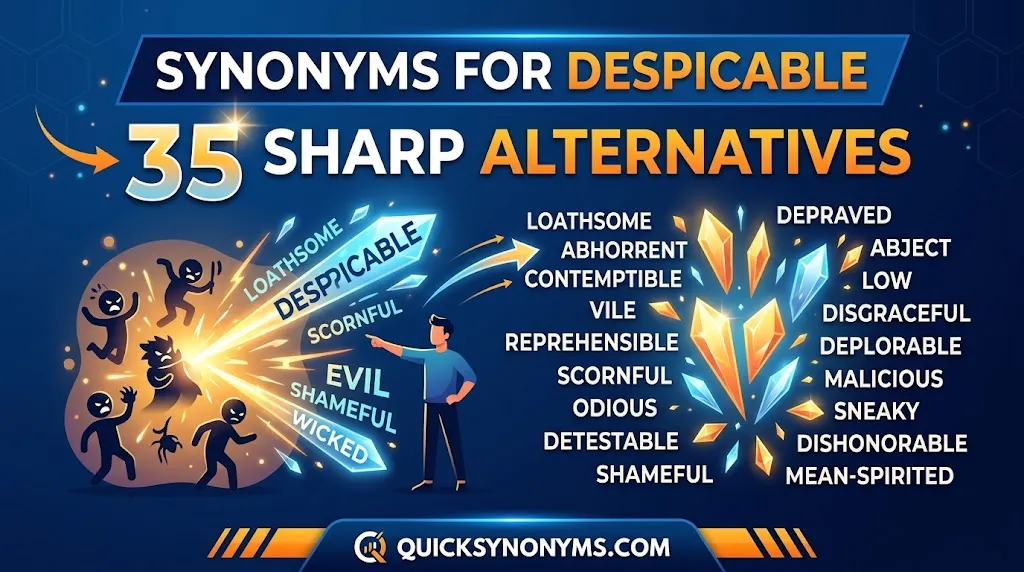
Some useful synonyms for despicable are contemptible, vile, wicked, shameful, disgraceful, dishonorable, reprehensible, heinous, immoral, and abhorrent.
Despicable describes someone or something that is extremely bad, shameful, or unworthy of respect. Imagine a person who cheats an honest customer and feels no regret. You might call that behavior despicable because it shows a serious lack of honesty and moral care.
The word is common when people strongly condemn cruel, dishonest, or unfair actions. Still, using the same word again and again can make your English sound repetitive.
Learning synonyms for despicable gives English learners more ways to express strong disapproval. It also helps content writers choose words that match the exact level of criticism they want to show.
In this guide, we will explore the meaning of despicable and 35 useful synonyms with examples. We will also cover its grammar, history, pronunciation, word formation, semantic categories, and common antonyms.
Meaning of Despicable
Definition
Despicable (Adjective):
Something or someone that is extremely bad, dishonest, cruel, or unworthy of respect.
Examples
- His despicable behavior shocked everyone at the meeting.
- Stealing from vulnerable people is a despicable act.
Connotative Meaning
Connotation: The feeling or idea that a word suggests beyond its basic meaning.
- Positive tone: Despicable is not normally positive.
- Negative tone: It strongly suggests moral failure, shame, cruelty, or dishonesty.
- Neutral tone: It can be used as a direct description, but it almost always carries a strong negative judgment.
Etymology
The word despicable comes from Latin despicere, meaning “to look down upon” or “to despise.” It developed through French before entering English.
- Old English (450–1100): The modern word despicable was not commonly used in Old English. English speakers used native words related to shame, scorn, and disgrace.
- Middle English (1100–1500): French and Latin vocabulary greatly influenced English. Words related to despise and despicable began entering English through French and learned Latin forms.
- Modern English (1500–Present): Despicable became established as an adjective meaning worthy of contempt, especially because of bad or immoral behavior.
The word is closely connected with despise, which comes from the same Latin root.
Pronunciation (IPA)
- IPA: /dɪˈspɪkəbəl/
- Syllables: des-pi-ca-ble
Affixation Pattern of Despicable
- Root: spec / spic, connected with the idea of looking or seeing
- Prefix: de-, historically connected with a downward or negative sense
- Suffix: -able, meaning “capable of” or “worthy of”
- Word formations:
- despicable – adjective
- despise – verb
- despised – verb/adjective
- despising – verb/noun
- despicably – adverb
- despicability – noun
35 Synonyms of Despicable With Meaning & Examples
1. Contemptible (Adjective)
Meaning: Deserving strong dislike or lack of respect.
Examples:
- His contemptible actions hurt many innocent people.
- Lying to someone who trusts you is contemptible.
2. Vile (Adjective)
Meaning: Extremely unpleasant, evil, or morally bad.
Examples:
- The criminal was known for his vile behavior.
- She made a vile remark about her colleague.
3. Wicked (Adjective)
Meaning: Morally wrong, evil, or intentionally harmful.
Examples:
- The story describes a wicked ruler.
- It was wicked to take advantage of the poor.
4. Shameful (Adjective)
Meaning: Causing a strong feeling of shame or embarrassment.
Examples:
- His treatment of the workers was shameful.
- Cheating in such a serious competition is shameful.
5. Disgraceful (Adjective)
Meaning: So bad that it causes loss of respect or honor.
Examples:
- The team’s behavior was disgraceful.
- It was disgraceful to abandon the injured animal.
6. Dishonorable (Adjective)
Meaning: Showing a lack of honesty, fairness, or moral principles.
Examples:
- He was criticized for his dishonorable actions.
- Breaking the agreement was dishonorable.
7. Reprehensible (Adjective)
Meaning: Deserving strong criticism because it is morally wrong.
Examples:
- The company was fined for reprehensible conduct.
- Such treatment of children is reprehensible.
8. Heinous (Adjective)
Meaning: Extremely evil or shocking.
Examples:
- The judge described the crime as heinous.
- The attack was a heinous act of violence.
9. Immoral (Adjective)
Meaning: Not following accepted moral standards.
Examples:
- Many people considered his actions immoral.
- It is immoral to deceive people for personal gain.
10. Abhorrent (Adjective)
Meaning: Extremely hateful or unacceptable.
Examples:
- Cruelty toward animals is abhorrent to many people.
- His racist comments were abhorrent.
11. Detestable (Adjective)
Meaning: Extremely unpleasant or deserving intense dislike.
Examples:
- His selfish behavior was detestable.
- They found the dishonest practice detestable.
12. Odious (Adjective)
Meaning: Extremely unpleasant, hateful, or offensive.
Examples:
- The dictator became known for his odious policies.
- His odious behavior made people avoid him.
13. Despised (Adjective)
Meaning: Strongly disliked or hated by others.
Examples:
- He became a despised figure in the community.
- The despised leader eventually lost power.
14. Loathsome (Adjective)
Meaning: So unpleasant or offensive that it causes strong disgust.
Examples:
- The villain committed several loathsome acts.
- His loathsome behavior shocked his friends.
15. Abominable (Adjective)
Meaning: Extremely bad, unpleasant, or morally offensive.
Examples:
- The prisoners suffered under abominable conditions.
- His treatment of the workers was abominable.
16. Atrocious (Adjective)
Meaning: Extremely cruel, terrible, or unacceptable.
Examples:
- The soldiers were accused of atrocious acts.
- The service at the restaurant was atrocious.
17. Evil (Adjective)
Meaning: Morally very bad and harmful.
Examples:
- The novel features an evil character.
- He believed the plan was deeply evil.
18. Corrupt (Adjective)
Meaning: Dishonest or morally wrong, especially because of personal gain.
Examples:
- The corrupt official accepted illegal payments.
- The investigation exposed a corrupt system.
19. Sinful (Adjective)
Meaning: Contrary to religious or moral rules.
Examples:
- The character believed his actions were sinful.
- He regretted his sinful behavior.
20. Criminal (Adjective)
Meaning: Related to or involving serious behavior that breaks the law.
Examples:
- The court punished his criminal actions.
- The investigation uncovered criminal activity.
21. Inexcusable (Adjective)
Meaning: Too bad or wrong to be accepted or forgiven.
Examples:
- His treatment of the child was inexcusable.
- Ignoring the warning was inexcusable.
22. Unforgivable (Adjective)
Meaning: So wrong that it seems impossible to forgive.
Examples:
- Betraying his closest friend felt unforgivable.
- The attack was considered unforgivable by the community.
23. Deplorable (Adjective)
Meaning: Shockingly bad or deserving strong criticism.
Examples:
- The workers were living in deplorable conditions.
- His behavior during the crisis was deplorable.
24. Base (Adjective)
Meaning: Morally low, dishonorable, or lacking good qualities.
Examples:
- He used base methods to win the argument.
- The politician was accused of base behavior.
25. Mean (Adjective)
Meaning: Unkind, selfish, or deliberately hurtful.
Examples:
- That was a mean thing to say.
- His mean behavior upset his classmates.
26. Nasty (Adjective)
Meaning: Very unpleasant, cruel, or offensive.
Examples:
- He made a nasty comment about her appearance.
- The argument became nasty very quickly.
27. Foul (Adjective)
Meaning: Morally offensive, unfair, or extremely unpleasant.
Examples:
- The player was criticized for using foul tactics.
- His foul language offended the audience.
28. Monstrous (Adjective)
Meaning: Extremely cruel, shocking, or unnatural.
Examples:
- The attack was described as a monstrous crime.
- It was monstrous to harm innocent people.
29. Barbaric (Adjective)
Meaning: Extremely cruel and lacking civilized behavior.
Examples:
- The prisoners were subjected to barbaric treatment.
- The practice was condemned as barbaric.
30. Inhuman (Adjective)
Meaning: Extremely cruel and lacking normal human kindness.
Examples:
- The victims suffered inhuman treatment.
- Such conditions are completely inhuman.
31. Heartless (Adjective)
Meaning: Showing no sympathy or kindness toward others.
Examples:
- His heartless decision left many families without support.
- It was heartless to ignore their suffering.
32. Callous (Adjective)
Meaning: Showing little concern for other people’s feelings or suffering.
Examples:
- His callous response made the situation worse.
- The manager was criticized for his callous attitude.
33. Ruthless (Adjective)
Meaning: Willing to hurt or defeat others without showing pity.
Examples:
- The ruthless leader removed every rival.
- The company used ruthless tactics to eliminate competition.
34. Unscrupulous (Adjective)
Meaning: Willing to act dishonestly to achieve a goal.
Examples:
- An unscrupulous seller may trick inexperienced buyers.
- The company was accused of using unscrupulous methods.
35. Despicable (Adjective)
Meaning: Extremely bad or morally offensive and therefore deserving contempt.
Examples:
- His despicable actions destroyed the family’s trust.
- Exploiting vulnerable people for money is despicable.
Prototype Meaning
The most typical meaning of despicable is morally very bad and deserving strong contempt. When people hear this word, they often imagine someone acting cruelly, dishonestly, selfishly, or unfairly while showing little concern for others. It is a strong word, so it usually describes behavior that goes far beyond a simple mistake or minor disagreement.
Prototype Categorization
The 35 words above can be grouped by their strongest shades of meaning. This helps writers select a synonym that fits the exact situation instead of using every word as a perfect replacement.
- Strong Moral Condemnation: contemptible, reprehensible, despicable, detestable, odious, abhorrent. These words focus on behavior that deserves strong disapproval.
- Extreme Evil or Cruelty: vile, wicked, heinous, evil, monstrous, barbaric, inhuman. These are useful when an action is extremely cruel or shocking.
- Dishonesty and Corruption: dishonorable, corrupt, unscrupulous, criminal, base. These words work well when the behavior involves cheating, corruption, or a lack of principles.
- Shame and Disgrace: shameful, disgraceful, deplorable, inexcusable, unforgivable. These words emphasize conduct that brings shame or cannot reasonably be accepted.
- Disgust and Offensiveness: loathsome, abominable, atrocious, foul, nasty. These words highlight behavior that is deeply unpleasant or offensive.
- Lack of Sympathy: heartless, callous, ruthless, mean. These synonyms focus more on a person’s lack of kindness, pity, or concern.
- Moral or Religious Wrongdoing: immoral, sinful. These words are useful when the action violates moral or religious standards.
- General Strong Disapproval: despised, wicked, detestable, despicable. These can describe people, actions, attitudes, or ideas that are strongly rejected.
This categorization helps writers avoid repetition and choose a word with the right emotional strength. For example, callous highlights a lack of sympathy, while heinous suggests extreme evil.
Antonyms of Despicable
1. Admirable (Adjective)
Meaning: Deserving respect, approval, or praise.
2. Respectable (Adjective)
Meaning: Considered worthy of respect and approval.
3. Honorable (Adjective)
Meaning: Showing strong moral principles and integrity.
4. Virtuous (Adjective)
Meaning: Having or showing high moral standards.
5. Noble (Adjective)
Meaning: Showing excellent moral qualities or unselfish behavior.
6. Good (Adjective)
Meaning: Morally right, kind, or beneficial.
7. Kind (Adjective)
Meaning: Caring and considerate toward others.
8. Compassionate (Adjective)
Meaning: Showing concern for people who are suffering.
9. Ethical (Adjective)
Meaning: Following accepted moral principles.
10. Respectful (Adjective)
Meaning: Showing consideration and respect toward others.
Short Questions and Answers
What does despicable mean?
Despicable means extremely bad, cruel, dishonest, or morally offensive and therefore deserving strong contempt.
When should despicable be used?
Use despicable when you want to strongly condemn a person, action, attitude, or behavior. It is stronger than simple words such as bad or unkind.
Is despicable positive or negative?
Despicable is strongly negative. It expresses serious disapproval and often suggests that someone or something is morally unacceptable.
How is it different from similar words?
Despicable is a broad word for behavior that deserves contempt. Heinous is usually stronger and is often used for extremely evil crimes. Callous focuses on a lack of sympathy, while unscrupulous focuses on dishonest or unethical behavior.
Conclusion
Learning despicable and its synonyms can make your English more precise and expressive. Instead of repeating one strong word, you can choose alternatives such as contemptible, vile, reprehensible, heinous, or callous based on the situation.
These words also help you show different shades of meaning. Some focus on cruelty, while others highlight dishonesty, shame, selfishness, or a lack of compassion.
A strong vocabulary improves both writing and speaking. It helps you communicate your ideas clearly and avoid simple repetition. For English learners and content writers, knowing these differences can also build confidence when choosing the right word.
Try learning a few synonyms each day and use them in your own sentences. With regular practice, words like despicable will become easier to understand and use naturally.
Explore More Synonyms: Synonyms for Considerate: 34 Better Words to Use

Senior English Language Expert
Eleanor Brooks specializes in English grammar, vocabulary, and word usage. She enjoys simplifying complex language concepts and creating practical resources that help learners write and speak with confidence.







1 thought on “Synonyms for Despicable: 35 Sharp Alternatives”