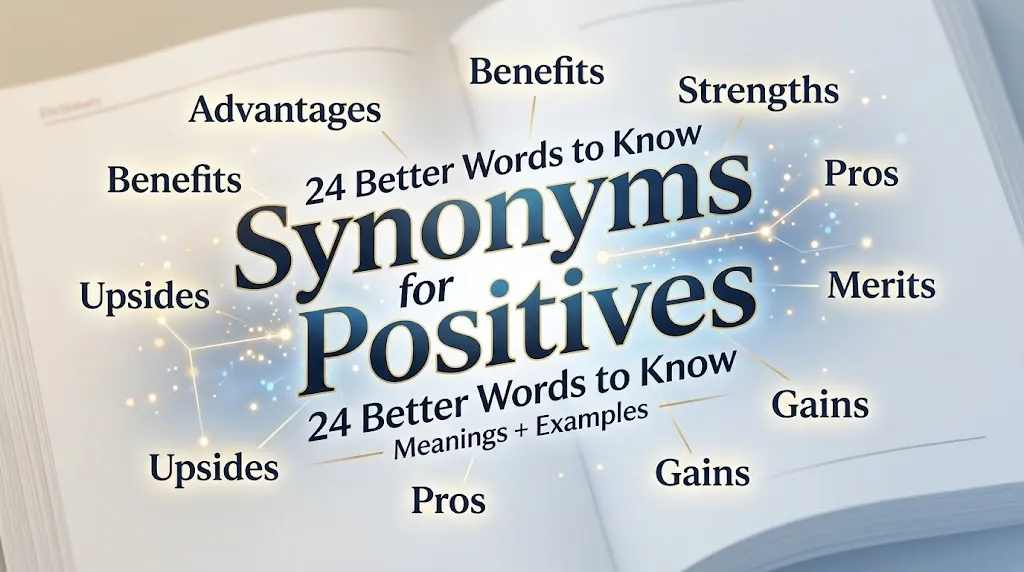
Common synonyms for positives include benefits, advantages, strengths, merits, gains, virtues, good points, assets, pluses, and favorable aspects.
Positives are the good, useful, or favorable parts of something. For example, when someone talks about a new job, they may mention the positives, such as good pay, flexible hours, and friendly coworkers. The word is common because people often want to focus on what is good about a person, choice, event, or situation.
Learning synonyms for positives helps English learners use more varied vocabulary. It also helps content writers avoid repeating the same word in articles, reviews, reports, and everyday conversations. Some alternatives work better in formal writing, while others sound more natural in casual speech. In this guide, you will learn the meaning of positives, its history, pronunciation, word formation, and 40 useful synonyms with clear examples and semantic categories.
Meaning of Positives
Definition
Positives (Noun, plural):
Positives are the good, helpful, useful, or favorable aspects of a person, thing, situation, or decision.
Examples
- The positives of working from home include flexibility and comfort.
- We discussed the positives and negatives of the new plan.
Connotative Meaning
Connotation (the feeling or idea a word suggests beyond its basic meaning) refers to the emotional meaning connected with a word.
- Positive tone: The word usually has a favorable and encouraging tone.
- Negative tone: The word itself is not negative, but it can appear when discussing problems or comparing good and bad points.
- Neutral tone: In an objective discussion, positives simply means favorable aspects or good points.
Etymology
The word positives comes from positive, which comes from Latin positivus, meaning “placed,” “settled,” or “affirmed.” It developed through French and entered English with meanings connected to something definite, certain, or favorable.
- Old English (450–1100): The modern word positive was not directly used in Old English, although related ideas were expressed through native words meaning certain, good, or definite.
- Middle English (1100–1500): Positive entered English through Anglo-French and Old French from Latin positivus. It could refer to something definite, established, or explicitly stated.
- Modern English (1500–Present): The word developed several meanings, including favorable, useful, optimistic, definite, and affirmative. The noun positive later came to describe a good point or favorable aspect, with positives referring to more than one.
Pronunciation (IPA)
- IPA: /ˈpɒz.ɪ.tɪvz/
- Syllables: pos-i-tives
- Stress: The first syllable is stressed.
Affixation Pattern of Positives
- Root: posit
- Prefix: None in the modern word positives
- Suffix: -ive forms the adjective positive, while -s marks the plural form.
- Word formations:
- posit (verb): to state or put forward an idea
- position (noun): a place, role, or viewpoint
- positive (adjective): favorable, certain, or affirmative
- positively (adverb): in a favorable or affirmative way
- positivity (noun): the quality of being positive
- positiveness (noun): the quality of being positive
- positives (plural noun): favorable points or aspects
40 Synonyms of Positives With Meaning & Examples
1. Benefits (Noun)
Meaning: Benefits are helpful results or advantages gained from something.
Examples:
- The benefits of exercise include better health.
- We discussed the benefits of the new system.
2. Advantages (Noun)
Meaning: Advantages are conditions that make something better or more useful.
Examples:
- One advantage of this job is flexible working hours.
- The plan has several advantages for small businesses.
3. Strengths (Noun)
Meaning: Strengths are good qualities or areas where someone or something performs well.
Examples:
- Communication is one of her main strengths.
- The report clearly explains the strengths of the product.
4. Merits (Noun)
Meaning: Merits are good qualities or features that make something worthy of approval.
Examples:
- The proposal has several merits.
- We should consider the merits of this approach.
5. Gains (Noun)
Meaning: Gains are improvements or valuable results obtained from something.
Examples:
- The company made significant gains this year.
- The new policy brought gains for local workers.
6. Virtues (Noun)
Meaning: Virtues are good qualities, especially moral or admirable ones.
Examples:
- Patience is one of his greatest virtues.
- The book discusses the virtues of honesty.
7. Pluses (Noun)
Meaning: Pluses are good features or favorable points.
Examples:
- The low price is one of the product’s biggest pluses.
- There are several pluses to living in a small town.
8. Good Points (Noun)
Meaning: Good points are favorable features or qualities.
Examples:
- The good points of the plan are easy to understand.
- She explained the good points of the proposal.
9. Assets (Noun)
Meaning: Assets are valuable qualities, resources, or features.
Examples:
- Her creativity is a major asset to the team.
- The company’s strong reputation is an important asset.
10. Upsides (Noun)
Meaning: Upsides are the favorable parts or benefits of a situation.
Examples:
- The main upside is the shorter travel time.
- There are several upsides to this decision.
11. Strengths (Noun)
Meaning: Strengths are qualities that give someone or something an advantage.
Examples:
- His leadership skills are clear strengths.
- The study identifies the strengths of the current system.
12. Favorable Aspects (Noun)
Meaning: Favorable aspects are parts of something that produce a good impression or result.
Examples:
- We considered the favorable aspects of the agreement.
- The review focuses on the product’s favorable aspects.
13. Good Qualities (Noun)
Meaning: Good qualities are desirable characteristics or traits.
Examples:
- Kindness and honesty are good qualities.
- The interview revealed many of her good qualities.
14. Advantages (Noun)
Meaning: Advantages are useful features that give someone or something an edge.
Examples:
- Experience gives him an advantage in the competition.
- The system has clear advantages over older models.
15. Improvements (Noun)
Meaning: Improvements are changes that make something better.
Examples:
- The update brought several improvements.
- We noticed major improvements in performance.
16. Successes (Noun)
Meaning: Successes are favorable results or achievements.
Examples:
- The project had many successes.
- Her recent successes increased her confidence.
17. Achievements (Noun)
Meaning: Achievements are successful results gained through effort.
Examples:
- Completing the project was a major achievement.
- His achievements impressed the entire team.
18. Accomplishments (Noun)
Meaning: Accomplishments are things successfully completed or achieved.
Examples:
- Her accomplishments include several major awards.
- The report lists the team’s accomplishments.
19. Rewards (Noun)
Meaning: Rewards are valuable or favorable results received for effort or action.
Examples:
- Hard work often brings rewards.
- The rewards of learning a language can last a lifetime.
20. Opportunities (Noun)
Meaning: Opportunities are favorable chances to do, achieve, or gain something.
Examples:
- The new job offers many opportunities.
- Education can create better opportunities.
21. Pros (Noun)
Meaning: Pros are the favorable points of a choice or situation.
Examples:
- We listed the pros before making a decision.
- The pros of this plan outweigh the costs.
22. Good Sides (Noun)
Meaning: Good sides are the favorable parts of a person, situation, or thing.
Examples:
- Every situation has good sides.
- We should look at the good sides of the change.
23. Favorable Features (Noun)
Meaning: Favorable features are characteristics that make something appealing or useful.
Examples:
- The phone has several favorable features.
- Its favorable features make it popular with students.
24. Strong Points (Noun)
Meaning: Strong points are qualities or features that are especially good.
Examples:
- Reliability is one of the car’s strong points.
- Her strong points include creativity and organization.
25. Good Features (Noun)
Meaning: Good features are useful or attractive parts of something.
Examples:
- The software has many good features.
- Speed is one of its best features.
26. Positive Aspects (Noun)
Meaning: Positive aspects are parts of something that have a good or useful effect.
Examples:
- We focused on the positive aspects of the experience.
- The teacher explained the positive aspects of the change.
27. Favorable Points (Noun)
Meaning: Favorable points are details that support a positive view of something.
Examples:
- The review mentions several favorable points.
- Cost and quality are favorable points of the product.
28. Assets (Noun)
Meaning: Assets are valuable qualities or resources that provide an advantage.
Examples:
- Her experience is an asset to the organization.
- Good communication skills are valuable assets.
29. Gains (Noun)
Meaning: Gains are positive changes, benefits, or increases.
Examples:
- The company reported financial gains.
- The treatment produced noticeable gains.
30. Boons (Noun)
Meaning: Boons are things that are very helpful or beneficial.
Examples:
- The internet has been a boon for education.
- The new road was a boon to local businesses.
31. Blessings (Noun)
Meaning: Blessings are things that bring happiness, help, or good fortune.
Examples:
- Good health is one of life’s greatest blessings.
- She considers her family a blessing.
32. Opportunities for Growth (Noun)
Meaning: Opportunities for growth are favorable chances to improve or develop.
Examples:
- The job provides opportunities for growth.
- The company gives employees many opportunities for growth.
33. Highlights (Noun)
Meaning: Highlights are the most notable or enjoyable parts of something.
Examples:
- The highlights of the trip included a visit to the museum.
- She shared the highlights of her week.
34. Good Results (Noun)
Meaning: Good results are successful or favorable outcomes.
Examples:
- The new strategy produced good results.
- Regular practice can lead to good results.
35. Favorable Outcomes (Noun)
Meaning: Favorable outcomes are results that are beneficial or desirable.
Examples:
- The negotiations ended with favorable outcomes.
- Careful planning can produce favorable outcomes.
36. Upsides (Noun)
Meaning: Upsides are benefits or good parts of an otherwise mixed situation.
Examples:
- One upside of remote work is greater flexibility.
- There are clear upsides to learning another language.
37. Strengths and Benefits (Noun)
Meaning: Strengths and benefits are useful qualities and favorable results.
Examples:
- The article explains the strengths and benefits of the program.
- We compared the strengths and benefits of both options.
38. Advantages and Benefits (Noun)
Meaning: Advantages and benefits are favorable features and useful results.
Examples:
- The guide explains the advantages and benefits of exercise.
- Customers can enjoy several advantages and benefits.
39. Favorable Results (Noun)
Meaning: Favorable results are outcomes that are successful, useful, or desirable.
Examples:
- The experiment produced favorable results.
- The team was pleased with the favorable results.
40. Good Outcomes (Noun)
Meaning: Good outcomes are results that are positive or beneficial.
Examples:
- The discussion led to good outcomes.
- Better planning often creates good outcomes.
Prototype Meaning
The most typical meaning of positives is the good or favorable parts of something. When people hear this word, they usually think about benefits, advantages, strengths, or good points. For example, if someone asks about the positives of a new job, they usually expect to hear about salary, flexibility, career growth, coworkers, or other useful features.
Prototype Categorization
The synonyms for positives can be grouped by their main meaning. This helps writers choose a word that matches the exact context instead of using the same word repeatedly.
- Benefits and Advantages: benefits, advantages, gains, upsides, boons, rewards. These words focus on useful results or things that make a situation better.
- Strength and Quality: strengths, merits, virtues, assets, strong points, good qualities. These words work well when discussing desirable characteristics.
- Good Features: good points, good features, favorable features, favorable aspects, positive aspects, favorable points. These are useful for reviews, comparisons, and descriptions.
- Success and Achievement: successes, achievements, accomplishments, improvements, good results, favorable results, good outcomes. These words focus on successful results or progress.
- Chances and Development: opportunities, opportunities for growth. These describe favorable chances for future improvement.
- Casual Alternatives: pluses, pros, good sides, highlights, upsides. These are useful in conversational or less formal writing.
- Positive Results and Effects: favorable outcomes, gains, rewards, benefits, good outcomes. These emphasize what happens as a result of an action or decision.
This categorization helps writers select precise vocabulary. For example, merits may suit formal writing, while pluses sounds more casual. Strengths works well for people and organizations, while benefits is often better for products, services, and actions.
Antonyms of Positives
Negatives (Noun)
Meaning: Negatives are unfavorable parts, problems, or disadvantages.
Drawbacks (Noun)
Meaning: Drawbacks are features or conditions that make something less useful or desirable.
Disadvantages (Noun)
Meaning: Disadvantages are conditions that place someone or something in a less favorable position.
Weaknesses (Noun)
Meaning: Weaknesses are areas where someone or something is less strong or effective.
Problems (Noun)
Meaning: Problems are difficulties or unwanted situations that need attention.
Cons (Noun)
Meaning: Cons are unfavorable points considered when making a decision.
Limitations (Noun)
Meaning: Limitations are restrictions that reduce what something can do.
Faults (Noun)
Meaning: Faults are flaws or defects in a person, product, system, or idea.
Short Questions and Answers
What does positives mean?
Positives means the good, useful, favorable, or desirable parts of something.
When should Positives be used?
Use positives when talking about the good points of a person, decision, experience, product, plan, or situation. It is common in both everyday and professional English.
Is Positives positive or negative?
Positives has a positive meaning because it refers to favorable aspects. However, it is often used alongside words such as negatives, drawbacks, or problems when comparing both sides.
How is it different from similar words?
Positives is a broad term for good aspects. Benefits usually focuses on useful results, advantages focuses on an edge over something else, strengths focuses on strong qualities, and merits often sounds more formal.
Conclusion
Learning positives and its synonyms can make your English clearer and more flexible. Instead of repeating the same word, you can use alternatives such as benefits, advantages, strengths, merits, and upsides based on the context. This can make your writing and speaking sound more natural.
Understanding these differences is useful for students, content writers, bloggers, and professionals. Try to learn a few new synonyms each day and use them in your own sentences. With regular practice, you can build a stronger vocabulary, avoid repetition, and feel more confident when using English.
Explore More Vocabulary: Synonyms for Outdoors: 18 Natural Alternatives.

Content Editor & Language Researcher
Daniel Foster specializes in editing educational content and researching English language topics. He is committed to creating well-structured, reader-friendly articles that make learning easier.







2 thoughts on “Synonyms for Positives: 40 Words to Boost Your Vocabulary”