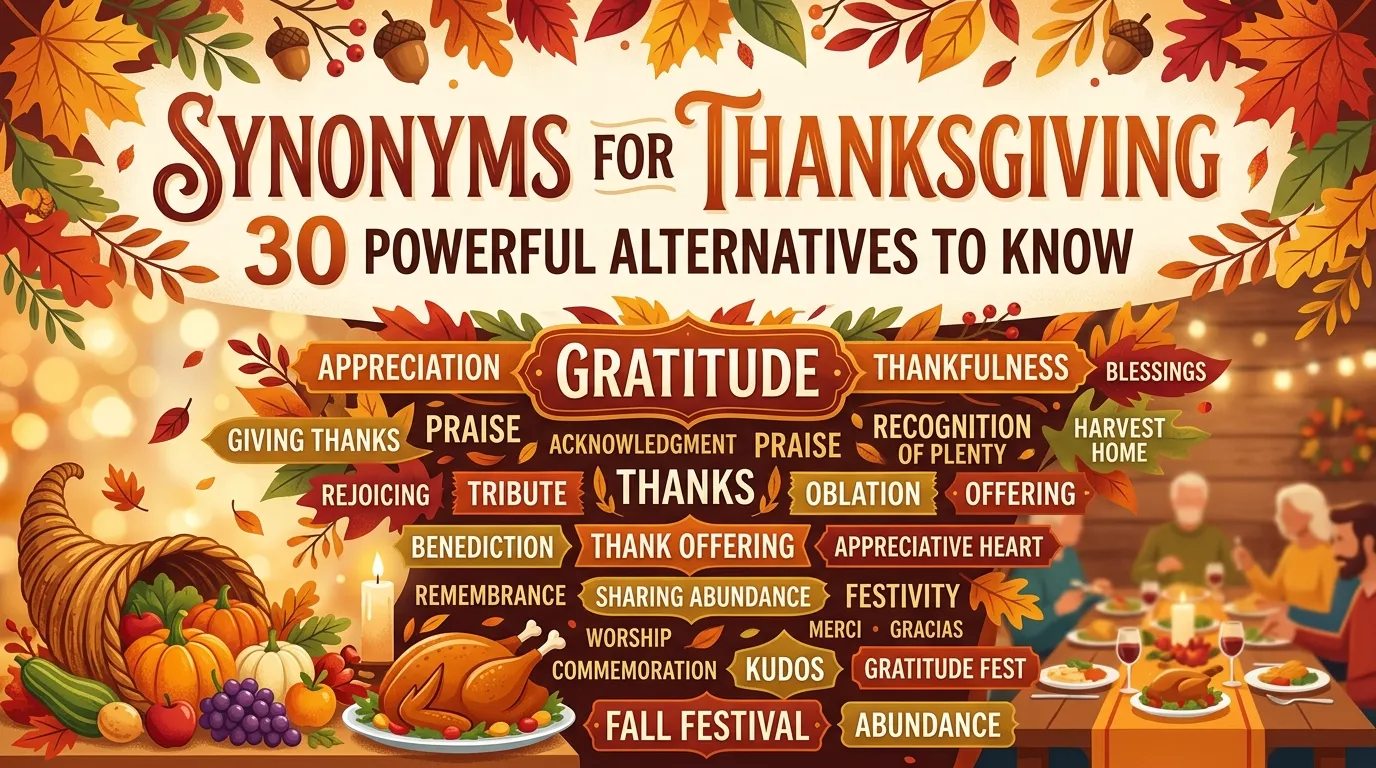
Thanksgiving means the act of showing thanks or expressing gratitude. It can also refer to a special holiday, especially the U.S. holiday celebrated with family, food, and traditions. For example, a family may gather for Thanksgiving, share a meal, and say what they are thankful for. The word is common because people often need to talk about gratitude, appreciation, celebration, and giving thanks. Learning synonyms for Thanksgiving helps English learners understand small differences in meaning and choose words that fit each situation. It also helps content writers avoid repetition and make their writing more natural. In this article, we will explore the meaning of Thanksgiving, its examples, connotations, history, pronunciation, word formation, and 30 related synonyms and alternatives. We will also group these words by meaning so you can choose the best one for each context.
Meaning of Thanksgiving
Definition
Thanksgiving (Noun):
Thanksgiving means the expression or feeling of thanks and gratitude. It can also mean a holiday or religious service held to give thanks.
Examples
- We gathered around the table for Thanksgiving.
- She offered thanksgiving for her family’s good health.
Connotative Meaning
Connotation (the feeling or idea that a word suggests beyond its basic meaning):
- Positive tone: Thanksgiving suggests gratitude, joy, family, kindness, and appreciation.
- Negative tone: The word itself is not normally negative, but it may have a negative tone when discussing conflict, exclusion, or difficult historical issues connected with the holiday.
- Neutral tone: In formal or religious writing, thanksgiving can simply mean an act or expression of giving thanks.
Etymology
Thanksgiving is a compound word formed from thank and giving.
- Old English (450–1100): Thank comes from Old English þanc, meaning thought, gratitude, or thanks. Giving comes from the verb giefan, meaning to give.
- Middle English (1100–1500): Forms related to thank and give developed into words closer to modern English. Expressions involving giving thanks became common in religious and everyday language.
- Modern English (1500–Present): Thanksgiving became established as a word for an act of giving thanks. It later became strongly associated with religious observance and, especially in American English, the annual Thanksgiving holiday.
Pronunciation (IPA)
- IPA: /ˌθæŋksˈɡɪvɪŋ/
- Syllables: thanks-giv-ing
Affixation Pattern of Thanksgiving
- Root: thank and give
- Prefix: None
- Suffix: -ing appears in giving and forms a present participle/gerund.
- Word formations:
- thank — noun/verb
- thankful — adjective
- thankfully — adverb
- thankfulness — noun
- thanksgiving — noun
- give — verb
- giving — noun/adjective/verb form
- giver — noun
- thanksgiving — compound noun
30 Synonyms of Thanksgiving With Meaning & Examples
1. Gratitude (Noun)
Meaning: A strong feeling of being thankful and appreciative.
Examples:
- She expressed gratitude for her family’s support.
- His gratitude was clear in his kind words.
2. Thankfulness (Noun)
Meaning: The feeling of being thankful for something.
Examples:
- He showed thankfulness for the opportunity.
- Her thankfulness made everyone smile.
3. Appreciation (Noun)
Meaning: Recognition of the value or goodness of someone or something.
Examples:
- The manager showed appreciation for the team’s hard work.
- We expressed our appreciation with a small gift.
4. Thanks (Noun)
Meaning: Words or actions used to show that you are grateful.
Examples:
- She gave her thanks to everyone who helped.
- Many thanks for your kindness.
5. Gratification (Noun)
Meaning: A feeling of pleasure or satisfaction from something received or achieved.
Examples:
- He felt gratification after helping his community.
- The award gave her a sense of gratification.
6. Recognition (Noun)
Meaning: An acknowledgment of someone’s value, effort, or contribution.
Examples:
- The award was recognition of her service.
- He received recognition for his generosity.
7. Acknowledgment (Noun)
Meaning: An expression that recognizes or accepts something.
Examples:
- The speaker gave an acknowledgment to the volunteers.
- Her acknowledgment of their help was sincere.
8. Praise (Noun)
Meaning: Words that express approval or admiration.
Examples:
- The teacher gave praise to the students.
- He received praise for his kindness.
9. Tribute (Noun)
Meaning: An expression of respect, admiration, or appreciation.
Examples:
- The event was a tribute to community workers.
- They paid tribute to their late teacher.
10. Honor (Noun)
Meaning: Great respect or recognition given to someone.
Examples:
- The ceremony was held in honor of the volunteers.
- They gathered to honor their parents.
11. Celebration (Noun)
Meaning: A special event or activity held to mark something important or joyful.
Examples:
- The family held a celebration after the ceremony.
- Thanksgiving is a major family celebration.
12. Feast (Noun)
Meaning: A large and special meal, often prepared for a celebration.
Examples:
- The family prepared a feast for Thanksgiving.
- Guests enjoyed a traditional feast together.
13. Commemoration (Noun)
Meaning: An event or act that remembers and honors something important.
Examples:
- The ceremony was a commemoration of the historic event.
- The town held a commemoration each year.
14. Observance (Noun)
Meaning: The practice of following a tradition, holiday, or religious event.
Examples:
- The family follows a quiet Thanksgiving observance.
- The religious observance included prayers of thanks.
15. Holiday (Noun)
Meaning: A special day set aside for celebration, remembrance, or rest.
Examples:
- Thanksgiving is an important holiday in the United States.
- Many people travel during the holiday.
16. Gathering (Noun)
Meaning: A meeting of people, often for a social purpose.
Examples:
- The Thanksgiving gathering included several generations.
- We enjoyed a family gathering at home.
17. Reunion (Noun)
Meaning: A meeting of people who have been apart for some time.
Examples:
- Thanksgiving became a family reunion.
- The cousins planned a reunion during the holiday.
18. Fellowship (Noun)
Meaning: Friendly companionship and a sense of community.
Examples:
- The meal created a feeling of fellowship.
- They enjoyed fellowship with friends and neighbors.
19. Communion (Noun)
Meaning: A shared relationship, connection, or spiritual fellowship.
Examples:
- The ceremony created a sense of spiritual communion.
- They gathered in communion with their community.
20. Blessing (Noun)
Meaning: Something considered a gift, benefit, or source of happiness.
Examples:
- Good health is a great blessing.
- She counted her family among her blessings.
21. Grace (Noun)
Meaning: A prayer or expression of thanks, especially before a meal.
Examples:
- The family said grace before dinner.
- He offered a short grace at the table.
22. Benediction (Noun)
Meaning: A blessing or prayer given at the end of a religious service.
Examples:
- The service ended with a benediction.
- The minister offered a peaceful benediction.
23. Prayer (Noun)
Meaning: Words spoken or thought to communicate with God or express spiritual feelings.
Examples:
- They began the meal with a prayer of thanks.
- Her prayer expressed gratitude for her family.
24. Devotion (Noun)
Meaning: Deep love, loyalty, or commitment to a person, cause, or faith.
Examples:
- Her devotion to her family was clear.
- The ceremony reflected their devotion and gratitude.
25. Thank-offering (Noun)
Meaning: A gift or offering given as an expression of thanks.
Examples:
- The family made a thank-offering after the successful harvest.
- The tradition included a thank-offering to the community.
26. Appreciation Ceremony (Noun Phrase)
Meaning: An event held to recognize and thank people.
Examples:
- The school held an appreciation ceremony for its teachers.
- The volunteers attended an appreciation ceremony.
27. Gratitude Gathering (Noun Phrase)
Meaning: A gathering focused on sharing thanks and appreciation.
Examples:
- The group organized a gratitude gathering.
- Their gratitude gathering brought neighbors together.
28. Harvest Festival (Noun Phrase)
Meaning: A celebration connected with a successful harvest and appreciation for food or nature.
Examples:
- The village held a harvest festival in autumn.
- Families attended the annual harvest festival.
29. Day of Thanks (Noun Phrase)
Meaning: A day set aside for expressing gratitude.
Examples:
- The community celebrated a day of thanks.
- They treated the event as a day of thanks and reflection.
30. Giving Thanks (Verb Phrase)
Meaning: The act of expressing gratitude.
Examples:
- The family spent the evening giving thanks.
- Giving thanks can help people focus on what matters.
Prototype Meaning
The most typical meaning of Thanksgiving is a special time for expressing gratitude and sharing a meal with family or friends. When people hear the word, they often imagine a holiday gathering, a large meal, family traditions, gratitude, and time spent together. In religious contexts, they may instead think of prayer or an expression of thanks to God.
Prototype Categorization
The 30 alternatives above can be grouped into several semantic categories:
- Direct gratitude words: gratitude, thankfulness, appreciation, thanks, and giving thanks directly express the idea of being thankful.
- Recognition and respect: recognition, acknowledgment, praise, tribute, and honor focus on recognizing someone’s value or contribution.
- Celebration and social events: celebration, feast, holiday, gathering, reunion, and harvest festival describe the social and festive side of Thanksgiving.
- Religious and spiritual terms: fellowship, communion, blessing, grace, benediction, prayer, and devotion fit religious or spiritual contexts.
- Formal remembrance: commemoration and observance are useful when discussing official, cultural, or traditional events.
- Gifts and appreciation: thank-offering and appreciation ceremony emphasize giving something or formally recognizing others.
- General gratitude experiences: gratification, gratitude gathering, and day of thanks can describe broader experiences of appreciation.
This categorization helps writers choose a word based on the exact meaning they want. For example, gratitude works well for an emotion, while feast focuses on food and observance emphasizes tradition.
Antonyms of Thanksgiving
1. Ingratitude (Noun)
Meaning: Lack of appreciation or thankfulness.
2. Thanklessness (Noun)
Meaning: Failure to show thanks or appreciation.
3. Unappreciation (Noun)
Meaning: A lack of recognition or appreciation.
4. Indifference (Noun)
Meaning: Lack of interest, concern, or feeling.
5. Disregard (Noun)
Meaning: Lack of attention, care, or respect.
Short Questions and Answers
What does Thanksgiving mean?
Thanksgiving means expressing thanks or gratitude. It can also refer to a holiday or religious observance centered on giving thanks.
When should Thanksgiving be used?
Use Thanksgiving when talking about gratitude, a formal or religious act of giving thanks, or the Thanksgiving holiday.
Is Thanksgiving positive or negative?
Thanksgiving normally has a positive connotation because it is connected with gratitude, appreciation, family, generosity, and celebration.
How is it different from similar words?
Thanksgiving can describe both the act of giving thanks and a specific holiday. Gratitude usually describes the feeling of being thankful, while appreciation often means recognizing the value of someone or something.
Conclusion
Learning Thanksgiving and its related words can make your English stronger and more flexible. Words such as gratitude, appreciation, thankfulness, celebration, feast, honor, and fellowship each highlight a different part of the idea. Some focus on the feeling of being thankful, while others describe family gatherings, religious practices, meals, or formal recognition. Knowing these differences helps you avoid repetition and select the right word for your writing and speech. It also makes your vocabulary more precise and natural. English learners can build confidence by practicing these words in short sentences and real conversations. Content writers can use them to create clearer and more engaging articles. Try learning a few new words each day and use them in your own sentences.
Related Words: Synonyms for good that start with b: 30 Best Words

Lexicographer & Vocabulary Specialist
Nathan Carter focuses on English vocabulary, synonyms, antonyms, and word meanings. He is passionate about producing clear, accurate, and easy-to-understand language guides for readers of all levels.