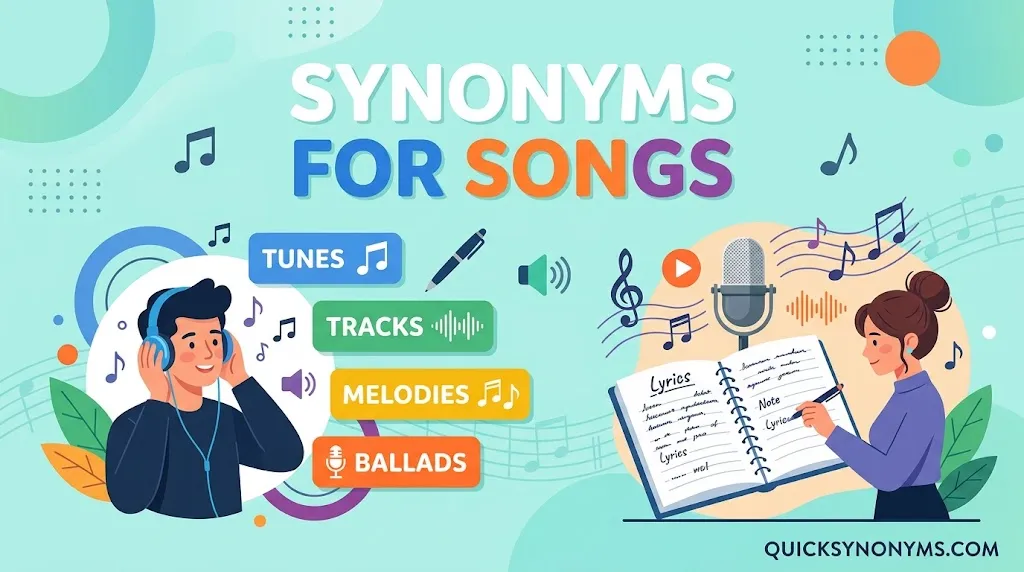
Common synonyms for songs include tunes, tracks, melodies, compositions, pieces, ballads, anthems, hymns, chants, and numbers.
Songs are musical works made to be sung, often with words and a melody. Imagine a group of friends sitting together and playing their favorite songs. They may call them tunes, tracks, or musical pieces. The word “songs” is common because it can describe many kinds of music, from a simple children’s song to a famous pop hit.
Learning synonyms for songs helps English learners speak and write with more variety. Content writers can also use the right alternative to avoid repeating the same word. In this guide, we explore the meaning of songs and 40 useful synonyms with simple examples. We also cover grammar, word history, pronunciation, word formation, emotional meaning, and semantic groups. These details can help you choose the best word for each musical situation.
Meaning of Songs
Definition
Songs (Noun): Musical compositions, usually containing words and a melody, that are sung or intended to be sung.
Examples
- We listened to our favorite songs during the long drive.
- The singer performed three new songs at the concert.
Connotative Meaning
Connotation: The feelings, ideas, or emotions that a word suggests beyond its basic meaning.
- Positive tone: Songs can suggest joy, love, celebration, memories, and creativity.
- Negative tone: In some contexts, songs may suggest sadness, grief, protest, or painful memories.
- Neutral tone: Songs can simply refer to musical works without expressing a particular feeling.
Etymology
The word song has a long history in English and is closely related to the verb sing.
- Old English (450–1100): Song came from Old English sang, meaning a song, singing, or act of singing.
- Middle English (1100–1500): The word developed into forms such as song and continued to mean a piece of music or something sung.
- Modern English (1500–Present): Song became the standard English word for a musical composition, while its meaning expanded across folk, classical, religious, popular, and many other musical styles.
Pronunciation (IPA)
- IPA: /sɔːŋz/
- Syllables: songs
Affixation Pattern of Songs
- Root: song
- Prefix: None
- Suffix: -s, the plural suffix
- Word formations:
- song (noun): a musical composition
- songs (noun, plural): more than one song
- songful (adjective): full of song or singing
- songster (noun): a singer or person who sings
- songbook (noun): a book containing songs
- songwriter (noun): a person who writes songs
- songwriting (noun): the activity of writing songs
- songbird (noun): a bird known for its singing
40 Synonyms of Songs, With Meaning & Examples
1. Tunes (Noun)
Meaning: Musical pieces, especially ones with a memorable melody.
Examples:
- The radio played several catchy tunes.
- She knows many traditional tunes.
2. Tracks (Noun)
Meaning: Individual recorded pieces of music on an album or collection.
Examples:
- My favorite track is the third one.
- The artist released five new tracks.
3. Melodies (Noun)
Meaning: Sequences of musical notes that form the main musical line.
Examples:
- The composer created beautiful melodies.
- I remember the melodies from my childhood.
4. Compositions (Noun)
Meaning: Complete pieces of music created by a composer or songwriter.
Examples:
- The musician performed several original compositions.
- Her compositions combine classical and modern sounds.
5. Pieces (Noun)
Meaning: Individual works of music.
Examples:
- The pianist played several beautiful pieces.
- These pieces are difficult to perform.
6. Ballads (Noun)
Meaning: Songs that usually tell a story or express strong emotions.
Examples:
- The singer performed two romantic ballads.
- Old ballads often tell stories of love and loss.
7. Anthems (Noun)
Meaning: Powerful songs associated with a group, country, event, or cause.
Examples:
- The fans sang the team’s anthem.
- The song became an anthem for a generation.
8. Hymns (Noun)
Meaning: Religious songs used for worship or praise.
Examples:
- The congregation sang several hymns.
- She learned traditional hymns at school.
9. Chants (Noun)
Meaning: Repeated words or sounds spoken or sung in a rhythmic way.
Examples:
- The crowd started loud chants.
- The monks performed ancient chants.
10. Numbers (Noun)
Meaning: Individual musical performances or pieces, especially in a show.
Examples:
- The band performed six numbers.
- Her final number received a standing ovation.
11. Airs (Noun)
Meaning: Melodies or songs, especially in traditional or formal music.
Examples:
- The musician played old Irish airs.
- She sang a beautiful folk air.
12. Lieder (Noun)
Meaning: Art songs, especially German songs for voice and piano.
Examples:
- The recital included several famous Lieder.
- He studied German Lieder at the conservatory.
13. Carols (Noun)
Meaning: Traditional songs, especially those connected with Christmas or celebration.
Examples:
- Children sang Christmas carols.
- The church was filled with familiar carols.
14. Serenades (Noun)
Meaning: Songs or pieces performed as an expression of love or affection.
Examples:
- The musician played romantic serenades.
- Old serenades were often performed outside a lover’s home.
15. Odes (Noun)
Meaning: Songs or poems that strongly praise someone or something.
Examples:
- The artist created odes to nature.
- The album contains several odes to freedom.
16. Ditties (Noun)
Meaning: Short, simple, and often light-hearted songs.
Examples:
- He sang a funny little ditty.
- The children enjoyed the cheerful ditties.
17. Rounds (Noun)
Meaning: Songs in which different people begin singing the same melody at different times.
Examples:
- The children sang several rounds.
- “Frère Jacques” is a well-known round.
18. Choruses (Noun)
Meaning: Repeated sections of a song, or songs performed by a group.
Examples:
- The audience joined in the choruses.
- The song has a memorable chorus.
19. Verses (Noun)
Meaning: Sections of a song containing lines that develop its message or story.
Examples:
- The singer changed the final verses.
- Each verse tells another part of the story.
20. Refrains (Noun)
Meaning: Repeated lines or sections in a song.
Examples:
- The refrain is easy to remember.
- Everyone joined in the familiar refrain.
21. Musical Works (Noun)
Meaning: Created pieces of music considered as artistic works.
Examples:
- The museum displayed several famous musical works.
- His musical works span many decades.
22. Vocal Pieces (Noun)
Meaning: Musical works written for singing voices.
Examples:
- The concert featured several vocal pieces.
- She performed three difficult vocal pieces.
23. Recordings (Noun)
Meaning: Captured versions of music or performances.
Examples:
- I found old recordings of the band’s songs.
- These recordings sound surprisingly clear.
24. Hits (Noun)
Meaning: Songs that become very popular or successful.
Examples:
- The singer performed her biggest hits.
- Several of their songs became international hits.
25. Singles (Noun)
Meaning: Songs released individually rather than only as part of an album.
Examples:
- The artist released two new singles.
- Her latest single reached the charts.
26. Releases (Noun)
Meaning: New pieces or recordings of music made available to the public.
Examples:
- The band’s latest releases gained attention.
- I always follow new music releases.
27. Numbers (Noun)
Meaning: Musical performances or sections presented as part of a show.
Examples:
- The musical featured several lively numbers.
- Her solo number was the highlight of the evening.
28. Lullabies (Noun)
Meaning: Gentle songs sung to help children fall asleep.
Examples:
- Her mother sang lullabies at bedtime.
- The album contains soft lullabies for children.
29. Spirituals (Noun)
Meaning: Religious songs that developed especially within African American communities.
Examples:
- The choir performed traditional spirituals.
- Spirituals remain an important part of American musical history.
30. Folk Songs (Noun)
Meaning: Traditional songs associated with a particular community or culture.
Examples:
- We learned several folk songs at school.
- The collection preserves old folk songs.
31. Love Songs (Noun)
Meaning: Songs about romantic love, relationships, or affection.
Examples:
- She enjoys listening to classic love songs.
- The album contains several emotional love songs.
32. Pop Songs (Noun)
Meaning: Songs made in the popular music style and intended for a broad audience.
Examples:
- The radio plays many modern pop songs.
- These pop songs have catchy melodies.
33. Soundtracks (Noun)
Meaning: Collections of music connected with a film, television show, game, or other production.
Examples:
- I often listen to movie soundtracks.
- The film has an unforgettable soundtrack.
34. Musical Pieces (Noun)
Meaning: Individual works of music.
Examples:
- The orchestra performed several musical pieces.
- These musical pieces require careful practice.
35. Vocal Numbers (Noun)
Meaning: Musical performances that prominently feature singing.
Examples:
- The show included several impressive vocal numbers.
- Her vocal number received loud applause.
36. Show Tunes (Noun)
Meaning: Songs written for musical theater or stage productions.
Examples:
- He loves classic show tunes.
- The performers sang famous show tunes.
37. Hymnal Songs (Noun)
Meaning: Songs intended for inclusion in or use with a hymnal, usually for worship.
Examples:
- The choir practiced several hymnal songs.
- The service included traditional hymnal songs.
38. Choral Works (Noun)
Meaning: Musical compositions written for a choir or group of singers.
Examples:
- The choir performed several choral works.
- The festival featured modern choral works.
39. Musical Selections (Noun)
Meaning: Chosen pieces of music for a performance, program, or collection.
Examples:
- The program included musical selections from several composers.
- We prepared five musical selections for the event.
40. Singing Pieces (Noun)
Meaning: Musical works designed to be performed by singers.
Examples:
- The students practiced several singing pieces.
- The teacher selected easy singing pieces for beginners.
Prototype Meaning
The most typical meaning of songs is musical works that people sing, usually with words, a melody, and sometimes instruments. When people hear the word “songs,” they often imagine recorded music, a singer performing on stage, or a familiar tune playing on the radio. Songs can be happy, sad, romantic, religious, traditional, or modern. The basic idea is a piece of music created for singing or musical expression.
Prototype Categorization
- General Music: tunes, tracks, melodies, compositions, pieces, musical works, recordings, releases, and musical selections are useful broad terms.
- Story and Emotion: ballads, love songs, odes, serenades, and lullabies describe songs by their emotional or storytelling purpose.
- Religious Music: hymns, chants, carols, spirituals, and hymnal songs are linked to worship, faith, or religious traditions.
- Performance Terms: numbers, vocal numbers, choruses, refrains, and verses are useful when discussing parts or performances of music.
- Cultural and Traditional Music: folk songs, airs, rounds, and Lieder refer to particular musical traditions or forms.
- Popular Music: hits, singles, pop songs, and tracks are common when discussing modern recorded music.
- Theater and Media: show tunes and soundtracks are best when music is connected with stage, film, television, or games.
This categorization helps writers select a synonym based on meaning rather than simply replacing one word with another. For example, hits works well for popular songs, while hymns is more suitable for religious songs.
Antonyms of Songs
There is no perfect direct antonym for songs because “song” names a type of musical work. However, these words can express contrasting ideas:
Silence (Noun)
- Meaning: The absence of sound.
- Example: The room fell into silence after the music stopped.
Speech (Noun)
- Meaning: Spoken language rather than sung music.
- Example: The performance included speech instead of songs.
Noise (Noun)
- Meaning: Unwanted, unpleasant, or unorganized sound.
- Example: The machines created noise rather than music.
Instrumental Silence (Noun)
- Meaning: A period without musical sound.
- Example: The dramatic scene ended in instrumental silence.
Short Questions and Answers
What does songs mean?
Songs means musical works that are usually sung, often with words and a melody.
When should songs be used?
Use songs when you are talking generally about musical works intended to be sung. It is the safest and most common word in everyday English.
Is songs positive or negative?
Songs is usually neutral. Its emotional effect depends on the type of music or the context. A song can express happiness, sadness, love, anger, faith, or many other feelings.
How is it different from similar words?
Songs is a broad term. Tunes often focuses on melody, tracks usually refers to recorded music, ballads often tell stories or express emotion, and anthems are powerful songs linked to a group, country, event, or cause.
Conclusion
Learning songs and its synonyms gives English learners more ways to describe music clearly. Words such as tunes, tracks, melodies, compositions, ballads, anthems, and hits can make writing more precise and interesting. Each alternative has its own meaning and works best in a particular setting. Choosing the right synonym can also help writers avoid repeating the same word in an article, essay, review, or conversation.
Regular vocabulary practice can make these words easier to remember and use naturally. Try learning a few synonyms each day and create your own sentences with them. Listen to music, read song reviews, and notice how different words describe musical works. With steady practice, you can strengthen your English vocabulary, improve your speaking and writing, and feel more confident when choosing the right word.
You May Also Like: Synonyms for Resist

Content Editor & Language Researcher
Daniel Foster specializes in editing educational content and researching English language topics. He is committed to creating well-structured, reader-friendly articles that make learning easier.