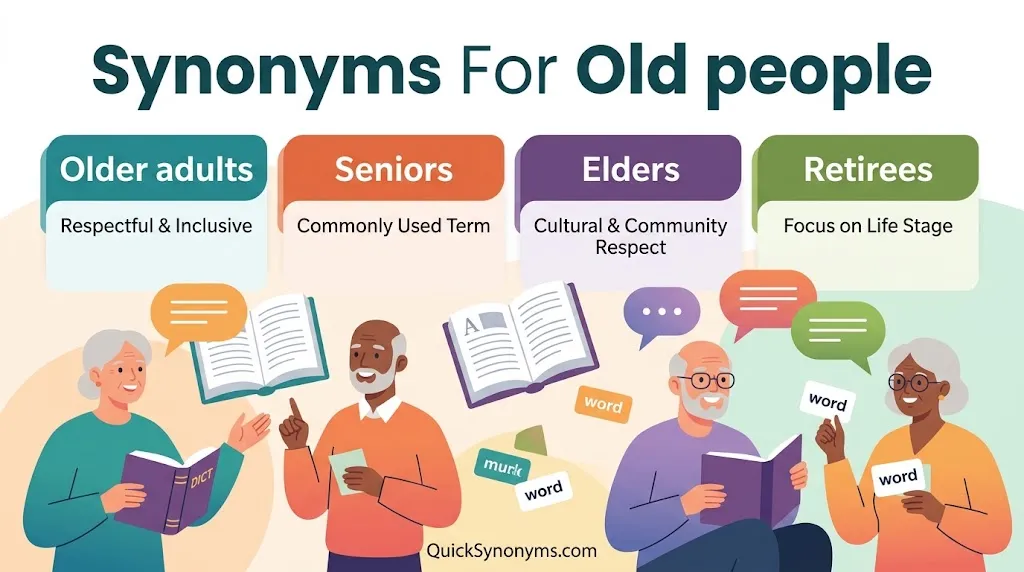
Synonyms for Old people include older adults, elderly people, seniors, aged people, and senior citizens. The best choice depends on tone, context, and audience.
Old people means people who are advanced in age. You may hear this phrase when someone talks about grandparents, older neighbors, or people who have lived through many years of life. For example, a child may say, “The old people in our town meet at the park every morning.” The phrase is common in everyday English, but it can sound too direct or impersonal in some situations.
Learning synonyms helps English learners choose words that sound more natural and respectful. It also helps content writers avoid repeating the same phrase. In this guide, we explore the meaning of old people and 35 useful alternatives, with simple examples, grammar notes, etymology, pronunciation, and semantic categories. These choices can help you write and speak with greater care.
Meaning of Old people
Definition
Old people (Noun phrase):
A general term for people who are considered advanced in age.
Examples
- The old people in the village enjoy meeting every evening.
- The community center offers activities for old people.
Connotative Meaning
Connotation: The feeling or idea that a word suggests beyond its basic meaning.
- Positive tone: May suggest experience, wisdom, or respect when used warmly.
- Negative tone: Can sometimes sound blunt, dismissive, or age-focused.
- Neutral tone: Simply describes people who are advanced in age, depending on context.
Etymology
The phrase old people combines two words with different histories.
- Old English (450–1100): Old comes from Old English eald, meaning aged or having existed for a long time. People developed through Middle English forms related to French peple.
- Middle English (1100–1500): Old appeared in forms such as old and olde. People developed from Anglo-French and Old French pople/peple, ultimately connected to Latin populus, meaning a people or population.
- Modern English (1500–Present): Old people became a common general phrase for people in advanced age, although alternatives such as older adults and senior citizens are often preferred in formal or respectful writing.
Pronunciation (IPA)
- IPA: /oʊld ˈpiːpəl/
- Syllables: old peo-ple
Affixation Pattern of Old people
Because old people is a two-word noun phrase, it does not have a single root and affixation pattern.
- Root: old + people
- Prefix: None
- Suffix: None
- Word formations:
- old – adjective
- older – comparative adjective
- oldest – superlative adjective
- old age – noun phrase
- old people – noun phrase
- older people – noun phrase
- people – plural noun
- person – singular noun
35 Synonyms of Old people, With Meaning & Examples
1. Older adults (Noun phrase)
Meaning: People who are relatively advanced in age, often used in respectful or formal contexts.
Examples:
- The program provides exercise classes for older adults.
- Older adults can benefit from regular social activities.
2. Elderly people (Noun phrase)
Meaning: People who are advanced in age, traditionally used as a polite description.
Examples:
- The charity delivers meals to elderly people.
- Elderly people may need extra support during extreme weather.
3. Seniors (Noun)
Meaning: Older people, especially those in later adulthood.
Examples:
- Seniors receive discounts at the museum.
- The center organizes activities for local seniors.
4. Senior citizens (Noun phrase)
Meaning: Older adults, especially in social, public, or official contexts.
Examples:
- Senior citizens can use the service at a reduced price.
- The city built a center for senior citizens.
5. Aged people (Noun phrase)
Meaning: People who are advanced in age.
Examples:
- The program supports aged people living alone.
- Special services are available for aged people.
6. Elderly (Noun/Adjective)
Meaning: A term referring to older people or describing someone advanced in age.
Examples:
- The elderly often value accessible public transportation.
- The clinic provides care for elderly patients.
7. Older people (Noun phrase)
Meaning: A direct and widely accepted term for people who are older.
Examples:
- Older people may enjoy quieter community spaces.
- The study examined how older people use technology.
8. Mature adults (Noun phrase)
Meaning: Adults who are mature in age or life experience.
Examples:
- The course is open to mature adults.
- Mature adults often bring useful experience to the workplace.
9. Aging adults (Noun phrase)
Meaning: Adults who are growing older.
Examples:
- The service was designed for aging adults.
- Aging adults may have different housing needs.
10. Advanced-age adults (Noun phrase)
Meaning: Adults who are at an advanced stage of life.
Examples:
- The facility provides care for advanced-age adults.
- Advanced-age adults may need accessible transportation.
11. Retired people (Noun phrase)
Meaning: People who have stopped working, often because they have reached retirement age.
Examples:
- Retired people joined the community trip.
- The club welcomes retired people from the neighborhood.
12. Retirees (Noun)
Meaning: People who have retired from regular employment.
Examples:
- Many retirees enjoy traveling.
- The program offers financial advice to retirees.
13. Golden-agers (Noun)
Meaning: An informal term for older adults, often highlighting later life positively.
Examples:
- The club organizes trips for golden-agers.
- Golden-agers gathered for a weekend event.
14. Golden agers (Noun)
Meaning: Older adults, especially when referring positively to their later years.
Examples:
- The center offers classes for golden agers.
- Golden agers participated in the art workshop.
15. Elders (Noun)
Meaning: Older people who may be respected for their age, knowledge, or experience.
Examples:
- The community listened to its elders.
- The elders shared stories with younger generations.
16. Older generation (Noun phrase)
Meaning: People from an older age group or generation.
Examples:
- The older generation remembers life before smartphones.
- The older generation shared valuable lessons with the children.
17. Elder generation (Noun phrase)
Meaning: A generation of people who are older than the current group being discussed.
Examples:
- The elder generation helped preserve the tradition.
- Young people learned from the elder generation.
18. Aging population (Noun phrase)
Meaning: A population containing a growing proportion of older people.
Examples:
- The country has an aging population.
- An aging population can change healthcare needs.
19. Senior adults (Noun phrase)
Meaning: Adults who are in an older age group.
Examples:
- The program provides meals for senior adults.
- Senior adults attended the health workshop.
20. Older generation members (Noun phrase)
Meaning: Individual people who belong to an older generation.
Examples:
- Older generation members shared their experiences.
- The project brings older generation members together with students.
21. Aging population members (Noun phrase)
Meaning: Individuals who belong to an aging or older population.
Examples:
- The service supports aging population members.
- Aging population members may benefit from accessible facilities.
22. Elder members (Noun phrase)
Meaning: Older members of a family, group, or community.
Examples:
- Elder members of the family attended the ceremony.
- The club respects its elder members.
23. Older generation adults (Noun phrase)
Meaning: Adults belonging to an older generation.
Examples:
- Older generation adults may have different media habits.
- The campaign was designed for older generation adults.
24. Long-lived people (Noun phrase)
Meaning: People who have lived for a long time.
Examples:
- The village is known for its long-lived people.
- Researchers studied the habits of long-lived people.
25. People of advanced age (Noun phrase)
Meaning: People who are at an advanced stage of life.
Examples:
- The service is available to people of advanced age.
- People of advanced age may need additional assistance.
26. People in later life (Noun phrase)
Meaning: People who are living through the later stages of adulthood.
Examples:
- People in later life can continue learning new skills.
- The course supports people in later life.
27. People in their later years (Noun phrase)
Meaning: People who have reached the later part of their lives.
Examples:
- People in their later years often value strong social connections.
- The program welcomes people in their later years.
28. People of mature age (Noun phrase)
Meaning: People who have reached a mature stage of adulthood.
Examples:
- The course is suitable for people of mature age.
- People of mature age can apply for the program.
29. People in old age (Noun phrase)
Meaning: People who are in the later stage of human life.
Examples:
- People in old age may benefit from community support.
- The book discusses the experiences of people in old age.
30. Aged adults (Noun phrase)
Meaning: Adults who are advanced in age.
Examples:
- The facility offers activities for aged adults.
- Aged adults were invited to the community event.
31. Senior members (Noun phrase)
Meaning: Older members of a group or organization.
Examples:
- Senior members of the club attended the meeting.
- The organization provides support for senior members.
32. Elder members of society (Noun phrase)
Meaning: Older people viewed as members of the wider community or society.
Examples:
- Elder members of society deserve access to quality services.
- The project connects students with elder members of society.
33. Older members of the community (Noun phrase)
Meaning: Older people who live within a particular community.
Examples:
- Older members of the community joined the festival.
- The library offers special events for older members of the community.
34. Older adults and seniors (Noun phrase)
Meaning: A combined expression referring to people in older age groups.
Examples:
- The center offers classes for older adults and seniors.
- Older adults and seniors can register for the program.
35. People in later adulthood (Noun phrase)
Meaning: People who are in the later stages of adulthood.
Examples:
- People in later adulthood may have different learning goals.
- The study focused on people in later adulthood.
Prototype Meaning
The most typical meaning of old people is simply people who are in the later stages of human life. When people hear this phrase, they may imagine grandparents, retirees, or older community members. However, the exact age is not fixed. Because old can sound blunt when used for people, terms such as older adults, seniors, and people in later life are often better choices in respectful or formal writing.
Prototype Categorization
The 35 alternatives can be grouped by meaning and tone:
- Respectful and modern: older adults, older people, seniors, senior adults, people in later life
- Formal or professional: people of advanced age, people in later adulthood, advanced-age adults, aged adults
- Community-focused: elders, elder members, senior members, older members of the community
- Retirement-related: retired people, retirees
- Positive or informal: golden-agers, golden agers, mature adults
- Population-focused: aging population, aging population members
- Age-stage descriptions: people in their later years, people in old age, people of mature age, long-lived people
This grouping helps writers choose a synonym based on purpose. For example, retirees focuses on employment status, while elders can emphasize respect and experience. Older adults is often a safe choice for general, respectful communication.
Antonyms of Old people
Young people (Noun phrase)
People who are relatively young.
Younger adults (Noun phrase)
Adults who belong to a younger age group.
Youth (Noun)
Young people considered as a group.
Adolescents (Noun)
Young people who are developing from childhood toward adulthood.
Children (Noun)
Young human beings who have not reached adulthood.
Infants (Noun)
Very young babies, usually in the earliest stage of life.
Short Questions and Answers
What does old people mean?
Old people refers to people who are considered advanced in age or in the later stages of life.
When should old people be used?
It can be used in everyday conversation, but older people or older adults may sound more respectful in many formal and professional contexts.
Is old people positive or negative?
It depends on context. The phrase can be neutral, but it may sound blunt or insensitive when used without care.
How is it different from similar words?
Retirees refers to retirement status, elders can suggest respect and experience, and seniors is a common alternative for older people. Older adults is often a neutral and respectful choice.
Conclusion
Learning alternatives to old people gives English learners more control over their vocabulary. Words such as older adults, seniors, elders, retirees, and people in later life can express similar ideas while adding different tones and meanings. Choosing the right synonym depends on the audience, subject, and purpose of your writing. This is especially important when discussing age because some expressions may sound more respectful than others.
Using synonyms also makes speaking and writing stronger. Instead of repeating old people, you can choose a phrase that fits the exact situation. Practice these 35 alternatives in short sentences each day, and pay attention to how native speakers use them. With regular practice, your vocabulary will grow, your writing will sound more natural, and your confidence in English will improve.
Learn More: Synonyms for Apparently
Lexicographer & Vocabulary Specialist
Nathan Carter focuses on English vocabulary, synonyms, antonyms, and word meanings. He is passionate about producing clear, accurate, and easy-to-understand language guides for readers of all levels.



1 thought on “Synonyms for Old people: 35 Respectful Choices”