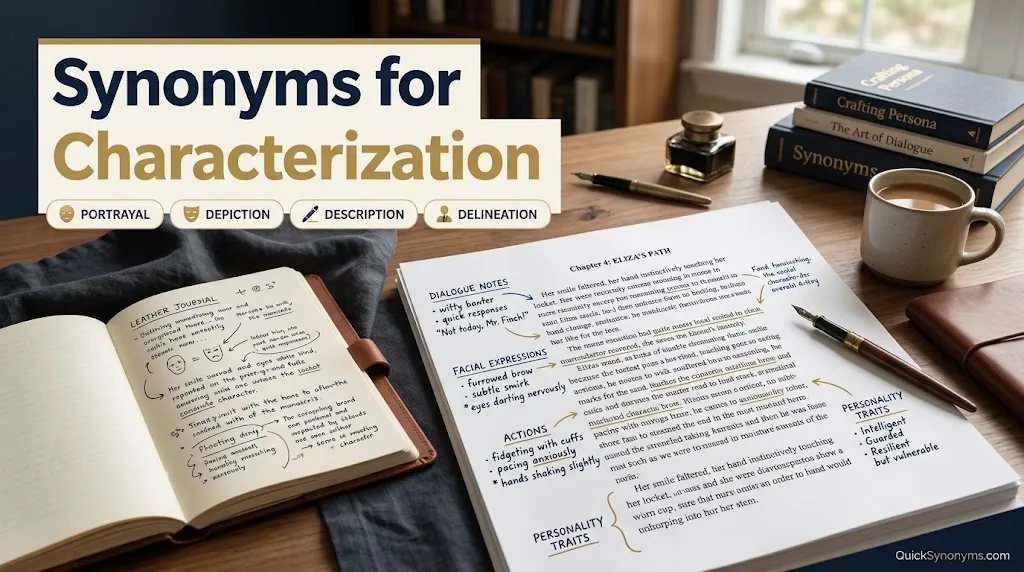
The best synonyms for Characterization include portrayal, depiction, description, delineation, and representation. These words are commonly used in literary and creative contexts to describe how a writer or artist presents a person’s character, personality, traits, or identity.
Characterization is the way a writer, filmmaker, or storyteller presents a person’s personality, traits, motives, and behavior. When you discuss how a novel makes a villain seem cruel or a hero seem brave, you are talking about characterization.
For example, imagine reading a novel where a quiet character slowly reveals courage through small actions. The writer is not simply describing that person. The writer is building a clear impression of the character.
Learning synonyms for characterization helps you discuss stories with greater precision. The alternatives below cover common literary and descriptive uses, from simple description to more focused delineation and profiling.
Meaning of Characterization
Definition
Characterization (noun): The way a person, character, or personality is described, presented, or developed so that its qualities become clear.
Example
- The author’s characterization of the shy protagonist becomes stronger as the story progresses.
Connotative Meaning
- Positive tone: Effective characterization can suggest depth, realism, complexity, or emotional richness.
- Negative tone: Weak characterization can suggest that a character feels flat, predictable, or poorly developed.
- Neutral tone: Characterization simply refers to the process or result of presenting a character’s qualities.
Formal vs Informal Usage
Characterization is a formal or neutral word. It is especially common in literary criticism, academic writing, film reviews, storytelling, and discussions of fiction. In everyday conversation, words such as description, portrayal, or presentation may sound more natural.
Etymology
The word has an interesting connection to the ancient idea of a character as a mark or distinctive feature.
- Old English (450-1100): The modern word characterization was not part of Old English. English writers used native words and descriptions to express related ideas.
- Middle English (1100-1500): Character entered English through French and Latin, ultimately tracing back to Greek kharakter, referring to a mark, engraved sign, or distinctive feature.
- Modern English (1500-Present): English developed characterize from character, followed by characterization, meaning the act or result of describing or presenting someone’s distinctive qualities.
Pronunciation (IPA)
- IPA: /ˌkærəktəraɪˈzeɪʃən/ (US), /ˌkærəktəraɪˈzeɪʃən/ (UK)
- Syllables: char-ac-ter-i-za-tion
- US/UK difference: The pronunciation is broadly the same in standard US and UK English, although individual speakers may vary slightly in vowel quality.
Affixation Pattern of Characterization
- Root: character
- Prefix: None
- Suffix: -ization
- Word formations:
- Character (noun): a person in a story or a distinctive quality or trait
- Characterize (verb): to describe or present the qualities of someone or something
- Characterization (noun): the act or result of characterizing
Synonyms of Characterization With Meaning & Examples
1. Portrayal (Noun)
Meaning: The way a person or character is presented through words, actions, images, or performance.
Examples:
- The author’s portrayal of the young detective feels realistic.
- The actor’s portrayal of the troubled father was convincing. Best for: novels, films, acting, and reviews.
2. Depiction (Noun)
Meaning: A representation or presentation of a person, character, or quality.
Examples:
- The novel offers a detailed depiction of its main character.
- The film’s depiction of the villain is unusually complex. Best for: literary and visual analysis.
3. Description (Noun)
Meaning: Words that explain what a person or character is like.
Examples:
- The author’s description of the protagonist makes her personality easy to understand.
- His description of the old sailor reveals his stubborn nature. Best for: general writing and simple explanations.
4. Delineation (Noun)
Meaning: A detailed and clear presentation of someone’s distinctive qualities or characteristics.
Examples:
- The novel’s delineation of the two brothers is remarkably precise.
- Her delineation of the antagonist reveals several conflicting traits. Best for: formal literary analysis.
5. Representation (Noun)
Meaning: The way a person, character, group, or quality is presented in a work.
Examples:
- The book’s representation of its central character changes over time.
- The film gives a thoughtful representation of the young woman’s personality. Best for: literature, film, and cultural discussion.
6. Rendering (Noun)
Meaning: A particular way of presenting or expressing a character or personality.
Examples:
- The author’s rendering of the villain makes him surprisingly sympathetic.
- The director’s rendering of the hero emphasizes his uncertainty. Best for: literary, artistic, and film criticism.
7. Presentation (Noun)
Meaning: The manner in which a character or personality is shown to an audience.
Examples:
- The writer’s presentation of the hero becomes more complex in later chapters.
- Her presentation of the character avoids common stereotypes. Best for: general literary and media discussion.
8. Profiling (Noun)
Meaning: The detailed description of a person’s traits, behavior, or characteristics.
Examples:
- The author’s profiling of the detective focuses on his unusual habits.
- The story uses careful profiling of its central characters to build tension. Best for: detailed character analysis and crime fiction.
9. Portraiture (Noun)
Meaning: The artistic or literary representation of a person’s character or personality.
Examples:
- The novelist’s portraiture of the elderly teacher is warm and subtle.
- Her portraiture of the antagonist gives the story emotional depth. Best for: literary and artistic criticism.
10. Sketch (Noun)
Meaning: A brief or basic presentation of a person’s character or qualities.
Examples:
- The opening chapter gives a quick sketch of the main character.
- The writer’s sketch of the village leader is brief but memorable. Best for: short descriptions and early character introductions.
11. Illustration (Noun)
Meaning: A clear example or presentation that helps show the qualities of a person or character.
Examples:
- The scene provides an effective illustration of the hero’s loyalty.
- This chapter is an illustration of the character’s growing confidence. Best for: explanatory and literary writing.
12. Individualization (Noun)
Meaning: The process of giving a character distinctive qualities that make the character feel like an individual.
Examples:
- The author’s individualization of the supporting characters makes them memorable.
- Careful individualization gives each member of the family a different personality. Best for: advanced literary analysis.
Characterization vs Its Closest Synonym
The closest everyday synonym for characterization is usually portrayal.
Unlike portrayal, which focuses broadly on how a character is presented, characterization often emphasizes the techniques used to reveal that character’s personality, motives, traits, and behavior.
Depiction is also close. However, depiction can refer to representing almost anything, while characterization specifically focuses on the qualities that make a person or fictional character distinctive.
Prototype Meaning
The most typical meaning of characterization is the way a writer makes a fictional character understandable and memorable. Readers usually think of the character’s personality, motives, behavior, dialogue, appearance, and relationships when they hear the word.
In literary analysis, characterization can be direct, such as when a narrator states that someone is dishonest, or indirect, such as when the character repeatedly lies through dialogue and actions.
Prototype Categorization
- Direct presentation: description, sketch, presentation
- Literary portrayal: portrayal, depiction, representation
- Detailed character treatment: delineation, rendering, portraiture
- Focused analysis: profiling, individualization
- Explanatory presentation: illustration
These categories help writers choose a synonym based on purpose. Use portrayal for a broad literary discussion, delineation for precise analysis, and sketch when the description is brief.
Antonyms of Characterization
There is no single perfect antonym for characterization, because the word describes a process of presenting character rather than a simple quality with one opposite.
Closest contextual opposites include:
- Anonymity (noun): a lack of identifying or distinctive personal qualities.
- Vagueness (noun): a lack of clear or specific detail.
- Obscurity (noun): a state in which something remains unclear or difficult to understand.
- Decharacterization (noun): a loss or removal of distinctive character traits; this is uncommon and context-dependent.
Short Questions and Answers
What does Characterization mean?
Characterization is the way a writer or creator presents the qualities, personality, motives, and behavior of a character or person.
What is the closest synonym for Characterization?
Portrayal is often the closest general synonym because both words describe how a character is presented to an audience.
Is Portrayal the same as Characterization?
They are closely related but not identical. Portrayal focuses on the overall presentation, while characterization often focuses on how distinctive character traits are established.
What is another word for Characterization in literature?
Common literary alternatives include portrayal, depiction, delineation, representation, and rendering.
Is Characterization a formal word?
Yes. Characterization is mainly a neutral-to-formal term and is especially common in academic writing, literary criticism, film analysis, and professional discussion.
What is the difference between Characterization and Description?
Description can explain what someone looks like or what something is like, while characterization specifically presents the qualities and personality that define a character.
Conclusion
Learning synonyms for characterization gives you more precise ways to discuss how writers present people and fictional characters. Words such as portrayal, depiction, and representation work well in general literary discussion.
More specialized choices, including delineation, portraiture, and individualization, can make formal analysis more precise. Choosing the right synonym also helps you avoid repeating the same word throughout an essay or review.
Practice these alternatives by using them in your own sentences. The more you connect each word with its specific context and tone, the easier it becomes to choose the right expression naturally and write with confidence.
Looking for more word choices? See Synonyms for Flair: 30 Words for Style & Talent.

Content Editor & Language Researcher
Daniel Foster specializes in editing educational content and researching English language topics. He is committed to creating well-structured, reader-friendly articles that make learning easier.







1 thought on “Synonyms for Characterization: 12 Better Alternatives”