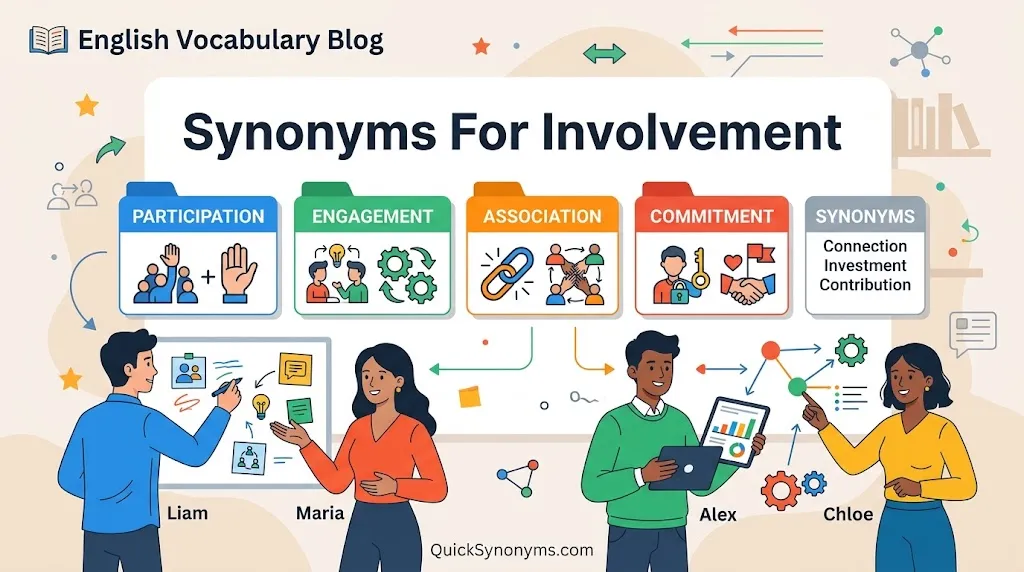
Synonyms for involvement include participation, engagement, participation, association, connection, contribution, cooperation, inclusion, interaction, commitment, and activity. The best synonym depends on whether you mean taking part, being connected, giving help, or being emotionally invested.
Involvement means taking part in something or being connected with a person, group, activity, or situation. For example, imagine a student who joins a school project, shares ideas, and helps complete the work. We can say the student has active involvement in the project. The word is common because it can describe social, personal, professional, and emotional connections.
Learning synonyms for involvement helps English learners choose more exact words. A writer may use participation for taking part, engagement for active interest, or association for a connection. This article explains the meaning of involvement and 34 useful synonyms with simple examples. It also covers grammar, etymology, pronunciation, word formation, and semantic categories to make each word easier to understand and use.
Meaning of synonyms for Involvement
Definition
synonyms for Involvement (Noun):
Involvement means taking part in something or having a connection, interest, responsibility, or relationship with it.
Examples
- Her involvement in the community project helped it succeed.
- His involvement with the company began five years ago.
Connotative Meaning
Connotation (the feeling or idea associated with a word beyond its basic meaning):
- Positive tone: Involvement can suggest interest, teamwork, commitment, support, or active participation.
- Negative tone: It can sometimes suggest unwanted participation, interference, or connection with a harmful situation.
- Neutral tone: Involvement can simply describe a person’s connection or participation without showing approval or disapproval.
Etymology
The word involvement comes from the verb involve, which ultimately comes from Latin involvere, meaning “to roll in” or “wrap up.” Its meaning later developed toward including someone or something in an activity, situation, or relationship.
- Old English (450–1100): Involvement was not part of Old English. Similar ideas were expressed through native words related to joining, including, or taking part.
- Middle English (1100–1500): The related verb involve entered English through French and Latin influence. Its meanings developed around including, entangling, or bringing something into a situation.
- Modern English (1500–Present): Involvement developed as the noun form of involve and became widely used for participation, connection, commitment, and personal interest.
Pronunciation (IPA)
- IPA: /ɪnˈvɒlvmənt/
- Syllables: in-volve-ment
Affixation Pattern of Involvement
- Root: volv, from Latin volvere, meaning “to roll”
- Prefix: in-, meaning “in” or “into”
- Suffix: -ment, forming a noun that describes a state, condition, or result
- Word formations:
- Involve – verb
- Involved – adjective / past participle
- Involving – adjective / present participle
- Involvement – noun
- Involuntarily – adverb, from a different formation of involuntary, not a synonym or direct derivative of involvement
34 Synonyms of Involvement, With Meaning & Examples
1. Participation (Noun)
Meaning: The act of taking part in an activity, event, or group.
Examples:
- Her participation in the debate was impressive.
- Student participation increased during the discussion.
2. Engagement (Noun)
Meaning: Active participation or interest in something.
Examples:
- The teacher encouraged greater engagement in class.
- Customer engagement is important for the brand.
3. Association (Noun)
Meaning: A connection or relationship with a person, group, or activity.
Examples:
- He has a long association with the organization.
- Her association with the project brought useful contacts.
4. Connection (Noun)
Meaning: A relationship or link between people, things, or ideas.
Examples:
- She has a strong connection with the local community.
- His connection to the company began through a friend.
5. Contribution (Noun)
Meaning: Something given or done to help achieve a shared goal.
Examples:
- Her contribution to the project was valuable.
- Everyone made a small contribution to the campaign.
6. Commitment (Noun)
Meaning: A strong promise or willingness to give time and effort to something.
Examples:
- His commitment to the team never changed.
- The project requires a serious commitment from everyone.
7. Cooperation (Noun)
Meaning: The act of working together to achieve a common goal.
Examples:
- The plan succeeded through everyone’s cooperation.
- We appreciate your cooperation during the project.
8. Interaction (Noun)
Meaning: Communication or activity between people or groups.
Examples:
- Regular interaction with customers improves trust.
- The event encouraged social interaction.
9. Inclusion (Noun)
Meaning: The act of making someone part of a group or activity.
Examples:
- The program promotes the inclusion of young people.
- Her inclusion in the team improved its diversity.
10. Attachment (Noun)
Meaning: A strong emotional connection to someone or something.
Examples:
- He developed a deep attachment to his hometown.
- Her emotional attachment to the project was clear.
11. Connection (Noun)
Meaning: A relationship or link between a person and a situation, group, or activity.
Examples:
- His connection with the charity lasted for years.
- Police investigated her connection to the organization.
12. Relation (Noun)
Meaning: A connection or association between people, things, or events.
Examples:
- The report explains his relation to the company.
- Their relation with the community remains strong.
13. Collaboration (Noun)
Meaning: The act of working with others to produce or achieve something.
Examples:
- The project was completed through close collaboration.
- Our collaboration produced several useful ideas.
14. Activity (Noun)
Meaning: Action or participation in a particular area or situation.
Examples:
- Her political activity increased during the campaign.
- Community activity has grown this year.
15. Interest (Noun)
Meaning: A feeling of wanting to learn about or take part in something.
Examples:
- His interest in science began at school.
- She showed strong interest in the new project.
16. Concern (Noun)
Meaning: A feeling of interest, care, or responsibility about something.
Examples:
- She expressed her concern about the community.
- His concern for the project was obvious.
17. Investment (Noun)
Meaning: The giving of time, effort, money, or resources to something.
Examples:
- Her time investment in the project was significant.
- Emotional investment can make a project more meaningful.
18. Support (Noun)
Meaning: Help or encouragement given to a person, group, or cause.
Examples:
- Her support for the campaign was valuable.
- The team received strong public support.
19. Commitment (Noun)
Meaning: Dedication to a person, activity, responsibility, or goal.
Examples:
- His commitment to the community is admirable.
- The role requires dedication and commitment.
20. Dedication (Noun)
Meaning: Great effort and loyalty given to a person, task, or purpose.
Examples:
- Her dedication to teaching is inspiring.
- The team’s dedication helped complete the project.
21. Membership (Noun)
Meaning: The state of belonging to a group or organization.
Examples:
- His membership in the club began last year.
- Membership in the organization requires regular participation.
22. Affiliation (Noun)
Meaning: A connection with a group, organization, or institution.
Examples:
- She has an academic affiliation with the university.
- His professional affiliation is listed on his profile.
23. Partnership (Noun)
Meaning: A relationship in which people or groups work together.
Examples:
- The project began through a strong partnership.
- Their business partnership lasted for many years.
24. Collaboration (Noun)
Meaning: Joint work between people or organizations toward a shared result.
Examples:
- The two teams formed a collaboration.
- The research was completed through international collaboration.
25. Assistance (Noun)
Meaning: Help given to someone who needs it.
Examples:
- Her assistance was important during the event.
- The volunteers provided assistance to local families.
26. Help (Noun)
Meaning: Support or aid given to someone or something.
Examples:
- Thank you for your help with the project.
- His help made the task much easier.
27. Responsibility (Noun)
Meaning: A duty or obligation that makes someone responsible for something.
Examples:
- She accepted responsibility for the project.
- His responsibility included managing the team.
28. Entanglement (Noun)
Meaning: A complicated connection or involvement that is difficult to escape.
Examples:
- He wanted to avoid legal entanglement.
- The investigation revealed several financial entanglements.
29. Interference (Noun)
Meaning: Unwanted involvement that affects or disrupts a situation.
Examples:
- His interference made the situation worse.
- The manager’s constant interference slowed the project.
30. Meddling (Noun)
Meaning: Unwanted or unnecessary involvement in other people’s affairs.
Examples:
- Her meddling caused problems between the two teams.
- He disliked his neighbor’s constant meddling.
31. Intervention (Noun)
Meaning: Action taken to become involved in a situation in order to change or improve it.
Examples:
- The problem required immediate intervention.
- Government intervention helped stabilize the situation.
32. Immersion (Noun)
Meaning: Deep involvement in an activity, subject, or experience.
Examples:
- Language immersion helped her improve quickly.
- His immersion in the project lasted several months.
33. Participation (Noun)
Meaning: The act of joining or taking part in something.
Examples:
- Active participation is expected from all members.
- Her participation made the event more successful.
34. Preoccupation (Noun)
Meaning: A strong and continuous interest in or concern about something.
Examples:
- His preoccupation with work affected his free time.
- Her preoccupation with the problem made it hard to relax.
Prototype Meaning
The prototype meaning of involvement is active participation or connection with something. When people hear this word, they often imagine someone taking part in an activity, helping with a project, joining a group, or showing strong interest in a situation. The exact meaning changes with context. For example, involvement in a project usually means participation, while involvement in a dispute can suggest a connection to a conflict.
Prototype Categorization
The 34 synonyms can be grouped into semantic categories based on their main shades of meaning. This helps writers select a word that matches the exact context.
- Active Participation: participation, engagement, activity, interaction, immersion
Use these when someone actively takes part in an event, task, subject, or group. - Connection and Relationship: association, connection, relation, affiliation, attachment
These work best when involvement means being linked to someone or something. - Teamwork and Shared Effort: cooperation, collaboration, partnership, contribution, assistance, support
These emphasize working with or helping others. - Interest and Dedication: interest, commitment, dedication, concern, investment, preoccupation
These highlight emotional, mental, or personal involvement. - Group Belonging: inclusion, membership, affiliation
These are useful when someone becomes part of a group or organization. - Duty and Responsibility: responsibility, commitment, investment
These fit situations where involvement includes an obligation or serious effort. - Problematic Involvement: entanglement, interference, meddling, intervention
These often carry negative or complicated meanings and should be chosen carefully.
Using these categories helps writers avoid repetition and choose the right level of meaning. For example, collaboration suggests teamwork, while meddling suggests unwanted involvement.
Antonyms of Involvement
Detachment (Noun)
A state of being emotionally or personally separate from something.
Disengagement (Noun)
The act of withdrawing from an activity or situation.
Withdrawal (Noun)
The act of moving away from participation or connection.
Separation (Noun)
The state of being apart from someone or something.
Indifference (Noun)
A lack of interest, concern, or attention.
Isolation (Noun)
The state of being separated from other people or activities.
Nonparticipation (Noun)
The state of not taking part in an activity or event.
Independence (Noun)
The state of acting or existing without dependence or close involvement with others.
Short Questions and Answers
What does synonyms for Involvement mean?
Synonyms for involvement are words that describe participation, connection, interest, support, commitment, or association with a person, activity, or situation.
When should Involvement be used?
Use involvement when you want to describe someone’s participation, connection, interest, responsibility, or relationship with something.
Is Involvement positive or negative?
Involvement is usually neutral. It can be positive when it means participation or support, but it can be negative when it refers to unwanted interference or connection with a problem.
How is it different from similar words?
Involvement is a broad term. Participation focuses on taking part, engagement suggests active interest, association focuses on connection, commitment stresses dedication, and interference suggests unwanted involvement.
Conclusion
Learning involvement and its synonyms can greatly improve English vocabulary and communication. Words such as participation, engagement, association, contribution, and commitment allow you to express different shades of meaning instead of repeating the same word. Understanding these differences also helps writers create clearer sentences and choose vocabulary that fits the situation. Strong synonym knowledge can make both formal and everyday English more precise.
Daily vocabulary practice is a simple way to build confidence. Learn a few synonyms at a time, read them in real sentences, and create your own examples. Pay attention to their tone and context because words that look similar may not always work in the same sentence. With regular practice, you can strengthen your writing, improve your speaking, avoid repetition, and communicate your ideas with greater confidence.
See Also: Synonyms for Venture: 40 Words for Adventure

ESL Writing Coach
Olivia Bennett helps English learners strengthen their writing, expand their vocabulary, and communicate more naturally. Her content is designed to make everyday and professional English simple and accessible.