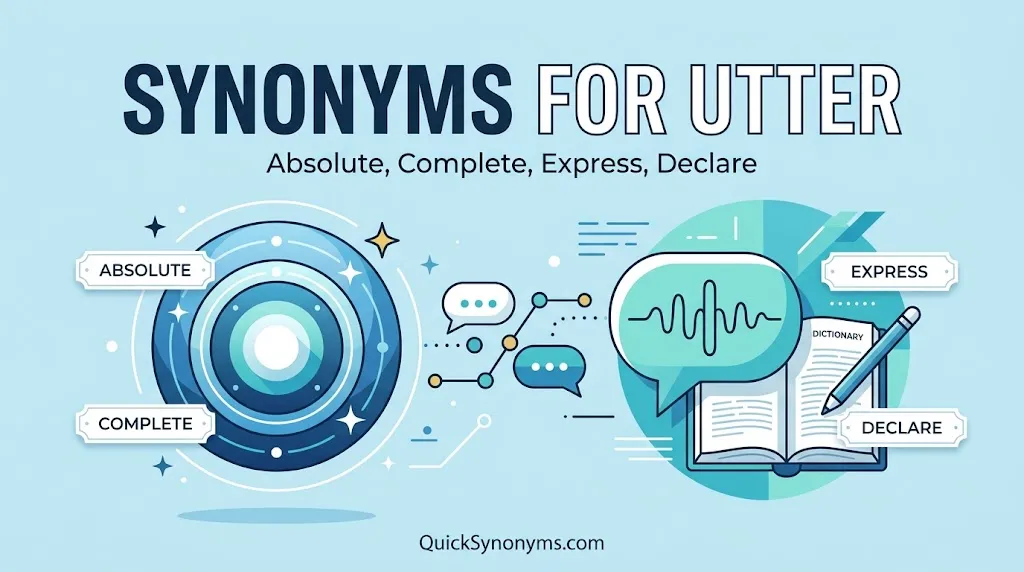
Synonyms for utter include absolute, complete, total, entire, outright, sheer, pure, downright, express, voice, say, speak, state, declare, pronounce, and articulate. The best synonym depends on whether utter means “complete” or “to say something.”
Utter has two common meanings. As an adjective, it means complete or total, as in “utter silence” or “utter nonsense.” As a verb, it means to say or produce words or sounds, as in “She uttered a quiet reply.” These two meanings make the word useful in both everyday and formal English.
Learning synonyms for utter helps English learners choose words that fit each situation. A writer may use absolute for complete certainty, sheer for strong emphasis, or declare when someone speaks firmly. This article explains the meaning of utter and 32 useful synonyms with simple examples. It also covers grammar, etymology, pronunciation, word formation, and semantic categories. These details can help you understand not only what each word means, but also when it sounds natural.
Meaning of synonyms for Utter
Definition
synonyms for Utter (Adjective / Verb):
As an adjective, utter means complete, total, or absolute. As a verb, it means to say, speak, or produce a sound.
Examples
- The decision was an utter disaster.
- She did not utter a single word during the meeting.
Connotative Meaning
Connotation (the feeling or idea associated with a word beyond its basic meaning):
- Positive tone: As an adjective, utter can add strong emphasis to a positive idea, such as “utter joy.”
- Negative tone: It often strengthens negative expressions, such as “utter nonsense” or “utter failure.”
- Neutral tone: As a verb, utter can simply mean to say or produce a sound without a strong emotional tone.
Etymology
The adjective utter comes from Middle English forms related to outer or outmost, while the verb utter developed from the idea of bringing something outward or expressing it. These histories led to the modern meanings of “complete” and “express in speech.”
- Old English (450–1100): Related forms such as ūtera meant “outer” or “outside.”
- Middle English (1100–1500): The word developed forms such as utter and gained meanings connected with what is outward or complete. The verb sense also developed around expressing something outwardly.
- Modern English (1500–Present): Utter became established with two major uses: an adjective meaning “complete” and a verb meaning “to say or express.”
Pronunciation (IPA)
- IPA: /ˈʌtər/
- Syllables: ut-ter
Affixation Pattern of Utter
- Root: utter
- Prefix: None
- Suffix: None in the modern English form
- Word formations:
- Utter – adjective
- Utter – verb
- Uttered – verb, past tense and past participle
- Uttering – verb, present participle
- Utterance – noun, something spoken or expressed
- Utterer – noun, a person who utters something
32 Synonyms of Utter, With Meaning & Examples
1. Absolute (Adjective)
Meaning: Complete and not limited in any way.
Examples:
- The decision was an absolute disaster.
- She showed absolute confidence in her plan.
2. Complete (Adjective)
Meaning: Whole or total, with nothing missing.
Examples:
- The room fell into complete silence.
- His answer was a complete surprise.
3. Total (Adjective)
Meaning: Complete or involving everything.
Examples:
- The project was a total failure.
- We experienced total confusion after the announcement.
4. Entire (Adjective)
Meaning: Whole or complete.
Examples:
- He spent the entire day studying.
- The entire plan changed overnight.
5. Outright (Adjective)
Meaning: Complete, direct, or without qualification.
Examples:
- The proposal was an outright failure.
- She gave an outright rejection of the offer.
6. Sheer (Adjective)
Meaning: Used to emphasize the complete or extreme nature of something.
Examples:
- The climb was a sheer test of endurance.
- Their victory came through sheer determination.
7. Pure (Adjective)
Meaning: Complete or unmixed, often used for emphasis.
Examples:
- The decision was based on pure luck.
- His reaction was pure joy.
8. Downright (Adjective)
Meaning: Completely or extremely, especially in a negative sense.
Examples:
- His behavior was downright rude.
- The claim was downright absurd.
9. Thorough (Adjective)
Meaning: Complete and careful in every part.
Examples:
- The team conducted a thorough investigation.
- She gave the document a thorough review.
10. Unqualified (Adjective)
Meaning: Complete and not limited by conditions or exceptions.
Examples:
- He offered his unqualified support.
- The proposal received unqualified approval.
11. Uttermost (Adjective)
Meaning: Greatest or most extreme.
Examples:
- She made the uttermost effort to help.
- He worked with his uttermost strength.
12. Absolute (Adjective)
Meaning: Complete or total without any exception.
Examples:
- The rule requires absolute silence.
- They demanded absolute secrecy.
13. Say (Verb)
Meaning: To express words or ideas through speech.
Examples:
- She did not say anything.
- What did he say about the plan?
14. Speak (Verb)
Meaning: To use your voice to communicate words or ideas.
Examples:
- He refused to speak about the incident.
- She spoke clearly during the meeting.
15. State (Verb)
Meaning: To express something clearly and directly in words.
Examples:
- The report states the main findings.
- She stated her opinion clearly.
16. Declare (Verb)
Meaning: To announce or say something firmly and openly.
Examples:
- The leader declared his support for the plan.
- She declared that she would continue.
17. Express (Verb)
Meaning: To communicate a thought, feeling, or idea.
Examples:
- He struggled to express his feelings.
- She expressed her concerns politely.
18. Voice (Verb)
Meaning: To express an opinion, concern, or feeling openly.
Examples:
- Several workers voiced their concerns.
- She voiced her disagreement with the decision.
19. Pronounce (Verb)
Meaning: To say or announce something formally.
Examples:
- The judge pronounced the final decision.
- The doctor pronounced him fit to return home.
20. Articulate (Verb)
Meaning: To express an idea clearly and effectively.
Examples:
- She articulated her argument well.
- He could articulate his thoughts clearly.
21. Verbalize (Verb)
Meaning: To express thoughts or feelings in words.
Examples:
- He found it difficult to verbalize his emotions.
- She finally verbalized her concerns.
22. Communicate (Verb)
Meaning: To share information, thoughts, or feelings.
Examples:
- We need to communicate our plans clearly.
- She communicated her expectations to the team.
23. Announce (Verb)
Meaning: To make information known publicly or officially.
Examples:
- The company announced its new policy.
- They announced the winner after the final round.
24. Mention (Verb)
Meaning: To refer to something briefly in speech or writing.
Examples:
- She did not mention the problem.
- He mentioned your name during the meeting.
25. Recite (Verb)
Meaning: To say something aloud from memory or a prepared text.
Examples:
- The student recited the poem.
- She recited the speech without looking at her notes.
26. Articulate (Verb)
Meaning: To express something clearly in spoken words.
Examples:
- He articulated his concerns during the meeting.
- She can articulate complex ideas simply.
27. Enunciate (Verb)
Meaning: To pronounce words clearly and distinctly.
Examples:
- The speaker enunciated every word.
- Please enunciate clearly when reading aloud.
28. Utterance (Noun)
Meaning: Something spoken or expressed aloud.
Examples:
- His first utterance was a quiet greeting.
- The strange utterance confused everyone.
29. Proclaim (Verb)
Meaning: To announce something publicly and confidently.
Examples:
- The king proclaimed the new law.
- She proclaimed her innocence to the crowd.
30. Assert (Verb)
Meaning: To state something confidently or strongly.
Examples:
- He asserted that the report was accurate.
- She asserted her right to speak.
31. Communicate (Verb)
Meaning: To give information or express thoughts through words or other means.
Examples:
- The manager communicated the new rules.
- Good leaders communicate their ideas clearly.
32. Reveal (Verb)
Meaning: To make information, feelings, or thoughts known.
Examples:
- She revealed the truth during the interview.
- His expression revealed his disappointment.
Prototype Meaning
The most typical meaning of utter depends on its grammatical role. As an adjective, people usually understand it as complete, total, or extreme, as in “utter chaos.” As a verb, it usually means to say or produce a sound, often with a formal tone, as in “He uttered a warning.” The adjective sense is especially common in phrases that strongly emphasize an idea.
Prototype Categorization
The 32 alternatives can be grouped by their main meaning. This helps writers choose a synonym that fits the exact context instead of replacing utter with a word that has a different shade of meaning.
- Complete or Total: absolute, complete, total, entire, outright, unqualified, uttermost
Use these when utter means something is complete, whole, or unrestricted. - Strong Emphasis: sheer, pure, downright, thorough
These words add force or stress to an idea. - Speaking and Saying: say, speak, state, declare, express, voice
These are useful when utter means communicating something through speech. - Clear Expression: articulate, verbalize, communicate, enunciate
These focus on how thoughts, feelings, or words are expressed. - Public or Formal Speech: pronounce, announce, proclaim, assert, recite
These fit formal statements, official announcements, or deliberate speech. - Reference and Disclosure: mention, reveal, utterance
These focus on bringing information, words, or feelings into expression.
Understanding these groups helps writers select the right synonym. For example, complete works for “utter silence,” while declare works better when describing a person who formally states something.
Antonyms of Utter
Partial (Adjective)
Not complete or whole.
Limited (Adjective)
Restricted in amount, degree, or extent.
Incomplete (Adjective)
Missing some part or not fully finished.
Qualified (Adjective)
Limited by conditions or exceptions.
Moderate (Adjective)
Not extreme or excessive.
Withhold (Verb)
To keep something from being expressed or given.
Conceal (Verb)
To keep information or feelings hidden.
Suppress (Verb)
To prevent something from being expressed or revealed.
Remain Silent (Verb Phrase)
To avoid speaking or saying anything.
Short Questions and Answers
What does synonyms for Utter mean?
Synonyms for utter are alternative words for its two main meanings: complete or total as an adjective, and say or express as a verb.
When should Utter be used?
Use utter as an adjective when you want to strongly emphasize that something is complete or extreme. Use it as a verb when describing the act of saying or producing a sound, especially in formal writing.
Is Utter positive or negative?
It depends on the context. The adjective often appears in negative phrases such as utter failure, but it can also describe positive ideas such as utter happiness. The verb utter is generally neutral.
How is it different from similar words?
When utter means complete, it is close to absolute, total, and complete. When it means say, it is close to speak, state, and express. However, utter often sounds more formal or emphatic than these everyday alternatives.
Conclusion
Learning utter and its synonyms gives English learners more precise ways to express completeness, intensity, speech, and communication. Words such as absolute, complete, sheer, and total can replace the adjective in suitable contexts, while say, state, express, and declare can replace the verb. Knowing these differences helps writers avoid repetition and choose vocabulary that matches the tone of a sentence.
Daily synonym practice can strengthen both writing and speaking skills. Try learning a few alternatives each day and use them in your own sentences. Pay attention to whether a word describes complete intensity or spoken expression. With regular practice, you can expand your vocabulary, communicate ideas more clearly, and build greater confidence in English.
You May Also Like: Synonyms for Resist: 30 Strong Alternatives

English Teacher & Linguistics Writer
Grace Whitmore creates engaging educational content on vocabulary, word usage, and effective communication. Her goal is to help learners build confidence through clear and practical English guidance.




1 thought on “Synonyms for Utter: 32 Strong Alternatives”