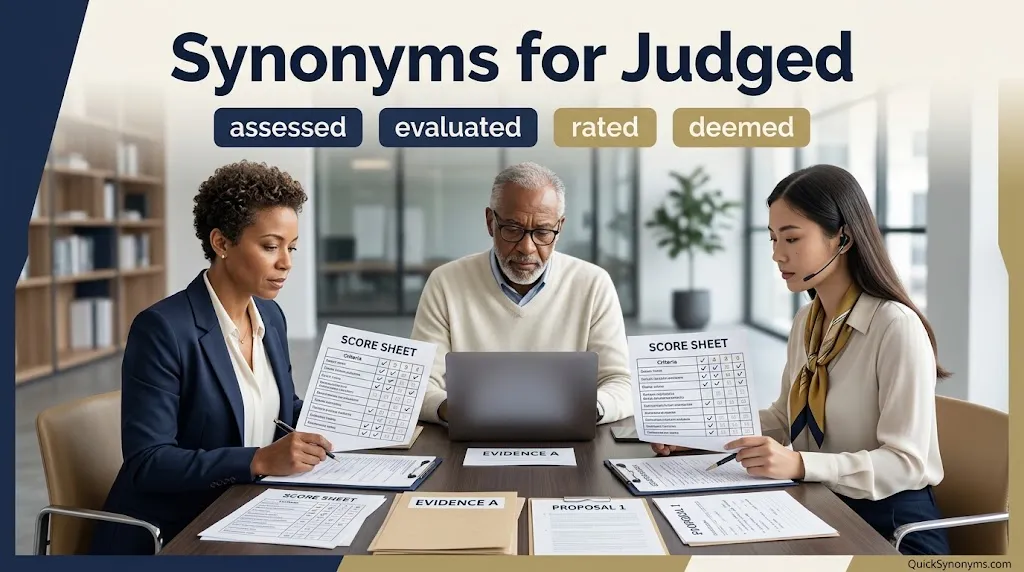
The best synonyms for Judged include assessed, evaluated, appraised, rated, and considered. These words are useful when describing evaluation, opinions, rankings, formal decisions, legal rulings, or estimates in everyday, academic, and professional English.
When a teacher marks your work, a panel scores a performance, or a court reaches a verdict, something has been judged. The word can describe careful evaluation, a formal decision, or even a personal opinion about someone or something.
Learning synonyms for judged helps you choose a word that matches the exact situation. A business proposal may be evaluated, a painting may be critiqued, a contestant may be rated, and a legal case may be adjudicated.
This guide covers 33 useful alternatives, their meanings, examples, tone, and best uses. It also explains the differences between close choices so you can avoid using a word that sounds similar but changes the meaning.
Meaning of Judged
Definition
Judged (verb): formed an opinion about something or someone, evaluated it, or reached a decision after considering relevant information.
It is the past tense and past participle of judge.
Example
- The panel judged the entries based on creativity and accuracy.
Connotative Meaning
(Connotation means the feeling or association a word carries beyond its basic meaning.)
- Positive tone: Can suggest fair, careful, or informed evaluation.
- Negative tone: Can suggest criticism, unfair opinions, or personal condemnation.
- Neutral tone: Can simply mean evaluating, deciding, or forming an opinion.
Formal vs Informal Usage
Judged is a neutral word that works in both formal and informal English. It is common in everyday speech, education, competitions, professional evaluation, and legal contexts.
Etymology
The word judge entered English through French and ultimately traces to Latin roots connected with deciding or determining matters according to law.
- Old English (450-1100): English did not yet use the modern word judge as a native English form. Native terms related to deciding or giving judgment were used instead.
- Middle English (1100-1500): Judge entered English through Anglo-French and Middle English forms related to Old French jugier, from Latin iudicare, meaning to judge or decide.
- Modern English (1500-Present): Judge developed into a common verb and noun. Judged became its regular past-tense and past-participle form.
Pronunciation (IPA)
- IPA: /dʒʌdʒd/
- Syllables: 1
- US/UK difference: There is no major standard difference in pronunciation between American and British English.
Affixation Pattern of Judged
- Root: judge
- Prefix: None
- Suffix: -ed, the regular past-tense and past-participle ending
- Word formations:
- judge (noun, verb)
- judgment (noun)
- judging (noun, verb form)
- judgmental (adjective)
- judgeship (noun)
Synonyms of Judged With Meaning & Examples
English has a broad vocabulary for judged because the word covers several related actions. It can mean evaluating quality, forming an opinion, making a formal decision, estimating something, or giving a legal ruling.
1. Assessed (verb)
Meaning: Evaluated something carefully to understand its quality, value, condition, or performance.
Examples:
- The teacher assessed the students’ written work.
- The team assessed the risks before starting the project.
Best for: Formal evaluation
2. Evaluated (verb)
Meaning: Examined something systematically to determine its quality, value, or effectiveness.
Examples:
- The committee evaluated each proposal.
- The manager evaluated her performance fairly.
Best for: Professional and academic writing
3. Appraised (verb)
Meaning: Carefully judged the value, quality, or condition of something.
Examples:
- The expert appraised the antique table.
- The agent appraised the property before listing it.
Best for: Value and professional assessment
4. Rated (verb)
Meaning: Judged something by giving it a level, score, or position on a scale.
Examples:
- Customers rated the restaurant highly.
- The judges rated each performance from one to ten.
Best for: Scores and rankings
5. Graded (verb)
Meaning: Judged work or performance according to a standard and assigned a grade.
Examples:
- The professor graded the final papers.
- The teacher graded the assignments over the weekend.
Best for: Schools and academic work
6. Scored (verb)
Meaning: Judged or measured a performance by assigning points.
Examples:
- The judges scored the dancers on technique.
- The panel scored each presentation separately.
Best for: Competitions and performance
7. Ranked (verb)
Meaning: Judged things in relation to one another and placed them in an order.
Examples:
- The editors ranked the entries by quality.
- The judges ranked her first among the finalists.
Best for: Comparative evaluation
8. Reviewed (verb)
Meaning: Examined something carefully and formed an opinion about it.
Examples:
- The committee reviewed the application.
- The editor reviewed the article before publication.
Best for: Documents and formal evaluation
9. Critiqued (verb)
Meaning: Judged something by examining its strengths, weaknesses, and overall quality.
Examples:
- The instructor critiqued the students’ designs.
- The writer’s work was critiqued by several editors.
Best for: Constructive criticism
10. Considered (verb)
Meaning: Thought carefully about something before forming an opinion or decision.
Examples:
- The committee considered all the evidence.
- She considered the offer before responding.
Best for: Careful thought and decisions
11. Weighed (verb)
Meaning: Carefully compared facts, choices, or arguments before reaching a judgment.
Examples:
- The judge weighed the evidence carefully.
- The committee weighed the advantages and disadvantages.
Best for: Evidence and competing options
12. Deemed (verb)
Meaning: Considered or officially regarded something as having a particular quality or status.
Examples:
- The project was deemed successful.
- The building was deemed unsafe.
Best for: Formal decisions
13. Regarded (verb)
Meaning: Considered or viewed someone or something in a particular way.
Examples:
- She was regarded as a strong leader.
- The discovery was regarded as important.
Best for: Opinions and reputation
14. Determined (verb)
Meaning: Reached a firm conclusion after considering facts or evidence.
Examples:
- The investigators determined the cause of the accident.
- The committee determined that the claim was valid.
Best for: Firm conclusions
15. Decided (verb)
Meaning: Reached a final choice, conclusion, or judgment.
Examples:
- The court decided the case.
- The committee decided that the proposal needed changes.
Best for: Final decisions
16. Adjudicated (verb)
Meaning: Formally judged a dispute or case, usually through an official authority.
Examples:
- The tribunal adjudicated the dispute.
- The case was adjudicated by an independent panel.
Best for: Legal and official disputes
17. Adjudged (verb)
Meaning: Formally judged or declared something to have a particular status or result.
Examples:
- The panel adjudged her the winner.
- The court adjudged the defendant liable.
Best for: Legal and formal decisions
18. Ruled (verb)
Meaning: Made an official decision about a legal case, dispute, or issue.
Examples:
- The court ruled in favor of the plaintiff.
- The judge ruled that the evidence was admissible.
Best for: Courts and official decisions
19. Arbitrated (verb)
Meaning: Formally judged a dispute and helped determine its outcome.
Examples:
- An independent expert arbitrated the contract dispute.
- The organization arbitrated the disagreement between the two companies.
Best for: Disputes and arbitration
20. Refereed (verb)
Meaning: Judged a contest or game and applied its rules.
Examples:
- She refereed the championship match.
- He refereed the game fairly.
Best for: Sports and competitions
21. Sentenced (verb)
Meaning: Formally judged someone in court and imposed a legal punishment.
Examples:
- The court sentenced him to five years in prison.
- The defendant was sentenced after the trial.
Best for: Criminal law
22. Condemned (verb)
Meaning: Judged someone or something to be wrong, unacceptable, or deserving strong disapproval.
Examples:
- The organization condemned the violent attack.
- Critics condemned the decision as unfair.
Best for: Strong negative judgment
23. Found (verb)
Meaning: Reached a formal conclusion about a person or issue, especially in a legal context.
Examples:
- The jury found him guilty.
- The court found the company responsible.
Best for: Legal verdicts
24. Declared (verb)
Meaning: Officially stated a judgment, result, or status.
Examples:
- The judges declared her the winner.
- The committee declared the project a success.
Best for: Official results
25. Pronounced (verb)
Meaning: Formally stated a legal judgment, sentence, or decision.
Examples:
- The judge pronounced the sentence.
- The court pronounced the defendant guilty.
Best for: Formal legal language
26. Estimated (verb)
Meaning: Judged an amount, size, value, or number without exact measurement.
Examples:
- We estimated the cost at $5,000.
- She estimated the distance to be two miles.
Best for: Approximate amounts
27. Gauged (verb)
Meaning: Judged the level, size, effect, or nature of something through observation or experience.
Examples:
- He gauged the audience’s reaction.
- She gauged the difficulty of the task quickly.
Best for: Informal measurement and perception
28. Calculated (verb)
Meaning: Determined an amount or result through reasoning, numbers, or careful estimation.
Examples:
- They calculated the total cost.
- She calculated that the journey would take six hours.
Best for: Numbers and reasoned estimates
29. Reckoned (verb)
Meaning: Judged, estimated, or believed something to be true.
Examples:
- He reckoned the journey would take three hours.
- She reckoned that the plan was worth trying.
Best for: Informal estimates and opinions
30. Concluded (verb)
Meaning: Reached a judgment or final opinion after considering information.
Examples:
- The researchers concluded that the treatment was effective.
- The investigators concluded that the error was accidental.
Best for: Evidence-based conclusions
31. Scrutinized (verb)
Meaning: Examined something very closely, often to identify problems, weaknesses, or important details.
Examples:
- The committee scrutinized the proposal before approving it.
- The auditors scrutinized the financial records carefully.
Best for: Detailed critical examination
32. Examined (verb)
Meaning: Looked at or studied something carefully in order to understand, evaluate, or determine its condition.
Examples:
- The expert examined the evidence before making a decision.
- The doctor examined the report for important details.
Best for: Careful inspection and evaluation
33. Inspected (verb)
Meaning: Examined something closely to check its condition, quality, or compliance with a standard.
Examples:
- The officer inspected the building for safety problems.
- The engineer inspected the equipment before use.
Best for: Safety, quality, and condition checks
Judged vs Its Closest Synonym
Judged vs Assessed
Unlike judged, which can include personal opinions, criticism, formal decisions, or legal rulings, assessed usually emphasizes a careful evaluation based on specific criteria.
For example, a teacher assessed a student’s work by looking at its quality and accuracy. Saying the teacher judged the student can sound broader and may suggest an opinion about the person rather than the work.
Judged vs Evaluated
Evaluated usually suggests a systematic process of examining quality, performance, or effectiveness. Judged is broader and can also describe reaching a verdict, forming a personal opinion, or deciding an outcome.
Use evaluated when the process matters. Use judged when the wider idea of forming an opinion or making a decision is more important.
Prototype Meaning
The most typical meaning of judged is to form an opinion or reach a decision after considering something. When people hear the word, they often imagine a teacher, judge, panel, or other person looking at evidence, performance, behavior, or quality and deciding what they think about it.
The word can be neutral, but it can also feel negative when it describes a person being criticized. In everyday speech, “I felt judged” often means “I felt that someone formed a negative opinion about me.”
Prototype Categorization
- Careful evaluation: assessed, evaluated, appraised, reviewed, critiqued, scrutinized, examined
- Scoring and comparison: rated, graded, scored, ranked
- Opinions and perceptions: considered, deemed, regarded, reckoned, concluded
- Formal decisions: determined, decided, adjudicated, adjudged, ruled
- Disputes and competitions: arbitrated, refereed, declared
- Legal judgments: sentenced, found, pronounced, condemned
- Estimation and measurement: estimated, gauged, calculated, weighed
- Inspection and condition checks: inspected
These categories help writers choose a synonym based on what kind of judgment they mean, rather than replacing judged with a word that only looks similar.
Antonyms of Judged
There is no single perfect antonym for judged in every context because the word has several meanings. Depending on the intended sense, these are useful contextual opposites:
- Ignored (verb): chose not to consider or evaluate something.
- Overlooked (verb): failed to notice or examine something.
- Accepted (verb): received or approved something rather than evaluating it negatively.
- Trusted (verb): accepted someone or something without requiring further evaluation.
- Withheld judgment (verb phrase): deliberately avoided forming an opinion or decision.
- Suspended judgment (verb phrase): postponed making an opinion until more information is available.
Short Questions and Answers
What does judged mean?
Judged means formed an opinion, evaluated something, or reached a decision. In legal contexts, it can also mean formally deciding a case or imposing a sentence.
What is the best synonym for judged?
Assessed, evaluated, and considered are strong general alternatives. The best choice depends on whether you mean careful evaluation, systematic analysis, or forming an opinion.
Is assessed the same as judged?
They overlap, but they are not always identical. Assessed usually emphasizes careful evaluation, while judged can also mean deciding, criticizing, estimating, or giving a formal verdict.
What is a formal synonym for judged?
Evaluated, assessed, adjudicated, and determined can sound more formal. Adjudicated is especially suitable for official disputes or legal matters.
What is a synonym for being judged by others?
Depending on the context, useful alternatives include being evaluated, assessed, critiqued, or scrutinized. “Being judged” often carries a stronger personal or negative feeling than these alternatives.
What is a legal synonym for judged?
In legal contexts, alternatives include adjudicated, adjudged, ruled, sentenced, found, and pronounced, depending on the exact legal action.
Conclusion
Learning alternatives to judged makes your writing more precise. Instead of using one broad word for every situation, you can choose assessed for careful evaluation, rated for scores, adjudicated for disputes, or estimated for approximate amounts.
These distinctions also make speaking easier. The right synonym tells your reader exactly what happened and what kind of judgment was involved.
Practice by replacing judged in your own sentences and checking whether the new word keeps the same meaning. With regular use, words such as evaluated, considered, determined, and concluded will become natural parts of your vocabulary.
Looking for more word choices? See Synonyms for Heartbreaking: 30 Words for Deep Sorrow

Senior English Language Expert
Eleanor Brooks specializes in English grammar, vocabulary, and word usage. She enjoys simplifying complex language concepts and creating practical resources that help learners write and speak with confidence.










1 thought on “Synonyms for Judged: 33 Alternatives for Better Word Choice”