Manufacture means to make or produce something, often with machines, tools, or a planned process. Imagine a factory where workers and machines turn raw steel into car parts. The company manufactures those parts before they are sent to car makers. The word is common in business, industry, science, and everyday English. Learning synonyms for manufacture helps English learners choose words that fit different situations. It also helps content writers avoid repeating the same word in articles, reports, and business writing. Some alternatives focus on making by hand, while others suggest factory production, design, building, or creating something new. In this article, you will learn the meaning of manufacture, its synonyms, examples, grammar, history, pronunciation, word formation, semantic categories, and antonyms. This will help you use the word with greater accuracy and confidence.
Meaning of Manufacture
Definition
Manufacture (Verb/Noun):
To make or produce goods, usually in large quantities and often with machines or an organized process.
As a noun, manufacture can also mean the process or activity of making goods.
Examples
- The company manufactures electric car batteries.
- The factory began the manufacture of medical equipment.
Connotative Meaning
Connotation: The feeling or idea that a word suggests beyond its basic meaning.
- Positive tone: Can suggest efficiency, quality, skill, and successful production.
- Negative tone: In some contexts, it can suggest something artificial, mass-produced, or deliberately invented.
- Neutral tone: Usually refers simply to the process of making or producing goods.
Etymology
The word manufacture comes from Latin roots connected with making something by hand. It entered English through French and developed into its modern industrial meaning.
- Old English (450–1100): The modern word manufacture was not part of Old English. English used native words such as make and work for related ideas.
- Middle English (1100–1500): Manufacture entered English through French forms related to manufacture, based on Latin manu factus, meaning “made by hand.”
- Modern English (1500–Present): The meaning expanded from handmade production to organized and industrial production using tools, machines, factories, and modern technology.
Pronunciation (IPA)
- IPA: /ˌmæn.jəˈfæktʃər/
- Syllables: man-u-fac-ture
Affixation Pattern of Manufacture
- Root: The word is built from Latin elements related to manus (“hand”) and facere (“to make”).
- Prefix: No standard English prefix in the modern word.
- Suffix: -ure, a noun-forming ending inherited through French and Latin.
- Word formations:
- manufacture — noun/verb
- manufactured — adjective/past participle
- manufacturing — noun/gerund/adjective
- manufacturer — noun
- manufactured goods — noun phrase
- manufacturing industry — noun phrase
- manufacturable — adjective
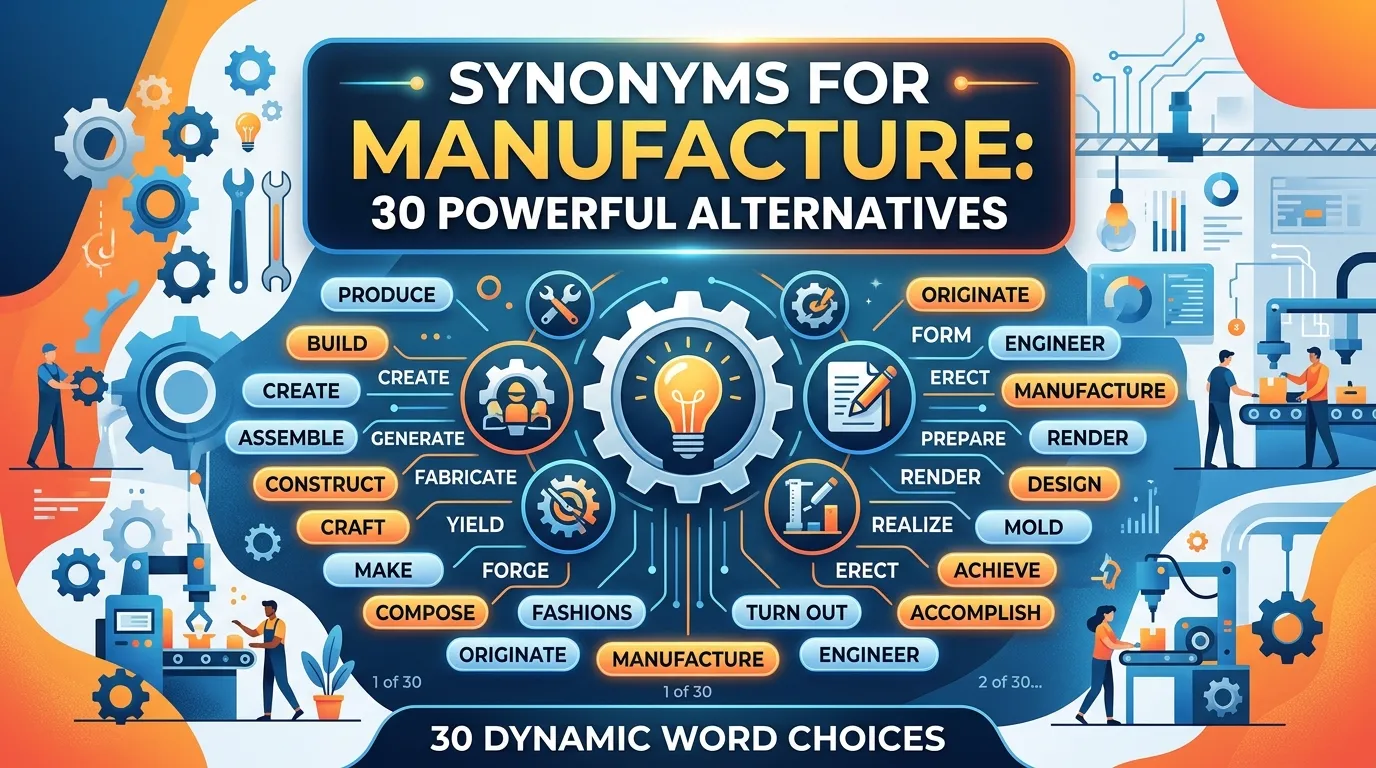
30 Synonyms of Manufacture With Meaning & Examples
1. Produce (Verb)
Meaning: To make or create something, especially in a planned or organized way.
Examples:
- The factory produces thousands of phones each month.
- Local farms produce fresh vegetables.
2. Make (Verb)
Meaning: To create or build something from materials or parts.
Examples:
- They make furniture from recycled wood.
- This company makes high-quality shoes.
3. Create (Verb)
Meaning: To bring something new into existence.
Examples:
- The team created a new product.
- Designers create useful tools for customers.
4. Fabricate (Verb)
Meaning: To make something, often from separate materials or parts.
Examples:
- The company fabricates metal components.
- Workers fabricated the parts in a modern facility.
5. Build (Verb)
Meaning: To construct something by putting parts or materials together.
Examples:
- The company builds industrial machines.
- Workers built the equipment in six weeks.
6. Construct (Verb)
Meaning: To build something carefully from different parts.
Examples:
- Engineers constructed the machine from steel.
- The factory constructs large storage units.
7. Assemble (Verb)
Meaning: To put separate parts together to form a complete product.
Examples:
- Workers assemble computers on the production line.
- The team assembled the device in the factory.
8. Craft (Verb)
Meaning: To make something with skill and care.
Examples:
- Skilled workers craft wooden furniture.
- The company crafts handmade leather bags.
9. Fashion (Verb)
Meaning: To shape or make something carefully, often with skill.
Examples:
- The artist fashioned a bowl from clay.
- Workers fashion metal into useful tools.
10. Form (Verb)
Meaning: To shape something into a particular structure or design.
Examples:
- Machines form plastic into containers.
- The workers formed the metal into sheets.
11. Shape (Verb)
Meaning: To give something a particular form or appearance.
Examples:
- Machines shape the steel into parts.
- Workers shape the material with special tools.
12. Mold (Verb)
Meaning: To shape a material by pressing or forming it into a particular shape.
Examples:
- The factory molds plastic into bottles.
- The material is molded into different parts.
13. Forge (Verb)
Meaning: To make or shape something, especially metal, using heat and force.
Examples:
- The company forges strong steel components.
- Workers forged the metal under extreme heat.
14. Develop (Verb)
Meaning: To create or improve a product, system, or idea through planning and testing.
Examples:
- Engineers developed a new engine.
- The company develops advanced medical devices.
15. Engineer (Verb)
Meaning: To design and create something using technical knowledge.
Examples:
- Scientists engineered a safer battery.
- The company engineers advanced computer systems.
16. Generate (Verb)
Meaning: To produce or create something.
Examples:
- The machine generates electricity.
- The system generates useful energy from solar power.
17. Construct (Verb)
Meaning: To put materials or parts together to create a complete structure or product.
Examples:
- The company constructs industrial equipment.
- Workers constructed the device from several parts.
18. Turn Out (Phrasal Verb)
Meaning: To produce or make something, often in large quantities.
Examples:
- The factory turns out thousands of products daily.
- This plant turns out high-quality electronic parts.
19. Mass-Produce (Verb)
Meaning: To manufacture large quantities of the same product.
Examples:
- The company mass-produces affordable vehicles.
- These parts are mass-produced in modern factories.
20. Process (Verb)
Meaning: To treat raw materials so they become usable or finished products.
Examples:
- The factory processes raw cotton into fabric.
- The plant processes food for supermarkets.
21. Prepare (Verb)
Meaning: To make something ready for use, sale, or another purpose.
Examples:
- The company prepares products for shipment.
- Workers prepare the materials before production.
22. Devise (Verb)
Meaning: To create a plan, method, or system through careful thought.
Examples:
- Engineers devised a new production method.
- The team devised a better way to make the product.
23. Design (Verb)
Meaning: To plan how something will look, work, or be made.
Examples:
- Engineers design machines for factories.
- The company designed a new production system.
24. Invent (Verb)
Meaning: To create something new that did not exist before.
Examples:
- The scientist invented a new device.
- The company invented a tool for faster production.
25. Concoct (Verb)
Meaning: To create or prepare something by combining different elements.
Examples:
- The team concocted a new chemical mixture.
- The chef concocted a unique sauce.
26. Manufacture Artificially (Verb Phrase)
Meaning: To create something through an artificial or controlled process rather than allowing it to occur naturally.
Examples:
- Scientists can manufacture artificially certain materials.
- The process helps manufacture artificially specific compounds.
27. Industrialize (Verb)
Meaning: To develop production on an industrial or factory-based scale.
Examples:
- The company industrialized its production process.
- New technology helped industrialize the industry.
28. Make Up (Phrasal Verb)
Meaning: To create or invent something, especially an idea, story, or explanation.
Examples:
- He made up a story about the missing product.
- The writer made up a fictional company.
29. Turn Into (Phrasal Verb)
Meaning: To change or transform one material or thing into another.
Examples:
- The factory turns raw materials into finished goods.
- Machines turn plastic into useful products.
30. Manufacture (Noun)
Meaning: The process or activity of producing goods.
Examples:
- The manufacture of cars requires many skilled workers.
- Modern manufacture depends heavily on technology.
Prototype Meaning
The most typical meaning of manufacture is to produce goods through an organized process, especially in a factory. When people hear manufacture, they often imagine machines, workers, raw materials, assembly lines, and finished products. The word usually suggests planned production rather than simply making something casually.
Prototype Categorization
The 30 alternatives can be grouped by their main meaning and use. This helps writers select a word that matches the exact situation instead of replacing manufacture with a synonym that sounds unnatural.
- General production: produce, make, create, generate, and turn out are useful when talking about making something in a broad sense.
- Factory and industrial production: fabricate, mass-produce, process, assemble, and industrialize fit manufacturing and business contexts.
- Building and construction: build and construct work best when something is physically put together from parts or materials.
- Skilled or artistic making: craft, fashion, shape, and mold suggest skill, design, or careful physical work.
- Metal production: forge is especially useful for shaping metal with heat or force.
- Technical creation: develop, engineer, devise, and design are common for products, systems, machines, and technical solutions.
- New invention: invent works when something genuinely new is created.
- Transformation: process and turn into emphasize changing raw materials into another form.
- Informal creation: make up and concoct are useful for invented stories, ideas, explanations, or mixtures.
- Large-scale production: mass-produce is the strongest choice when the key idea is making large quantities of identical products.
Antonyms of Manufacture
1. Destroy (Verb)
Meaning: To damage something so it no longer exists or works.
2. Demolish (Verb)
Meaning: To completely destroy a building or structure.
3. Dismantle (Verb)
Meaning: To take something apart into separate pieces.
4. Deconstruct (Verb)
Meaning: To break something down into its separate parts.
5. Disassemble (Verb)
Meaning: To separate a product or structure into its components.
6. Break (Verb)
Meaning: To damage something so it no longer works or stays whole.
7. Eliminate (Verb)
Meaning: To remove or get rid of something.
8. Consume (Verb)
Meaning: To use something until little or none remains.
Short Questions and Answers
What does manufacture mean?
Manufacture means to make or produce goods, often in large quantities through machines, tools, or an organized process.
When should manufacture be used?
Use manufacture when discussing the production of goods, especially in factories, industries, businesses, and organized production systems.
Is manufacture positive or negative?
Manufacture is usually neutral. Its tone depends on context. It can suggest efficient production in one sentence and artificial creation in another.
How is it different from similar words?
Manufacture often suggests organized or industrial production. Craft suggests skilled or careful making, assemble means putting parts together, fabricate often focuses on making components, and create has a much broader meaning.
Conclusion
Learning manufacture and its synonyms can make your English clearer and more flexible. The word is especially useful when discussing factories, products, business, industry, and production. However, its alternatives can express more specific ideas. You can use craft for skilled making, assemble for putting parts together, forge for shaping metal, develop for creating products or systems, and mass-produce for making goods in large quantities. Knowing these differences helps you avoid repetition and choose words that match your exact meaning. It also strengthens both writing and speaking skills. For better results, practice a few new synonyms each day and use them in your own sentences. Regular vocabulary practice will help you write with greater accuracy, variety, and confidence.
Related words: Synonyms for Handling: 30 Powerful Words to Know

English Teacher & Linguistics Writer
Grace Whitmore creates engaging educational content on vocabulary, word usage, and effective communication. Her goal is to help learners build confidence through clear and practical English guidance.