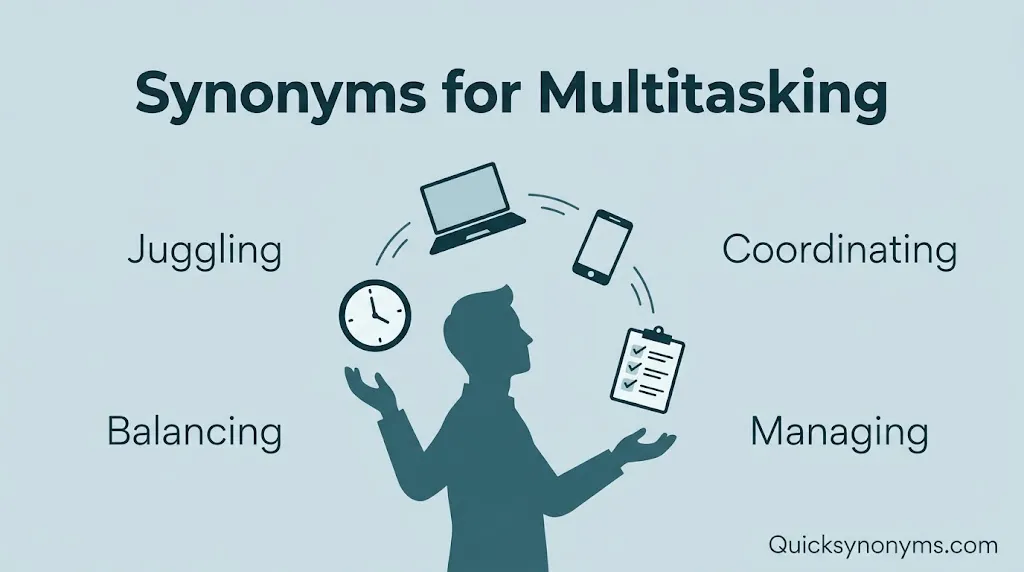
Multitasking means handling more than one task at the same time.
Picture a parent cooking dinner, answering a work email, and helping with homework, all within the same ten minutes. That’s multitasking in action.
People use this word often because modern life rarely allows one task at a time. Jobs, homes, and even phones ask us to juggle several things at once.
Learning synonyms for multitasking helps English learners and content writers avoid repeating the same word. It also helps resumes, articles, and everyday speech sound more natural and precise.
This article covers the meaning of multitasking, its history, pronunciation, word formation, and 20 useful synonyms with clear examples.
Meaning of Multitasking
Definition
Multitasking (Noun/Gerund): Doing or managing more than one task at the same time.
Examples
- She’s good at multitasking during busy shifts.
- Multitasking helped him finish three projects in one day.
Connotative Meaning
- Positive tone: Multitasking can sound impressive, showing skill, energy, and efficiency.
- Negative tone: It can also suggest stress, distraction, or lower quality work.
- Neutral tone: It can simply describe doing more than one task, without judging how well it went.
(Connotation: the feeling or idea a word suggests beyond its basic meaning.)
Etymology
- Old English (450–1100): Neither part of the word existed in its modern form. Task traces back later through Old French.
- Middle English (1100–1500): Task entered English through Old French tasque, from Latin taxare (to assess or tax). Multi- is a Latin prefix meaning “many,” though it wasn’t combined with task until much later.
- Modern English (1500–Present): Multitasking first described computers running several programs at once. By the late 20th century, people began using it to describe humans handling multiple tasks together.
Pronunciation (IPA)
- IPA: /ˌmʌl.tiˈtæsk.ɪŋ/
- Syllables: mul-ti-task-ing
Affixation Pattern of Multitasking
- Root: task
- Prefix: multi- (meaning “many”)
- Suffix: -ing (forms the gerund or present participle)
- Word formations:
- multitask (verb)
- multitasker (noun)
- multitasked (verb, past tense)
- multitasking (noun/adjective)
20 Synonyms of Multitasking With Meaning & Examples
1. Juggling (Verb/Gerund)
Meaning: Managing several tasks or demands at the same time.
Examples:
- She’s juggling three clients this week.
- He is juggling work and childcare every morning.
2. Balancing (Verb/Gerund)
Meaning: Managing multiple responsibilities without letting any one fall behind.
Examples:
- She is balancing school and a part-time job.
- He balances two projects without missing deadlines.
3. Multiprocessing (Noun)
Meaning: Handling several tasks or processes at once, often in technical contexts.
Examples:
- The system relies on multiprocessing to run faster.
- Engineers designed the chip for smoother multiprocessing.
4. Task-Switching (Noun)
Meaning: Moving quickly between different tasks instead of doing them at the exact same time.
Examples:
- Constant task-switching can slow down focus.
- Her day involved nonstop task-switching between calls and emails.
5. Doing Several Things at Once (Verb Phrase)
Meaning: Handling more than one activity during the same period.
Examples:
- She was doing several things at once during the launch.
- He got used to doing several things at once at his new job.
6. Managing Multiple Priorities (Verb Phrase)
Meaning: Handling several important tasks that all need attention.
Examples:
- She’s skilled at managing multiple priorities under pressure.
- He spent the morning managing multiple priorities at once.
7. Polytasking (Noun/Gerund)
Meaning: An informal term for handling many tasks at the same time.
Examples:
- Her polytasking skills impressed the whole team.
- He joked about his polytasking during finals week.
8. Handling Multiple Responsibilities (Verb Phrase)
Meaning: Being in charge of several duties at the same time.
Examples:
- She’s handling multiple responsibilities as both manager and trainer.
- He handled multiple responsibilities during the busy season.
9. Parallel Processing (Noun Phrase)
Meaning: Working on more than one task at the same time, often used for computers or complex systems.
Examples:
- The software uses parallel processing to save time.
- Their team relies on parallel processing to handle big data sets.
10. Spinning Plates (Idiom)
Meaning: Managing many tasks at once, often with a sense of pressure.
Examples:
- She felt like she was spinning plates all week.
- Running three departments meant constantly spinning plates.
11. Wearing Many Hats (Idiom)
Meaning: Taking on several different roles or responsibilities.
Examples:
- At a small company, employees often wear many hats.
- She wears many hats as founder, designer, and marketer.
12. Splitting Your Attention (Verb Phrase)
Meaning: Dividing focus between two or more tasks.
Examples:
- He kept splitting his attention between the call and the report.
- Splitting your attention too often can lower your focus.
13. Working Simultaneously (Adverb Phrase)
Meaning: Carrying out tasks at the same time.
Examples:
- The teams worked simultaneously to meet the deadline.
- She answered emails while working simultaneously on the report.
14. Dividing Your Focus (Verb Phrase)
Meaning: Sharing attention across more than one task.
Examples:
- Dividing your focus between two screens can slow you down.
- He divided his focus between driving and the phone call, which wasn’t safe.
15. Managing Competing Demands (Verb Phrase)
Meaning: Handling several urgent needs that require attention at once.
Examples:
- She’s managing competing demands from two departments.
- He managed competing demands during the product launch.
16. Doing Double Duty (Idiom)
Meaning: Serving two purposes or handling two roles at once.
Examples:
- This room does double duty as an office and guest room.
- She did double duty as both host and organizer.
17. Coordinating Multiple Tasks (Verb Phrase)
Meaning: Organizing and managing several tasks so they work together smoothly.
Examples:
- He’s coordinating multiple tasks across three teams.
- She coordinated multiple tasks to keep the event on schedule.
18. Overseeing Several Projects (Verb Phrase)
Meaning: Supervising more than one project at the same time.
Examples:
- She’s overseeing several projects this quarter.
- He oversees several projects while training new staff.
19. Simultaneous Task Management (Noun Phrase)
Meaning: The organized handling of multiple tasks at once, often used in formal or technical writing.
Examples:
- The role requires strong simultaneous task management skills.
- Her resume highlighted her simultaneous task management experience.
20. Cross-Tasking (Noun/Gerund)
Meaning: Handling tasks from different areas or departments at the same time.
Examples:
- Cross-tasking helped her understand every part of the business.
- He got comfortable with cross-tasking after his first year.
Prototype Meaning
The most typical meaning of multitasking is handling more than one task during the same period of time. When people hear the word, they often picture someone busy with several duties at once, whether at work, at home, or on a device. The word can describe smooth, skillful handling of tasks or a stressful, scattered attempt to keep up with too much at once.
Prototype Categorization
- Everyday phrases: juggling, balancing, doing several things at once, wearing many hats. These fit casual, spoken English.
- Workplace and resume language: managing multiple priorities, handling multiple responsibilities, coordinating multiple tasks, overseeing several projects. These suit professional writing.
- Technical and formal terms: multiprocessing, parallel processing, task-switching, simultaneous task management. These fit technical or academic contexts.
- Idioms and expressions: spinning plates, doing double duty. These add color and personality to writing.
- Focus-related phrases: splitting your attention, dividing your focus, working simultaneously. These describe how attention is shared across tasks.
Grouping these words this way helps writers pick the right tone. For example, wearing many hats fits a friendly bio, while simultaneous task management fits a formal resume.
Antonyms of Multitasking
Focusing (Verb/Gerund)
Meaning: Giving full attention to a single task.
Single-tasking (Noun/Gerund)
Meaning: Doing only one task at a time.
Concentrating (Verb/Gerund)
Meaning: Directing full attention toward one thing.
Prioritizing (Verb/Gerund)
Meaning: Choosing one task to complete before starting another.
Sequential Working (Noun Phrase)
Meaning: Completing tasks one after another, rather than at the same time.
Short Questions and Answers
What does multitasking mean?
Multitasking means handling more than one task during the same period of time.
When should multitasking be used?
Use multitasking when describing someone managing several duties, tasks, or roles at once, whether at work, at home, or with technology.
Is multitasking positive or negative?
Multitasking can be positive when it shows skill and efficiency, but it can sound negative when it suggests stress, distraction, or lower quality work.
How is it different from similar words?
Multitasking usually means doing tasks at the same time, while task-switching means moving quickly between tasks rather than doing them together. Wearing many hats focuses more on different roles than on doing tasks simultaneously.
Conclusion
Learning synonyms for multitasking helps you describe busy, demanding situations with more precision. Words such as juggling and balancing work well for everyday speech, while managing multiple priorities and coordinating multiple tasks suit resumes and professional writing.
Using different words instead of repeating multitasking keeps your writing fresh and specific. It also helps you match your tone, whether you’re writing a casual message or a formal report.
Practicing these words in real sentences builds confidence and makes your English sound more natural. If you want to understand the research behind why multitasking is often less effective than it feels, the American Psychological Association has published useful findings on the subject.
Want to expand your vocabulary further? Check out Synonyms for Implemented in Resume: 25 Smart Alternatives

ESL Writing Coach
Olivia Bennett helps English learners strengthen their writing, expand their vocabulary, and communicate more naturally. Her content is designed to make everyday and professional English simple and accessible.