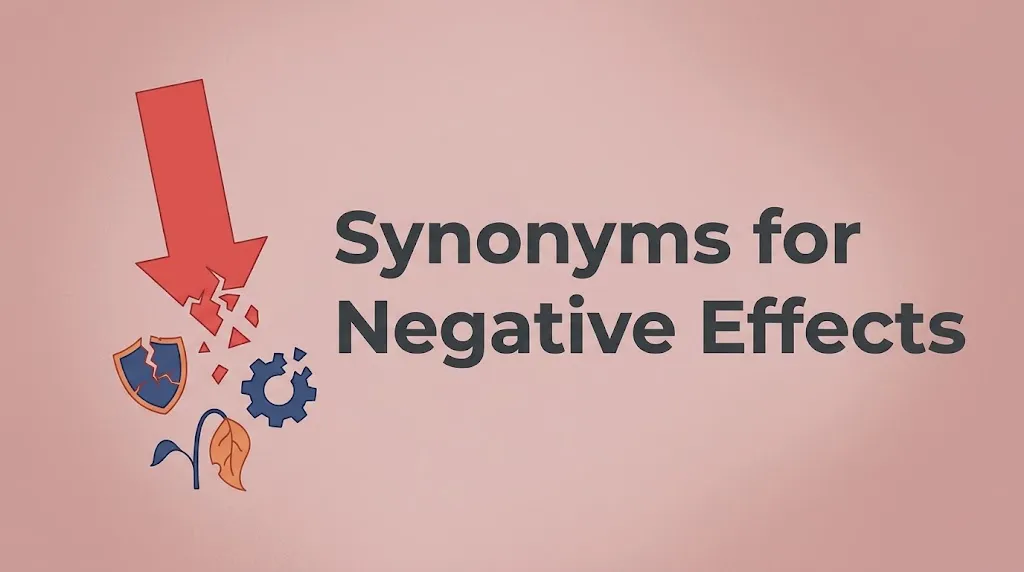
The best synonyms for negative effects include adverse effects, detrimental effects, harmful consequences, drawbacks, and downsides. These words are used when something causes harm, damage, or an unwanted outcome, with the exact choice depending on the field, tone, and severity of the impact.
Negative effects describes any outcome, result, or influence that causes harm, loss, or an unwanted change. Imagine a medication that disrupts sleep, a policy that hurts small businesses, or a habit that damages a relationship. In each case, the phrase can describe what went wrong.
Learning synonyms for negative effects helps you express the exact kind of harm or consequence you mean. Some alternatives focus on medical or scientific outcomes, while others highlight financial loss, emotional damage, or long-term risk. This guide explains their meanings, tones, examples, and best uses so you can choose the right word with confidence.
Meaning of Negative Effects
Definition
Negative effects (noun phrase): results or outcomes that are harmful, damaging, or unfavorable, often occurring as a consequence of an action, decision, substance, or event.
Example
- Skipping breakfast can have negative effects on concentration throughout the day.
Connotative Meaning
- Positive tone: Not applicable. The phrase inherently signals harm or an unwanted outcome.
- Negative tone: Suggests harm, damage, risk, or loss, whether physical, financial, emotional, or social.
- Neutral tone: Can be used descriptively in research or reporting, simply noting an outcome without emotional weight, as in “the study measured the negative effects of the treatment.”
(Connotation means the feeling or idea a phrase suggests beyond its basic meaning.)
Formal vs Informal Usage
Negative effects is generally neutral to formal. It appears often in medical, scientific, business, environmental, and academic writing, as well as in everyday conversation.
Etymology
The phrase negative effects combines two words with distinct origins that developed separately before pairing together in modern English.
- Old English (450-1100): Neither word existed in its modern form. Both developed later through Latin roots absorbed into English.
- Middle English (1100-1500): Effect entered English through Old French effect, from Latin effectus (a result, a thing accomplished). Negative arrived slightly later, from Latin negativus, related to negare (to deny).
- Modern English (1500-Present): The two words combined into the fixed phrase negative effects, commonly used to describe harmful or unwanted outcomes across science, medicine, business, and everyday speech.
Pronunciation (IPA)
- IPA: /ˈnɛɡ.ə.tɪv ɪˈfɛkts/
- Syllables: negative (3 syllables), effects (2 syllables)
- US/UK difference: The stress pattern and vowel sounds are essentially the same in both varieties.
Affixation Pattern of Negative Effects
- Root: neg (related to denial or refusal), fect (related to making or doing)
- Prefix: ef- (a form of ex-, meaning “out of”)
- Suffix: -ative (negative), -s (effects, plural marker)
- Word formations:
- negate (verb): to make ineffective or deny the truth of something
- negativity (noun): the quality of being negative or pessimistic
- affect (verb): to influence or produce a change in something
- effective (adjective): producing a desired or intended result
30 Synonyms of Negative Effects With Meaning & Examples
1. Adverse Effects (Noun Phrase)
Meaning: Harmful or unwanted results, often used in medical or scientific contexts.
Examples:
- The drug’s adverse effects included nausea and fatigue.
- Researchers monitored the adverse effects of the new fertilizer.
Best for: Medical and scientific writing
2. Detrimental Effects (Noun Phrase)
Meaning: Damaging results that reduce quality, value, or wellbeing.
Examples:
- Excessive noise has detrimental effects on productivity.
- The policy’s detrimental effects were felt across the industry.
Best for: Formal essays and academic arguments
3. Harmful Consequences (Noun Phrase)
Meaning: Results that cause damage, injury, or loss.
Examples:
- The decision led to harmful consequences for local farmers.
- Ignoring the warning had harmful consequences for the entire team.
Best for: General formal writing
4. Deleterious Effects (Noun Phrase)
Meaning: Seriously harmful effects, often used in technical or scientific contexts.
Examples:
- Pollution has deleterious effects on marine life.
- The study examined the deleterious effects of chronic stress.
Best for: Highly formal or scientific writing
5. Injurious Effects (Noun Phrase)
Meaning: Effects that cause harm or injury, often physical.
Examples:
- The chemical has injurious effects on skin.
- Long exposure produced injurious effects on the workers.
Best for: Legal or health-related contexts
6. Unfavorable Consequences (Noun Phrase)
Meaning: Outcomes that work against a desired result.
Examples:
- The merger produced unfavorable consequences for shareholders.
- Poor planning led to unfavorable consequences for the launch.
Best for: Business and policy analysis
7. Adverse Consequences (Noun Phrase)
Meaning: Unwanted results that follow a decision or action.
Examples:
- The report outlined the adverse consequences of the new tax.
- Cutting corners can bring adverse consequences later.
Best for: Risk assessments and reports
8. Negative Repercussions (Noun Phrase)
Meaning: Indirect or delayed harmful results that follow an event.
Examples:
- The scandal had negative repercussions for the company’s reputation.
- Missing the deadline caused negative repercussions across departments.
Best for: Long-term or indirect outcomes
9. Detrimental Impact (Noun Phrase)
Meaning: A strong, harmful influence on something.
Examples:
- Deforestation has a detrimental impact on local wildlife.
- The strike had a detrimental impact on production schedules.
Best for: Environmental and social studies
10. Downsides (Noun)
Meaning: Disadvantages or drawbacks of a situation or choice.
Examples:
- One of the downsides of remote work is isolation.
- Every plan has its downsides.
Best for: Everyday and conversational writing
11. Drawbacks (Noun)
Meaning: Disadvantages that reduce the appeal or value of something.
Examples:
- The main drawback of the new system is its cost.
- Despite its drawbacks, the plan moved forward.
Best for: Casual writing and reviews
12. Fallout (Noun)
Meaning: The harmful aftermath of a specific event or decision.
Examples:
- The company is still dealing with the fallout from the recall.
- Political fallout followed the announcement.
Best for: Event-driven consequences
13. Setbacks (Noun)
Meaning: Problems that slow down or reverse progress.
Examples:
- The project faced several setbacks last quarter.
- A funding setback delayed the launch.
Best for: Project and progress-related contexts
14. Side Effects (Noun Phrase)
Meaning: Secondary and often unwanted results of an action, especially medication.
Examples:
- Common side effects include headaches and dizziness.
- The treatment caused unexpected side effects.
Best for: Medical writing
15. Bad Influence (Noun Phrase)
Meaning: A harmful effect on someone’s behavior or choices.
Examples:
- Social media can be a bad influence on self-esteem.
- His friends were a bad influence during college.
Best for: Relationships and behavior
16. Harmful Effects (Noun Phrase)
Meaning: Results that cause damage or injury.
Examples:
- Sunlight overexposure has harmful effects on skin.
- The chemical spill had harmful effects on the river.
Best for: General scientific or health writing
17. Undesirable Effects (Noun Phrase)
Meaning: Results that are unwanted, even if not severely damaging.
Examples:
- The policy produced several undesirable effects.
- Overtraining can lead to undesirable effects on the body.
Best for: Neutral, formal descriptions
18. Damaging Effects (Noun Phrase)
Meaning: Effects that reduce quality, function, or value.
Examples:
- The scandal had damaging effects on public trust.
- Erosion has damaging effects on coastal land.
Best for: Environmental and reputational contexts
19. Negative Impact (Noun Phrase)
Meaning: A general term for harmful influence or result.
Examples:
- The layoffs had a negative impact on morale.
- Climate change has a negative impact on agriculture.
Best for: General-purpose formal and informal writing
20. Negative Outcomes (Noun Phrase)
Meaning: Unfavorable results of a process, decision, or event.
Examples:
- The trial recorded several negative outcomes.
- Poor communication often leads to negative outcomes.
Best for: Research and analysis
21. Ramifications (Noun)
Meaning: A complex chain of consequences following an action.
Examples:
- The decision had legal ramifications.
- Few considered the long-term ramifications of the policy.
Best for: Legal, political, and strategic writing
22. Blowback (Noun)
Meaning: A strong negative reaction, often against a decision or policy.
Examples:
- The announcement caused immediate blowback from customers.
- Political blowback forced the committee to reconsider.
Best for: Informal writing about reactions to decisions
23. Costs (Noun)
Meaning: Losses or sacrifices, not necessarily financial.
Examples:
- The costs of neglecting sleep add up over time.
- Every choice carries certain costs.
Best for: Broad, everyday descriptions of loss
24. Health Risks (Noun Phrase)
Meaning: Potential dangers to physical or mental wellbeing.
Examples:
- Smoking carries serious health risks.
- The report listed the health risks of the chemical.
Best for: Medical and public health writing
25. Downside Risk (Noun Phrase)
Meaning: The potential for a negative financial or business outcome.
Examples:
- Investors weighed the downside risk before committing.
- The plan carries significant downside risk.
Best for: Finance and business writing
26. Negative Externalities (Noun Phrase)
Meaning: Harmful side effects of an activity that impact third parties.
Examples:
- Air pollution is a classic negative externality.
- The factory’s negative externalities affected nearby residents.
Best for: Economics and policy writing
27. Damaging Consequences (Noun Phrase)
Meaning: Serious harmful results following an action or event.
Examples:
- The leak had damaging consequences for the ecosystem.
- Poor oversight led to damaging consequences for investors.
Best for: Formal reports and journalism
28. Negative Fallout (Noun Phrase)
Meaning: The lingering harmful results after a major event or decision.
Examples:
- The company faced negative fallout for months.
- Negative fallout from the merger affected staff morale.
Best for: Business and organizational contexts
29. Unintended Consequences (Noun Phrase)
Meaning: Harmful results that were not planned or expected.
Examples:
- The regulation produced several unintended consequences.
- Automation had unintended consequences for smaller suppliers.
Best for: Policy and systems analysis
30. Ecological Impact (Noun Phrase)
Meaning: Harmful influence on the environment or natural systems.
Examples:
- The spill’s ecological impact lasted for years.
- Scientists measured the ecological impact of the dam.
Best for: Environmental and scientific writing
Negative Effects vs Its Closest Synonym
Unlike drawbacks, negative effects often implies a measurable or observable result rather than a general disadvantage. For example, “a plan with drawbacks” simply notes weak points, while “a plan with negative effects on morale” points to an actual outcome that occurred.
Unlike side effects, negative effects is not limited to secondary or unintended results. Side effects usually refers to outcomes that occur alongside an intended action, such as medication, while negative effects can describe any harmful result, direct or indirect, planned for or not.
Prototype Meaning
The most typical meaning of negative effects is a harmful or unwanted result that follows an action, decision, substance, or event. When people hear the phrase, they often imagine a health risk, a financial loss, environmental damage, or a decline in wellbeing.
The phrase can describe both immediate, visible harm and slower, cumulative damage, such as the negative effects of poor sleep over several years.
Prototype Categorization
- Medical and physical harm: adverse effects, side effects, injurious effects, harmful effects
- Formal and academic harm: detrimental effects, deleterious effects, negative repercussions
- Business and financial harm: downside risk, unfavorable consequences, negative externalities
- Environmental harm: ecological impact, damaging effects, detrimental impact
- Everyday and conversational harm: downsides, drawbacks, setbacks, costs
- Event-driven harm: fallout, blowback, negative fallout
- Complex or delayed harm: ramifications, unintended consequences, negative repercussions
These categories help writers choose a synonym based on the type and timing of harm, rather than replacing negative effects with a word that only partly matches its meaning.
Antonyms of Negative Effects
- Benefits (noun): advantages or helpful results.
- Positive effects (noun phrase): favorable or beneficial outcomes.
- Advantages (noun): favorable circumstances or conditions.
- Gains (noun): improvements or increases in value.
- Upsides (noun): the favorable aspects of a situation.
- Improvements (noun): positive changes that increase quality or value.
- Positive outcomes (noun phrase): favorable results of an action or decision.
Short Questions and Answers
What does negative effects mean?
Negative effects means harmful or unwanted results that follow an action, decision, substance, or event. It can describe physical, financial, emotional, or environmental harm.
Is negative effects a formal phrase?
Yes, it is neutral to formal and appears often in medical, scientific, business, and academic writing, as well as everyday speech.
What is the best synonym for negative effects?
Adverse effects works well for medical and scientific writing, while drawbacks or downsides suit casual, everyday writing.
Is negative effects the same as side effects?
Not exactly. Side effects usually refers to secondary results of a specific action, like medication, while negative effects can describe any kind of harm, direct or indirect.
What is a formal synonym for negative effects?
Deleterious effects, detrimental effects, and adverse consequences work well as formal alternatives, depending on the field.
Can negative effects describe long-term harm?
Yes. Phrases like negative repercussions and unintended consequences are often used to describe harm that appears gradually or becomes clear only after time has passed.
Conclusion
Learning synonyms for negative effects gives you more control over how you describe harm, risk, and unwanted outcomes. Words such as adverse effects work well in medical and scientific writing, while downsides and drawbacks fit casual, everyday language, and ramifications points to a complex chain of consequences.
These words can also make everyday speech and formal writing more precise. Instead of repeating negative effects, you can select a synonym that shows exactly what kind of harm occurred and why it matters. Practice by writing a few sentences with different alternatives each day. Over time, this will strengthen your vocabulary, improve your descriptions, reduce repetition, and make you more confident when speaking or writing.
Want to expand your vocabulary further? Check out Synonyms for Positives: 40 Words to Boost Your Vocabulary

Lexicographer & Vocabulary Specialist
Nathan Carter focuses on English vocabulary, synonyms, antonyms, and word meanings. He is passionate about producing clear, accurate, and easy-to-understand language guides for readers of all levels.