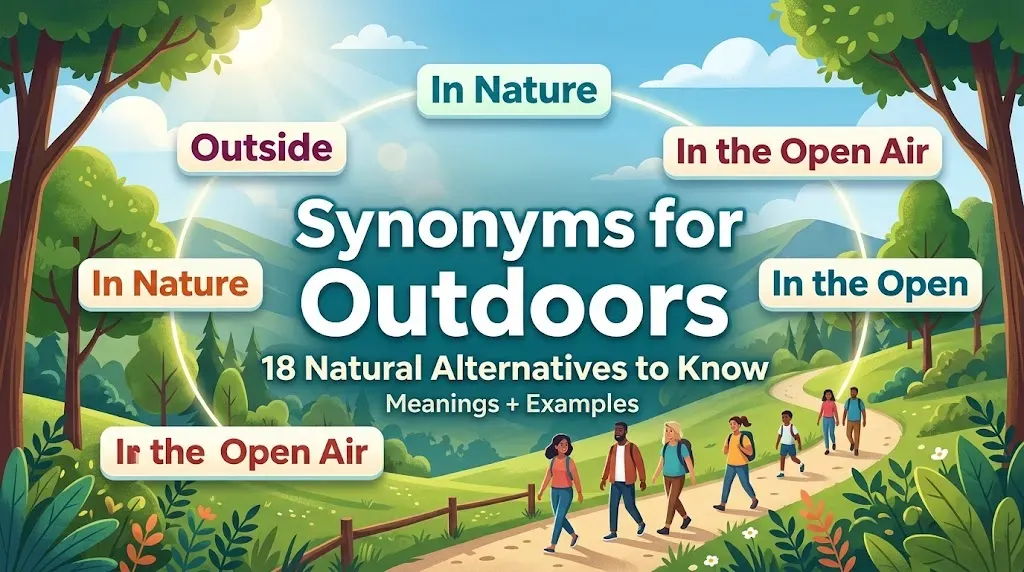
Synonyms for Outdoors include outside, out of doors, in the open, and in the open air. Other useful alternatives include out in nature, in nature, under the sky, in the fresh air, and in the great outdoors.
Outdoors means being or doing something outside, rather than inside a building. For example, you might say, “The children are playing outdoors” when they are playing outside.
The word is common in everyday English. It is often used when talking about nature, fresh air, recreation, sports, travel, and outdoor activities.
Learning synonyms for outdoors helps English learners choose words that fit different situations. It also helps students, writers, bloggers, and content creators avoid repeating the same word.
Different alternatives can create slightly different images or tones. Some sound casual, while others are more descriptive or specific.
In this guide, you will learn the meaning, examples, pronunciation, etymology, word formation, synonyms, semantic categories, antonyms, and common usage differences of outdoors.
Meaning of Outdoors
Definition
Outdoors (Adverb/Noun): In or into a place that is outside, especially away from buildings or enclosed spaces.
As an adverb, outdoors usually describes an action that happens outside.
Examples
- The children are playing outdoors.
- We spent most of the afternoon outdoors.
- Fresh air makes working outdoors enjoyable.
- They prefer eating outdoors in summer.
Connotative Meaning
Connotation: Outdoors often suggests open space, fresh air, nature, freedom, and outdoor activity.
Positive tone: It can suggest freedom, relaxation, health, adventure, and enjoyment.
Negative tone: The word itself is usually neutral, but being outdoors can suggest discomfort when the weather is cold, hot, rainy, or unsafe.
Neutral tone: It can simply describe a location outside a building.
Etymology
The word outdoors developed from the phrase out of doors, meaning outside or away from an enclosed building.
- Old English (450–1100): The modern word outdoors does not come directly from a single Old English word. Its parts have older Germanic roots, especially out and door.
- Middle English (1100–1500): English used expressions involving out and door to describe being outside.
- Modern English (1500–Present): Out of doors became an established expression for being outside. The single-word form outdoors later became common as an adverb and noun.
The related word outdoor combines out with door and literally suggests what is beyond a door or outside a building.
Pronunciation (IPA)
- IPA: /ˌaʊtˈdɔːrz/
- Syllables: out-doors
Affixation Pattern of Outdoors
The word outdoors is a compound formation rather than a simple root with a normal prefix and suffix.
- Root elements: out + door
- Prefix: None
- Suffix: None in the usual morphological sense
- Formation: out + doors
The final -s reflects the plural form of door in the historical phrase out of doors. In modern outdoors, the whole word functions mainly as an adverb.
Word Formations
- outdoors – adverb: outside or in an open-air place
- outdoor – adjective: relating to activities or places outside
- outdoor activity – noun phrase: an activity done outside
- outdoorsy – adjective: enjoying or suited to outdoor activities
18 Synonyms of Outdoors With Meaning & Examples
1. Outside (Adverb)
Meaning: In or to a place that is not inside a building or enclosed space.
Examples:
- The children are playing outside.
- Please wait outside the building.
2. Out of Doors (Adverbial Phrase)
Meaning: Outside, especially away from buildings.
Examples:
- We spent the whole day out of doors.
- They enjoy exercising out of doors.
3. In the Open (Adverbial Phrase)
Meaning: In an open area rather than inside or enclosed.
Examples:
- The ceremony was held in the open.
- We decided to sleep in the open.
4. In the Open Air (Adverbial Phrase)
Meaning: Outside where there is natural air and no enclosed roof.
Examples:
- We enjoyed lunch in the open air.
- Exercising in the open air can feel refreshing.
5. In the Fresh Air (Adverbial Phrase)
Meaning: Outside where you can enjoy clean or natural air.
Examples:
- I like reading in the fresh air.
- The doctor encouraged him to spend time in the fresh air.
6. In Nature (Adverbial Phrase)
Meaning: In a natural outdoor environment rather than an urban or indoor setting.
Examples:
- She loves spending weekends in nature.
- We learned a lot while walking in nature.
7. Out in Nature (Adverbial Phrase)
Meaning: Outside in a natural environment.
Examples:
- We spent the weekend out in nature.
- He feels relaxed when he is out in nature.
8. In the Great Outdoors (Noun Phrase)
Meaning: In large, natural outdoor spaces, especially away from cities.
Examples:
- They love hiking in the great outdoors.
- Camping lets us enjoy the great outdoors.
9. Under the Sky (Adverbial Phrase)
Meaning: In an open outdoor place with the sky above you.
Examples:
- We had dinner under the sky.
- They spent the evening talking under the sky.
10. Beneath the Sky (Adverbial Phrase)
Meaning: Outside in an open area with the sky overhead.
Examples:
- The group gathered beneath the sky.
- We rested beneath the sky after the hike.
11. In an Open Space (Adverbial Phrase)
Meaning: In a place that is open and not enclosed by buildings or walls.
Examples:
- The children played in an open space.
- We held the meeting in an open space.
12. In the Open Country (Adverbial Phrase)
Meaning: Outside in rural or undeveloped land.
Examples:
- They enjoy riding horses in the open country.
- We spent the afternoon walking in the open country.
13. Outside the House (Adverbial Phrase)
Meaning: In an area beyond the walls of a house.
Examples:
- The dog is sleeping outside the house.
- We sat outside the house and talked.
14. Outside the Building (Adverbial Phrase)
Meaning: In an area beyond the walls of a building.
Examples:
- Several people were waiting outside the building.
- We met outside the building after work.
15. In the Natural World (Adverbial Phrase)
Meaning: In the outdoor environment of plants, animals, and natural surroundings.
Examples:
- Children can learn a lot in the natural world.
- We observed many birds in the natural world.
16. Al Fresco (Adverbial Phrase)
Meaning: Outside, especially when eating or spending leisure time.
Examples:
- We enjoyed dinner al fresco.
- The café lets guests dine al fresco.
17. In the Outdoors (Prepositional Phrase)
Meaning: In an outdoor environment or open-air setting.
Examples:
- Many people enjoy working in the outdoors.
- She feels happiest in the outdoors.
18. In Open Country (Adverbial Phrase)
Meaning: Outside in wide, uncrowded rural land.
Examples:
- The hikers traveled in open country.
- We spent the morning riding in open country.
Prototype Meaning
The prototype meaning of outdoors is simply outside, away from enclosed buildings.
When people hear the word, they often imagine places such as parks, gardens, forests, beaches, fields, streets, or other open areas.
The word can describe simple everyday actions, such as eating, playing, walking, working, or exercising outside. It can also suggest nature and outdoor recreation depending on the context.
Example: “The family spends a lot of time outdoors.”
Prototype Categorization
Open-Air Location
These alternatives focus on being outside rather than inside: outside, out of doors, in the open, in the open air. They are useful when the main idea is simply an outdoor location.
Fresh Air and Nature
These include in the fresh air, in nature, out in nature, in the natural world. They emphasize natural surroundings, fresh air, or contact with nature.
Wide Outdoor Spaces
These include in the great outdoors, in open country, in the open country, in an open space. They are useful when the setting is large, open, rural, or undeveloped.
Descriptive Outdoor Expressions
These include under the sky, beneath the sky, al fresco. They create a more vivid or specific description of outdoor experiences.
Semantic grouping helps writers choose the right alternative instead of treating every synonym as completely interchangeable. For example, outside is general, while al fresco is especially natural when talking about dining.
Antonyms of Outdoors
1. Indoors (Adverb)
Meaning: Inside a building or enclosed space.
2. Inside (Adverb)
Meaning: In an enclosed place or within a building.
3. Within (Preposition/Adverb)
Meaning: Inside a particular place, area, or boundary.
4. Inward (Adverb)
Meaning: Toward the inside rather than toward the outside.
5. Inside the Building (Adverbial Phrase)
Meaning: In the interior of a building.
Short Questions and Answers
What does outdoors mean?
Outdoors means outside, especially away from buildings or enclosed spaces.
When should outdoors be used?
Use outdoors when describing an activity or situation that happens outside.
Example: “We exercise outdoors every morning.”
Is outdoors positive or negative?
Outdoors is usually neutral. Context can make it positive when it suggests fresh air or nature, or negative when weather or conditions are unpleasant.
How is outdoors different from outside?
Both can mean being outside. Outside is more general and can refer to a specific location, while outdoors often emphasizes being in an open-air environment.
What is the best synonym for outdoors?
Outside is usually the best everyday alternative. Out of doors and in the open air are useful when a more descriptive style is needed.
Is outdoors one word?
Yes. Outdoors is normally written as one word when it functions as an adverb, as in “We played outdoors.”
Conclusion
Learning synonyms for outdoors gives you more ways to describe outdoor places and activities. The simplest alternative is often outside, but other phrases can add more detail.
For example, in nature highlights natural surroundings, while in the open air focuses on being outside in fresh air. Al fresco works especially well for outdoor dining.
Knowing these differences can help English learners speak and write with greater variety. It also helps students, writers, bloggers, and content creators choose words that match their exact meaning.
Practice these alternatives in your own sentences. The more you use them, the easier it becomes to choose the right word naturally.
Expand Your Vocabulary: Synonyms for Don’t: 20 Better Ways to Say It

Lexicographer & Vocabulary Specialist
Nathan Carter focuses on English vocabulary, synonyms, antonyms, and word meanings. He is passionate about producing clear, accurate, and easy-to-understand language guides for readers of all levels.






1 thought on “Synonyms for Outdoors: 18 Natural Alternatives”