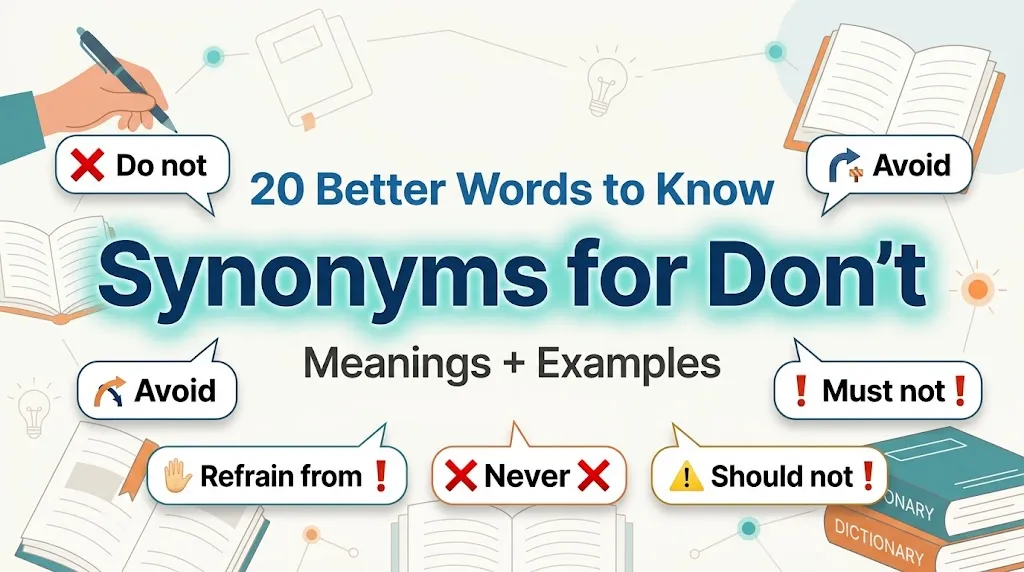
Synonyms for don’t include do not, avoid, refrain from, and never. Other useful alternatives include must not, should not, and try not to.
Imagine a friend is about to touch a hot pan. You quickly say, “Don’t touch it!” The word don’t is short, common, and useful. We use it every day to give advice, warnings, instructions, and negative statements.
Don’t is a contraction of do not. It is common in everyday English and can make speech and writing sound natural and direct.
Still, repeating “don’t” too often can make writing sound plain. Learning alternatives helps English learners and content writers express the same idea with a better tone.
In this guide, you will learn the meaning, pronunciation, history, grammar, and useful alternatives for don’t. You will also see simple examples and semantic groups to help you choose the right expression.
Meaning of Don’t
Definition
Don’t (Contraction / Auxiliary Verb):
“Don’t” is the contraction of do not. It is used to make negative statements, give negative commands, or tell someone not to do something.
Examples
- I don’t like spicy food.
- Don’t touch that hot pan.
Connotative Meaning
(Connotation means the feeling or emotional tone connected with a word beyond its basic meaning.)
- Positive tone: Don’t can sound caring when used to give helpful advice.
- Negative tone: Don’t can sound strict when used as a command or warning.
- Neutral tone: Don’t can simply state that an action does not happen or is not true.
Etymology
Old English (450–1100)
The modern form don’t did not exist in Old English. English used different ways to express negation, often using forms related to ne and verbs.
Middle English (1100–1500)
As English developed, negative constructions changed. The use of auxiliary verbs became more important in forming negative statements.
Modern English (1500–Present)
Don’t developed as a contraction of do not. Merriam-Webster records its first known use in this sense as 1632.
Today, don’t is the standard contraction of do not. In standard English, doesn’t is normally used with third-person singular subjects such as he, she, and it.
Pronunciation (IPA)
- IPA: /doʊnt/ in American English
- IPA: /dəʊnt/ in British English
- Syllables: don’t, 1 syllable
Affixation Pattern of Don’t
- Root: do
- Prefix: None
- Suffix: None
- Contraction element: not is shortened to ’nt
Word formations
- do – verb
- does – verb
- doing – present participle
- done – past participle
- don’t – contraction of do not
- doesn’t – contraction of does not
- don’ts – noun, referring to things that should not be done
20 Synonyms of Don’t With Meaning & Examples
1. Do Not (Verb Phrase)
Meaning: The full form of “don’t,” often used for emphasis or formal writing.
Examples:
- Please do not enter this room.
- I do not agree with that idea.
2. Avoid (Verb)
Meaning: To stay away from something or choose not to do it.
Examples:
- Avoid using your phone while driving.
- Avoid making the same mistake twice.
3. Refrain From (Verb Phrase)
Meaning: To deliberately stop yourself from doing something.
Examples:
- Please refrain from talking during the test.
- Refrain from making rude comments.
4. Never (Adverb)
Meaning: Not at any time.
Examples:
- Never give your password to strangers.
- Never ignore important warnings.
5. Must Not (Modal Verb Phrase)
Meaning: Shows that something is not allowed or is strictly forbidden.
Examples:
- You must not enter this area.
- Visitors must not feed the animals.
6. Should Not (Modal Verb Phrase)
Meaning: Advises someone that an action is unwise or undesirable.
Examples:
- You should not skip breakfast every day.
- We should not judge people too quickly.
7. Ought Not To (Modal Verb Phrase)
Meaning: Says that something should not be done.
Examples:
- You ought not to speak so harshly.
- We ought not to waste valuable resources.
8. Try Not To (Verb Phrase)
Meaning: Advises someone to make an effort to avoid an action.
Examples:
- Try not to worry about small problems.
- Try not to interrupt the speaker.
9. Be Careful Not To (Verb Phrase)
Meaning: Warns someone to avoid a possible mistake or problem.
Examples:
- Be careful not to spill the coffee.
- Be careful not to lose your keys.
10. Abstain From (Verb)
Meaning: To deliberately choose not to take part in an action.
Examples:
- He decided to abstain from the discussion.
- She chose to abstain from making a comment.
11. Stop (Verb)
Meaning: To end an action that is already happening.
Examples:
- Stop making that noise.
- Stop running in the hallway.
12. Quit (Verb)
Meaning: To stop doing something, often permanently.
Examples:
- Quit wasting your time.
- He decided to quit complaining.
13. Resist (Verb)
Meaning: To avoid giving in to an urge or temptation.
Examples:
- Resist the temptation to spend too much.
- Resist checking your phone during the meeting.
14. Steer Clear Of (Verb Phrase)
Meaning: To deliberately stay away from something.
Examples:
- Steer clear of unnecessary arguments.
- Steer clear of suspicious websites.
15. Keep Away From (Verb Phrase)
Meaning: To stay at a distance from someone or something.
Examples:
- Keep away from the wet paint.
- Keep away from dangerous equipment.
16. Stay Away From (Verb Phrase)
Meaning: To avoid going near or becoming involved with something.
Examples:
- Stay away from that broken fence.
- Stay away from negative conversations.
17. Refrain (Verb)
Meaning: To hold yourself back from doing something.
Examples:
- Please refrain during the presentation.
- He tried to refrain from arguing.
18. Be Prohibited From (Verb Phrase)
Meaning: To be officially forbidden from doing something.
Examples:
- Students are prohibited from using phones during exams.
- Visitors are prohibited from entering this area.
19. Be Forbidden To (Verb Phrase)
Meaning: To be officially or strongly told that an action is not allowed.
Examples:
- Guests are forbidden to enter the private area.
- Employees are forbidden to share confidential files.
20. Say No To (Verb Phrase)
Meaning: To refuse or reject something.
Examples:
- Learn to say no to unnecessary distractions.
- She decided to say no to the offer.
Prototype Meaning
The most typical meaning of don’t is simple negation. It tells someone that an action should not happen or states that someone does not perform an action.
For example, “Don’t touch that” is a direct warning, while “I don’t know” simply expresses a lack of knowledge.
The best alternative depends on context. Do not is more formal, avoid focuses on staying away, refrain from sounds polite and formal, and must not expresses a strong rule.
Prototype Categorization
The synonyms for don’t can be grouped by their main meaning and tone. This helps writers choose an alternative that fits the situation instead of replacing every “don’t” with the same word.
- Direct and neutral: Do not, never, should not
- Strong rules: Must not, be prohibited from, be forbidden to
- Polite or formal: Refrain from, abstain from, be careful not to
- Avoiding an action: Avoid, try not to, steer clear of, keep away from, stay away from
- Stopping an action: Stop, quit
- Resisting an action: Resist
- Refusing something: Say no to
Antonyms of Don’t
1. Do (Verb)
Meaning: To perform or carry out an action.
2. Allow (Verb)
Meaning: To let someone do something.
3. Permit (Verb)
Meaning: To officially or willingly allow an action.
4. Encourage (Verb)
Meaning: To support someone in doing something.
5. Accept (Verb)
Meaning: To agree to receive or take something.
Short Questions and Answers
What does “don’t” mean?
Don’t is the contraction of do not. It is used to make negative statements or tell someone not to do something.
When should “don’t” be used?
Use don’t in everyday speech and informal writing when you want a natural and direct negative expression.
For formal writing, do not may sound more appropriate, especially when you want extra emphasis.
Is “don’t” positive or negative?
Don’t has a negative grammatical meaning because it expresses negation. Its emotional tone depends on the situation.
For example, “Don’t worry” sounds caring, while “Don’t touch that” can sound strict.
How is “don’t” different from similar words?
Don’t is a broad negative expression. Avoid means to stay away from something, refrain from means to hold yourself back, and must not usually expresses a strong rule.
Conclusion
Learning alternatives for don’t can make your English more flexible and natural. Instead of using the same word repeatedly, you can choose an expression that matches your exact meaning.
Words such as avoid, refrain from, must not, and never can add variety to everyday speech and writing. Each one has its own level of strength and formality.
For English learners, these alternatives can improve vocabulary and speaking confidence. For writers, they can make sentences clearer and reduce repetition.
Practice a few alternatives each day. The more you use them in real sentences, the easier it becomes to choose the right word naturally.
Discover More Words: Synonyms for Dinner: 13 Better Words to Use

Lexicographer & Vocabulary Specialist
Nathan Carter focuses on English vocabulary, synonyms, antonyms, and word meanings. He is passionate about producing clear, accurate, and easy-to-understand language guides for readers of all levels.







1 thought on “Synonyms for Don’t: 20 Better Ways to Say It”