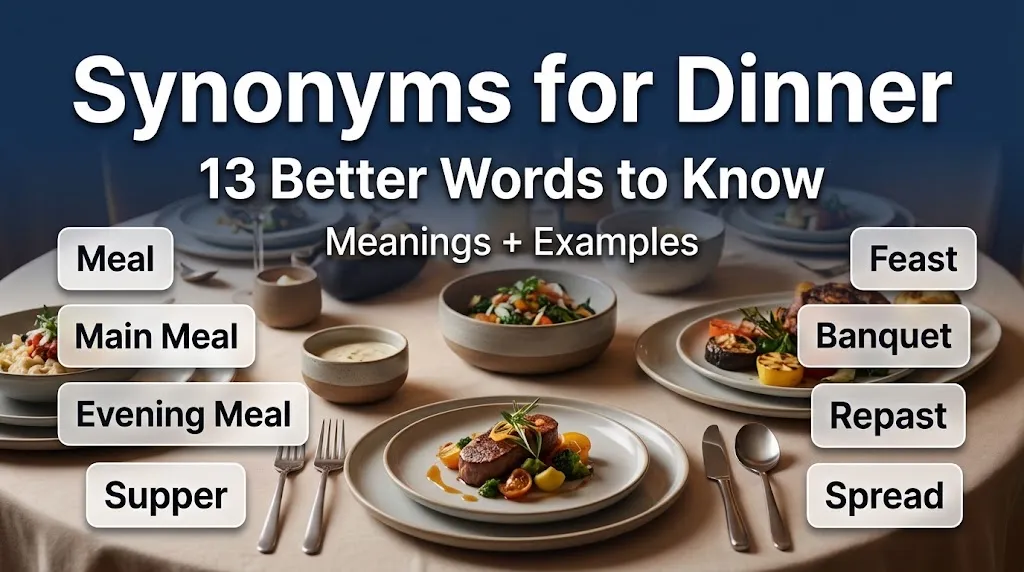
Synonyms for Dinner include meal, main meal, evening meal, and supper. Other useful alternatives include repast, feast, banquet, spread, and collation.
Dinner is the meal people often enjoy after a long day. Imagine coming home from work or school, sitting with your family, and asking, “What are we having for dinner?” The word is simple, common, and useful in everyday English.
The meaning of dinner can change slightly by region and context. Today, it usually means the main meal of the day, often eaten in the evening. It can also describe a formal social event where a meal is served.
Learning synonyms for dinner helps English learners speak and write with more variety. It also helps content writers choose words that match the tone, setting, and type of meal.
In this guide, you will learn the meaning, pronunciation, history, grammar, and semantic categories of dinner. You will also see useful synonyms with simple meanings and examples.
Meaning of Dinner
Definition
Dinner (Noun):
Dinner means the main meal of the day, usually eaten in the evening in modern English. It can also mean the food served at that meal or a formal meal held for a special event.
Examples
- We had dinner at seven o’clock.
- She cooked dinner for the whole family.
Connotative Meaning
Connotation: Connotation is the feeling or idea that a word may suggest beyond its basic meaning.
- Positive tone: Dinner can suggest family time, comfort, celebration, or hospitality.
- Negative tone: In some contexts, dinner may suggest pressure, expense, or an unwanted formal event.
- Neutral tone: Dinner can simply refer to the main meal of the day.
Etymology
The word dinner has a long history. It came into Middle English from Old French disner, which originally referred to the first meal of the day. The Old French word came from a Vulgar Latin form meaning “to break one’s fast.”
Old English (450–1100)
The modern word dinner was not yet established in Old English. English had other words for meals and eating, but the later form came through French rather than directly from Old English.
Middle English (1100–1500)
In Middle English, forms such as diner and dyner were used. At first, the word referred to the first large meal of the day, often eaten in the morning or around midday.
Modern English (1500–Present)
Over time, the main meal gradually moved later in the day. As eating habits changed, dinner became strongly associated with the evening meal. That meaning is now common in modern English.
Pronunciation (IPA)
- IPA: /ˈdɪnər/
- Syllables: din-ner
The first syllable receives the main stress. In British pronunciation, the final sound is commonly less pronounced than in American English.
Affixation Pattern of Dinner
- Root: dinner is a historical borrowing from French rather than a modern English word built from a simple root.
- Prefix: None
- Suffix: No productive suffix creates the basic noun dinner.
- Word formations:
- dinner – noun
- dinnerless – adjective
- dinnertime – noun
- dinnerware – noun
- dinner party – noun phrase
- dinner table – noun phrase
- dinner menu – noun phrase
The related verb dine is historically connected to dinner, although dinner should not be treated as a simple modern derivation of dine.
13 Synonyms of Dinner With Meaning & Examples
1. Meal (Noun)
Meaning: Food eaten at one time, especially one of the regular meals of the day.
Examples:
- We enjoyed a warm meal together.
- She prepared a healthy meal for her children.
2. Main Meal (Noun Phrase)
Meaning: The most important or substantial meal of the day.
Examples:
- Dinner is usually our main meal.
- We had our main meal in the evening.
3. Evening Meal (Noun Phrase)
Meaning: A meal eaten in the evening.
Examples:
- We usually have our evening meal at eight.
- The family sat down for their evening meal.
4. Supper (Noun)
Meaning: A meal eaten in the evening, often with a less formal feeling than dinner.
Examples:
- We had a simple supper at home.
- She invited us to stay for supper.
The distinction between dinner and supper varies by region. In modern use, both can refer to the evening meal, while supper can sound less formal in some varieties of English.
5. Repast (Noun)
Meaning: A meal, especially a formal or old-fashioned way of referring to food eaten at one time.
Examples:
- The guests enjoyed a pleasant repast.
- They shared a quiet evening repast.
Repast is more formal and literary than dinner.
6. Feast (Noun)
Meaning: A large or special meal with plenty of food.
Examples:
- The family prepared a feast for the guests.
- We enjoyed a feast of rice, vegetables, and grilled meat.
Feast suggests abundance or celebration, so it is not always a direct replacement for an ordinary dinner.
7. Banquet (Noun)
Meaning: A large and formal meal held for a special event or group.
Examples:
- The company held a formal banquet.
- Guests attended a banquet after the ceremony.
Banquet is especially useful when dinner is a formal social event.
8. Spread (Noun)
Meaning: A large and attractive selection of food prepared for a meal.
Examples:
- They prepared a wonderful spread for dinner.
- The table was covered with a colorful spread.
Spread is informal and often focuses on the food rather than the meal itself.
9. Collation (Noun)
Meaning: A light or simple meal, often used in formal or traditional contexts.
Examples:
- The guests were served a light collation.
- They stopped for a small collation after the event.
Collation is less common in everyday conversation than meal or dinner.
10. Refection (Noun)
Meaning: A meal, especially in formal, historical, or literary language.
Examples:
- The monks gathered for their evening refection.
- They shared a quiet refection after the service.
Refection is uncommon in modern everyday English but remains a recognized word for a meal.
11. Blowout (Noun)
Meaning: An informal term for a large, filling, or especially enjoyable meal.
Examples:
- We had a huge blowout after the game.
- They planned a weekend blowout with plenty of food.
Blowout is casual and should not be used for every ordinary dinner. It suggests something unusually large or enjoyable.
12. Nosh-Up (Noun)
Meaning: An informal term for a large or enjoyable meal.
Examples:
- They had a big nosh-up after the match.
- We enjoyed a weekend nosh-up with friends.
Nosh-up is informal and more common in British English than in formal writing.
13. Chow (Noun)
Meaning: Informal language for food or a meal.
Examples:
- Let’s get some chow before the movie.
- The group stopped for some quick chow.
Chow is very informal. It can refer to food in general, so it is less precise than dinner.
Prototype Meaning
The prototype meaning of dinner is the main meal of the day. In modern English, many people picture an evening meal shared at home, in a restaurant, or with friends.
The typical image may include a table, prepared food, drinks, and people eating together. However, dinner does not have to be formal or elaborate.
Prototype Categorization
- Everyday meal terms: meal, main meal, evening meal are the safest choices for ordinary situations.
- Evening meal terms: supper is useful when you want a less formal or regional alternative to dinner.
- Formal meal terms: banquet and repast fit formal, ceremonial, or literary contexts.
- Large or special meal terms: feast and blowout suggest a meal that is bigger or more exciting than usual.
- Food-focused terms: spread and chow focus more on the food being served than on the meal as an occasion.
- Traditional or literary terms: collation and refection are better suited to formal, historical, or literary writing.
- Informal social terms: nosh-up works best in casual British-style English.
This grouping helps writers choose a word based on meaning and tone. For a normal family meal, meal or evening meal is safer. For a celebration, feast or banquet may be more suitable.
Antonyms of Dinner
There is no perfect direct antonym for dinner because it names a type of meal rather than an opposite idea.
Still, some contrasting meal terms may be useful depending on context:
Snack (Noun)
Meaning: A small amount of food eaten between or instead of larger meals.
Fasting (Noun)
Meaning: The practice of going without food for a period of time.
Breakfast (Noun)
Meaning: The first meal of the day, traditionally eaten after the overnight fast.
These are contextual contrasts rather than exact dictionary antonyms.
Short Questions and Answers
What does dinner mean?
Dinner usually means the main meal of the day, especially the evening meal in modern English.
When should dinner be used?
Use dinner when talking about the main meal of the day or a formal event where that meal is served.
Is dinner positive or negative?
Dinner is normally neutral. It can suggest positive ideas such as family, comfort, celebration, or hospitality depending on the context.
How is it different from similar words?
Meal is broader than dinner. Supper often sounds less formal or more regional. Feast suggests plenty of food or celebration, while banquet suggests a formal event. Repast is more formal or literary.
Conclusion
Learning synonyms for dinner gives you more ways to express simple ideas. Words such as meal, supper, feast, and banquet can help you match your language to different situations.
For everyday English, meal, main meal, and evening meal are clear choices. For formal writing, banquet, repast, or refection may work better. Informal words such as chow and nosh-up can make casual speech sound more natural.
Using the right synonym also helps you avoid repetition in writing. It can make descriptions clearer, more precise, and more interesting.
Practice these words in short sentences each day. The more you use them, the easier it becomes to choose the right word with confidence.
Explore More Synonyms: Synonyms for Confrontation: 21 Words for Conflict

Lexicographer & Vocabulary Specialist
Nathan Carter focuses on English vocabulary, synonyms, antonyms, and word meanings. He is passionate about producing clear, accurate, and easy-to-understand language guides for readers of all levels.









1 thought on “Synonyms for Dinner: 13 Better Words to Use”