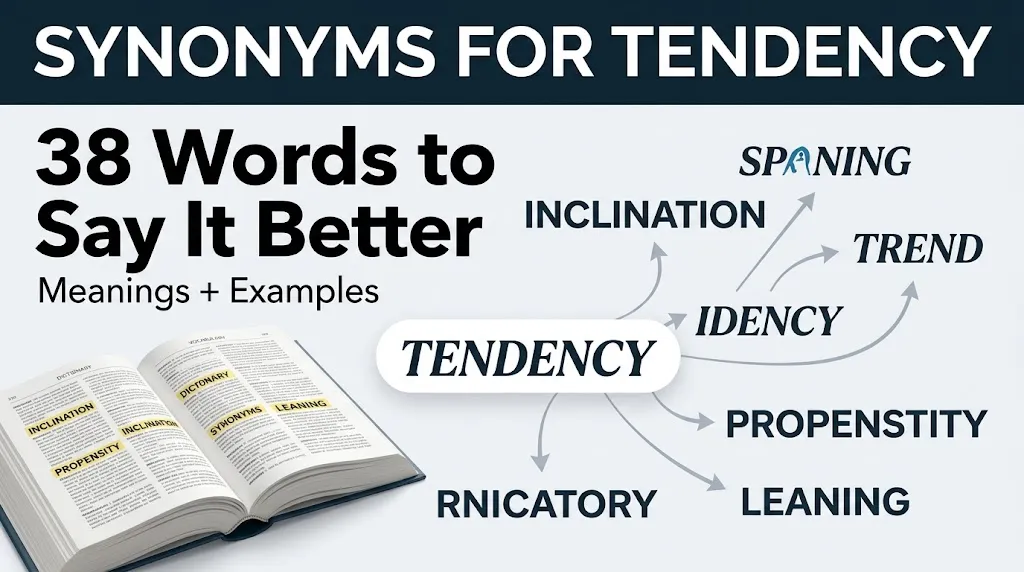
Synonyms for tendency include inclination, trend, propensity, and leaning. Other useful alternatives include proclivity, disposition, penchant, habit, pattern, bias, predisposition, preference, and inclination.
Tendency means a usual way of behaving, thinking, or developing. For example, if someone often arrives late, you can say they have a tendency to be late.
The word is common in everyday English, academic writing, business, news, and formal communication. It helps describe repeated behavior, a natural preference, or a general direction.
Learning synonyms for tendency can make your English more flexible. It also helps you avoid repeating the same word in essays, articles, emails, and conversations.
However, similar words do not always have exactly the same meaning. Some describe personal behavior, while others describe preferences, habits, trends, or changes.
In this guide, you will learn the meaning, pronunciation, history, grammar, and 38 useful synonyms of tendency. You will also see simple examples and semantic categories to help you choose the right word.
Meaning of Tendency
Definition
Tendency (Noun):
A tendency is a usual pattern, behavior, preference, or direction that someone or something is likely to follow.
Examples
- She has a tendency to worry about small problems.
- There is a tendency for prices to rise during the holiday season.
- He has a tendency to speak very quickly.
- The weather shows a tendency to become colder in winter.
Connotative Meaning
Connotation: The feeling or idea that a word suggests beyond its basic meaning.
- Positive tone: Tendency can describe a useful habit, such as a tendency to help others.
- Negative tone: It can describe an unwanted behavior, such as a tendency to complain.
- Neutral tone: It can simply describe a general pattern, such as a tendency for temperatures to rise in summer.
Etymology
The word tendency comes from Latin tendere, meaning “to stretch,” “extend,” or “direct.” The word is related to the idea of moving or leaning toward something.
- Old English (450–1100): The modern word tendency was not part of everyday Old English vocabulary. Other words were used to express ideas such as inclination, direction, or habit.
- Middle English (1100–1500): Latin-based vocabulary entered English through French and scholarly writing. Words related to tendere helped develop the idea of leaning or moving toward something.
- Modern English (1500–Present): Tendency developed its modern meaning of a natural inclination, repeated behavior, or general direction.
Pronunciation (IPA)
- IPA: /ˈtendənsi/
- Syllables: ten-den-cy
Affixation Pattern of Tendency
- Root: tend
- Prefix: None
- Suffix: -ency
Word Formations
- tend – verb: to be likely to behave in a certain way
- tendency – noun: a usual inclination or pattern
- tending – verb/adjective: moving toward or showing a particular direction
- tended – verb: past tense of tend
- tendentious – adjective: showing a strong or biased tendency
- tendentiously – adverb: in a tendentious way
- tendentiousness – noun: the quality of being tendentious
38 Synonyms of Tendency With Meaning & Examples
1. Inclination (Noun)
Meaning: A natural preference or tendency to behave or think in a particular way.
Examples:
- She has an inclination to help people.
- His inclination is to avoid arguments.
2. Trend (Noun)
Meaning: A general direction in which something is developing or changing.
Examples:
- There is a trend toward remote work.
- The trend shows that online sales are growing.
3. Propensity (Noun)
Meaning: A natural tendency to behave in a particular way.
Examples:
- He has a propensity for taking risks.
- Some people have a propensity to worry.
4. Leaning (Noun)
Meaning: A preference or tendency toward a particular idea, choice, or opinion.
Examples:
- She has a leaning toward traditional art.
- His political leanings are difficult to identify.
5. Proclivity (Noun)
Meaning: A strong natural tendency to do or like something.
Examples:
- He has a proclivity for adventure.
- Her proclivity for detail helps her at work.
6. Disposition (Noun)
Meaning: A person’s natural way of behaving or feeling.
Examples:
- She has a cheerful disposition.
- His calm disposition helped everyone relax.
7. Penchant (Noun)
Meaning: A strong liking or tendency toward something.
Examples:
- She has a penchant for classic novels.
- He has a penchant for expensive watches.
8. Predilection (Noun)
Meaning: A strong preference for a particular thing.
Examples:
- He has a predilection for spicy food.
- Her predilection for simple designs is clear.
9. Bias (Noun)
Meaning: A tendency to favor one person, idea, or side over another.
Examples:
- The report showed a bias toward large companies.
- Personal bias can affect judgment.
10. Habit (Noun)
Meaning: A behavior that someone repeats regularly.
Examples:
- He has a habit of checking his phone.
- Her habit of reading helps her learn new words.
11. Pattern (Noun)
Meaning: A repeated or regular way in which something happens.
Examples:
- We noticed a pattern in customer behavior.
- The data shows a clear pattern of growth.
12. Predisposition (Noun)
Meaning: A natural tendency to behave, think, or react in a certain way.
Examples:
- She has a predisposition toward careful planning.
- His predisposition to worry can make decisions harder.
13. Preference (Noun)
Meaning: A greater liking for one choice than another.
Examples:
- She has a preference for tea.
- Customer preference changes over time.
14. Fondness (Noun)
Meaning: A strong liking or affection for something.
Examples:
- He has a fondness for old movies.
- Her fondness for animals is well known.
15. Incline (Noun)
Meaning: A natural tendency or preference toward something.
Examples:
- He has an artistic incline.
- Her natural incline is toward creative work.
16. Bent (Noun)
Meaning: A natural tendency or strong interest in a particular activity or subject.
Examples:
- He has a scientific bent.
- Her artistic bent led her to study design.
17. Drift (Noun)
Meaning: A gradual movement or tendency toward a particular direction.
Examples:
- The conversation showed a political drift.
- There is a gradual drift toward simpler designs.
18. Direction (Noun)
Meaning: The general course or tendency of movement or development.
Examples:
- The company is moving in a positive direction.
- The research shows a clear direction of change.
19. Course (Noun)
Meaning: The general path or development that something follows.
Examples:
- The project took a different course.
- We can see the course of economic change.
20. Movement (Noun)
Meaning: A general change or development toward a particular position or idea.
Examples:
- There is a movement toward cleaner energy.
- The movement toward digital payments is growing.
21. Orientation (Noun)
Meaning: A general direction, approach, or attitude toward something.
Examples:
- The company has a strong customer orientation.
- His academic orientation affects his career choices.
22. Urge (Noun)
Meaning: A strong feeling that makes someone want to do something.
Examples:
- She felt an urge to leave early.
- He resisted the urge to complain.
23. Impulse (Noun)
Meaning: A sudden desire or tendency to act without much thought.
Examples:
- He bought the item on impulse.
- She had an impulse to laugh.
24. Drive (Noun)
Meaning: A strong inner force that pushes someone toward an action or goal.
Examples:
- She has a strong drive to succeed.
- His drive to improve never disappears.
25. Disposition (Noun)
Meaning: A person’s natural tendency to feel or behave in a certain way.
Examples:
- Her friendly disposition made everyone comfortable.
- He has a serious disposition at work.
26. Inclination (Noun)
Meaning: A natural leaning toward a particular action, idea, or choice.
Examples:
- I have little inclination to argue.
- She showed an inclination to agree.
27. Likelihood (Noun)
Meaning: The chance or probability that something will happen.
Examples:
- There is a high likelihood of rain.
- The likelihood of success depends on preparation.
28. Recurrence (Noun)
Meaning: The repeated occurrence of something.
Examples:
- The recurrence of the problem worried the team.
- Researchers studied the recurrence of the behavior.
29. Regularity (Noun)
Meaning: The quality of happening repeatedly or in a predictable way.
Examples:
- The regularity of his visits surprised us.
- The data shows regularity in seasonal sales.
30. Frequency (Noun)
Meaning: The rate or number of times something happens.
Examples:
- The frequency of errors has decreased.
- We measured the frequency of customer complaints.
31. Continuation (Noun)
Meaning: The act or tendency of something to continue over time.
Examples:
- The continuation of the trend surprised analysts.
- The policy allowed the continuation of the program.
32. Persistence (Noun)
Meaning: The quality of continuing in the same way despite difficulty or opposition.
Examples:
- His persistence in studying paid off.
- The persistence of the trend was unexpected.
33. Predilection (Noun)
Meaning: A particular preference or tendency toward something.
Examples:
- His predilection for history influenced his career.
- She has a predilection for quiet places.
34. Affinity (Noun)
Meaning: A natural liking, connection, or attraction to something.
Examples:
- She has an affinity for languages.
- He developed an affinity for classical music.
35. Attraction (Noun)
Meaning: A strong interest or pull toward something.
Examples:
- He feels an attraction to creative work.
- The city has a strong attraction for young professionals.
36. Susceptibility (Noun)
Meaning: A tendency to be easily affected by something.
Examples:
- Children may have greater susceptibility to peer pressure.
- His susceptibility to stress affects his work.
37. Predominance (Noun)
Meaning: The state of being more common, powerful, or noticeable than others.
Examples:
- The predominance of online shopping is growing.
- Researchers studied the predominance of this behavior.
38. Disposition (Noun)
Meaning: A natural readiness or tendency to behave in a particular way.
Examples:
- Her disposition toward kindness was clear.
- His positive disposition helped the team.
Prototype Meaning
The most typical meaning of tendency is a repeated or natural pattern that makes someone or something likely to behave or develop in a certain way.
When people hear tendency, they usually imagine something that happens regularly or moves in a predictable direction.
For example, “She has a tendency to arrive late” suggests a repeated behavior. It does not mean that she was late only once.
Prototype Categorization
The 38 alternatives above do not all replace tendency in every sentence. Their meanings change slightly depending on context. Grouping them by meaning makes it easier to choose the best word.
- Natural Inclination: inclination, propensity, proclivity, leaning, predisposition, bent, and disposition. These words work well when describing someone’s natural behavior, attitude, or way of thinking.
- Preference and Liking: penchant, predilection, preference, fondness, and affinity. Use these when the idea is mainly about what someone likes or prefers.
- Repeated Behavior: habit, pattern, recurrence, regularity, and frequency. These words are useful when something happens again and again.
- General Direction: trend, drift, direction, course, movement, and orientation. These are especially useful for social, economic, scientific, and business changes.
- Inner Motivation: urge, impulse, and drive. These describe internal forces or feelings that encourage someone to act.
- Probability or Vulnerability: likelihood and susceptibility. These are useful when a tendency means that something is likely to happen or someone is easily affected.
- Continuing or Dominant Patterns: continuation, persistence, and predominance. These words are better when discussing an ongoing or strongly established pattern.
This categorization helps writers choose a synonym based on its exact meaning instead of replacing tendency with a word that only looks similar.
Antonyms of Tendency
1. Disinclination (Noun)
A lack of desire or willingness to do something.
2. Reluctance (Noun)
An unwillingness or hesitation to act.
3. Aversion (Noun)
A strong dislike or opposition toward something.
4. Randomness (Noun)
A lack of a predictable pattern or direction.
5. Unpredictability (Noun)
The quality of being difficult to predict.
6. Inconsistency (Noun)
A lack of regularity or a stable pattern.
7. Irregularity (Noun)
The quality of not following a regular pattern.
8. Stability (Noun)
A state of remaining steady rather than continually changing.
Short Questions and Answers
What does tendency mean?
Tendency means a usual pattern, inclination, or direction in which someone or something is likely to behave or develop.
When should tendency be used?
Use tendency when describing a repeated behavior, natural inclination, general pattern, or likely direction.
Is tendency positive or negative?
Tendency is neutral by itself. Its tone depends on the behavior or situation being described.
How is it different from similar words?
Tendency is a broad word. Habit focuses on repeated behavior, trend focuses on general change, propensity suggests a natural likelihood, and preference focuses on what someone likes or chooses.
What is the best synonym for tendency?
There is no single best synonym for every situation. Inclination is useful for personal preferences, trend works well for general changes, propensity suggests a natural likelihood, and habit describes repeated behavior.
Can tendency describe a positive behavior?
Yes. For example, “She has a tendency to help others” describes a positive behavior.
Can tendency describe a negative behavior?
Yes. For example, “He has a tendency to complain” describes an unwanted behavior.
Conclusion
Learning tendency and its synonyms can make your English stronger and more flexible.
The word is useful for describing habits, behavior, preferences, patterns, and changes. However, similar words can have different shades of meaning.
For example, habit focuses on repeated behavior, while trend describes a general direction. Inclination often describes a personal preference, while propensity suggests a natural likelihood.
Knowing these differences helps you choose the right word for each situation. It also prevents repetition in essays, articles, emails, and everyday conversations.
For English learners, regular synonym practice can improve vocabulary, speaking, and writing. Try learning a few new words each day and use them in your own sentences. With consistent practice, you can communicate your ideas more clearly and confidently.
Read more: Synonyms for Commonly: 30 Words to Use Instead

Content Editor & Language Researcher
Daniel Foster specializes in editing educational content and researching English language topics. He is committed to creating well-structured, reader-friendly articles that make learning easier.






1 thought on “Synonyms for Tendency: 38 Words to Say It Better”